







As digital content grows, people need clear audio help for learning and tasks. Today, many apps turn written words into natural voices for better reach and comfort. Here, a text-to-speech API lets developers add voice output without building complex systems. Hence, in this guide, we will explain features and top text to speech API choices to help readers decide confidently. You will also find simplified tips to support smart selection for apps and services.
What is a Text-to-Speech API?
A TTS API is a tool that turns written text into a clear and natural voice. It works by taking text through a simple request and converting it into sound. Plus, the system uses smart speech models that understand tone, language, and pronunciation. Developers send text through the API, which analyzes context and pronunciation carefully.
In addition, advanced methods like neural networks or concatenative synthesis create realistic audio. Moreover, the resulting speech can even stream or download in formats like MP3 or WAV. So, this makes apps more engaging and accessible for all audiences.
Key Features of the AI Voice API
AI voice APIs offer powerful tools to turn text into realistic audio. Below, you will find some prominent features to help developers choose the right text-to-speech API:
- Voice Quality: Neural models generate expressive voices that sound natural across languages. Besides, they adapt tone and pace instantly to match emotion and meaning during speech.
- Speech Customization: Developers can control voice style, pitch, speed, and emphasis using SSML settings to deliver consistent and context-aware speech output across applications.
- Low Latency: Responses stream in real time for live interactions like chats or meetings. Moreover, fast delivery makes conversations feel fluid and more naturally human-driven across apps.
- Multilingual Support: Comes with various languages and accents for truly global voice applications. So, developers can deploy one API for diverse audiences without rebuilding localized versions.
- Standard Protocols: Supports REST, gRPC, and common formats like MP3, WAV, or PCM. Hence, these APIs use standard protocols for easy integration into web and mobile apps.
- Batch Processing: Processes multiple texts asynchronously, saving time on large-scale audio generation. Therefore, the batch feature improves workflow efficiency for enterprise or educational platforms.
Use Cases for TTS APIs
The TTS APIs are becoming essential for apps that need voice output quickly. Now, let’s see how a free text-to-speech API helps in the real world:
- E-Learning Platforms: Learners listen to lessons efficiently without reading long study materials manually. Furthermore, it supports language learning by turning written content into spoken audio.
- Voice Assistants: Virtual helpers respond clearly using natural, customized AI speech. Moreover, they guide users instantly by answering questions and performing tasks in real time.
- Media Production: Creators use TTS for narrations and game characters quickly and efficiently. So, it saves recording time and provides uniform quality across multiple media projects.
- Navigation Apps: Drivers get live spoken directions without checking screens or getting distracted. Hence, voice updates make travel safer and smarter by guiding routes smoothly in motion.
- Smart Devices: Connected gadgets like speakers and wearables respond using natural AI voices. Plus, they make homes more interactive by talking, guiding, and informing users effectively.
10 Best Online Text-to-Speech APIs
Modern digital applications need natural and realistic voices to improve overall user engagement. Below are some of the best text-to-speech API options offering scalable and high-quality voice solutions:
1. ElevenLabs
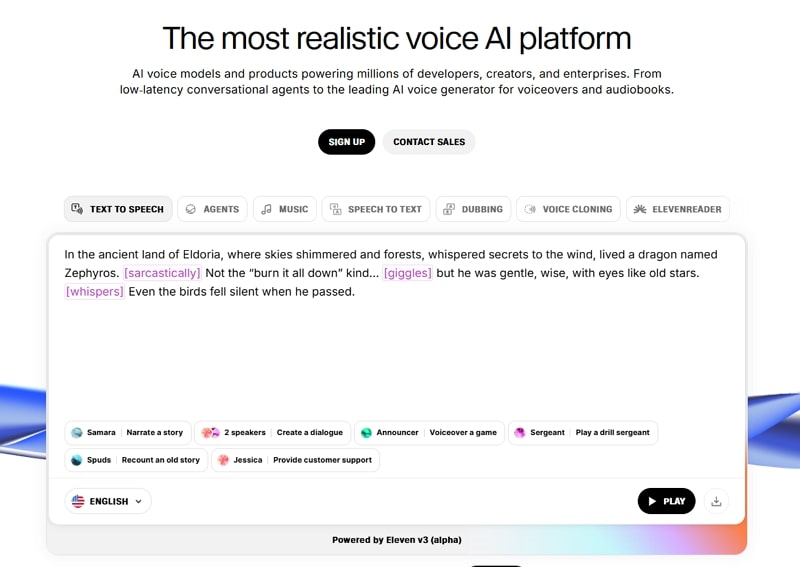
ElevenLabs is a text-to-speech API that generates natural, multilingual voice output from text while maintaining consistent voice characteristics across languages. It allows developers to customize voice style, tone, and stability through API parameters, making it suitable for AI assistants and voice-driven applications.
In addition to real-time voice generation, ElevenLabs supports AI dubbing and high-quality narration for content creation. Developers can preview generated audio and export it in common formats such as MP3, enabling flexible integration across platforms.
Key Features
- Experience ultra-fast voice responses for real-time conversational interactions.
- Voices prioritize human realism and reduce robotic or synthetic audio artifacts.
- Localize audio content efficiently while preserving original speaker identity.
2. Google Cloud Text‑to‑Speech
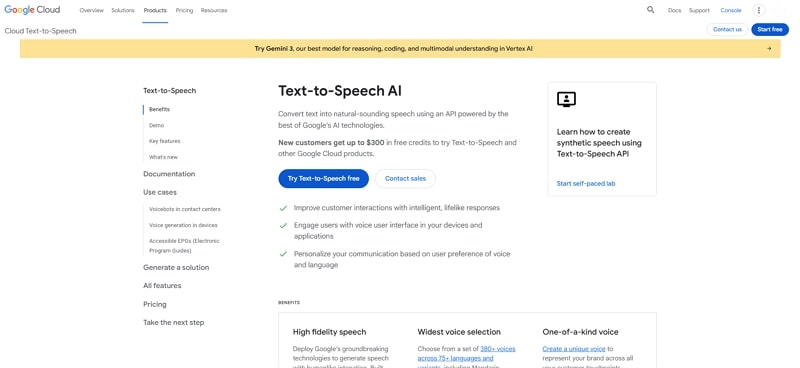
You can also use the Google Cloud free TTS API to convert written text into highly natural-sounding speech using AI models. Besides, Gemini TTS provides speech synthesis across over 75 locales worldwide. In addition, it supports real-time AI dialogue with ultra-low latency audio streaming. Long-form audio can also be synthesized asynchronously with up to one million input bytes. Additionally, people can control accent and emotional expression through natural-language prompts.
Key Features
- Use Chirp 3 HD voices for spontaneous, conversational, and emotionally expressive speech.
- Leverage AudioML-based models for highly natural and conversational voice generation.
- Increase output volume by 16 decibels or reduce volume significantly.
3. Microsoft Azure Speech Service
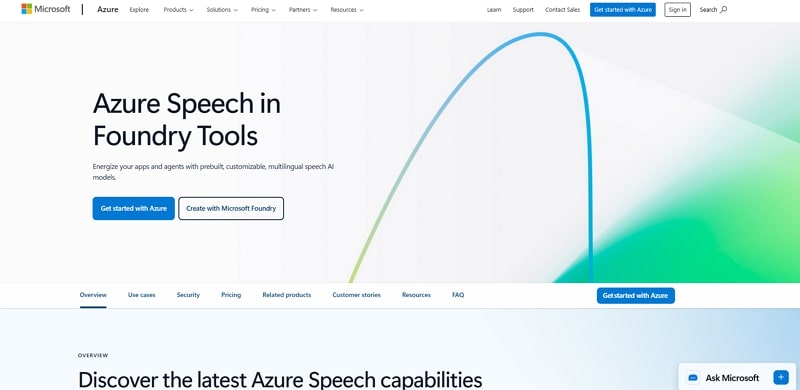
Microsoft Azure Speech Service enables real-time speech-to-speech translation across multiple languages for 5 audio streams. Plus, it supports speech-to-text in environments with limited or no internet access. You can even identify and verify speakers through secure speaker recognition transactions. Plus, it allows users to control speech output using SSML for pitch and pause emphasis. Besides, this free text-to-speech API calculates text-to-speech usage through converted character counts.
Key Features
- Offers deep customization options for voice tone, speed, style, and expressive delivery.
- Achieve low-latency speech processing for seamless real-time conversational voice experiences.
- Access over 140 voices across 70 supported languages and regional dialects.
4. OpenAI Text‑to‑Speech

This TTS API supports intelligent, real-time applications using the newest and most reliable GPT-4o mini TTS model. Furthermore, it enables adjustment of emotional range to match expressive or neutral speech needs. You can even export your generated result in various audio formats such as MP3 and AAC. Moreover, it supports 58 languages by providing input text in your chosen language. This generates high-quality synthetic speech using advanced neural voice models.
Key Features
- Each organization can create up to 20 custom voices using TTS models.
- Supports controlled voice sampling to maintain consistent quality during custom voice generation.
- Allows experimenting with voices using the interactive OpenAI.fm demo platform.
5. Deepgram Aura
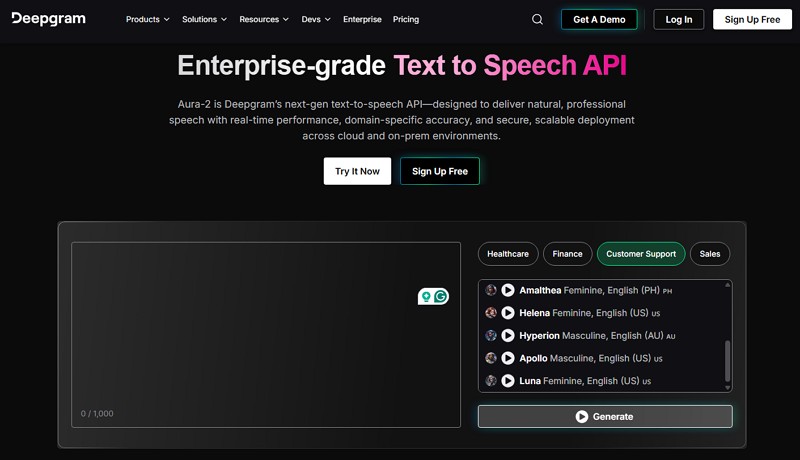
Deepgram Aura offers 40+ languages and various voices with multiple accents and persona styles. Moreover, it allows adjustment of dynamic tone and emotions for conversational speech outputs. This text-to-speech API automatically handles many short real-time conversations efficiently, supporting large-scale AI agent deployment. Plus, it is compatible with existing AI stacks such as STT and LLM components. Additionally, it delivers sub-200ms latency, enabling ultra-responsive voice interactions and real-time conversations.
Key Features
- Context-aware synthesis improves pronunciation accuracy and natural pacing in speech output.
- Supports live voice interactions with AI agents, ideal for high-throughput conversational applications.
- Works seamlessly with Deepgram’s large language models for intelligent agents.
6. Resemble AI
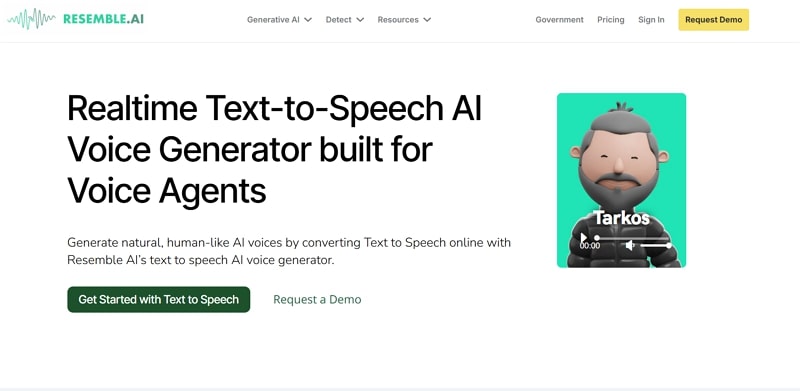
Users should try this text-to-speech API as it converts text into natural and human-like speech using an advanced TTS engine. It also produces voiceovers in 142+ languages and several regional dialects. Besides, you can adjust speaking style, tempo, and rhythm to create engaging voiceovers. It is a combination of various emotional colors to make the speech more engaging. Individuals can manage pauses and articulation to professional standards.
Key Features
- Localize AI speech in over 100 languages for engaging global audience experiences.
- Modify existing AI voices by adjusting pitch, speed, and emotional tone.
- Maintain uniform AI voice style and tone across multiple output projects.
7. Lovo AI (Genny)
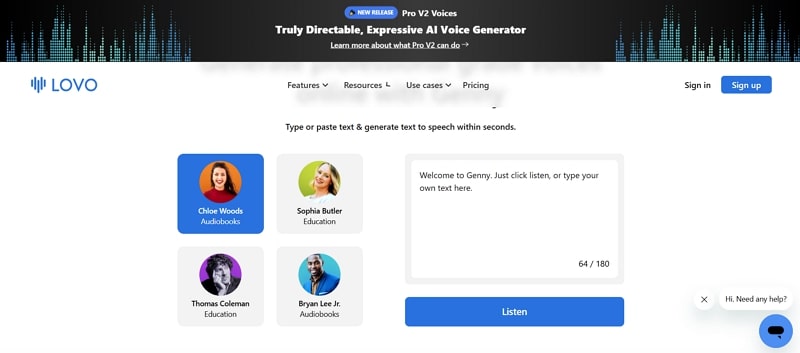
With this free text-to-speech API, anyone can convert written text into realistic and natural-sounding speech within seconds. Moreover, you can export your generated audio in various popular audio formats such as WAV and MP4. In addition, this API offers 500 on-demand AI voices to match your brand or content style. Users can also automatically convert pasted or uploaded text into editable script blocks for efficiency.
Key Features
- Choose from over 100 languages and accents to localize your audio content easily.
- Voiceovers maintain exceptional clarity and tone for professional-grade audio production.
- Edit audio blocks interactively to fine-tune speech timing and pronunciation accurately.
8. Speechify
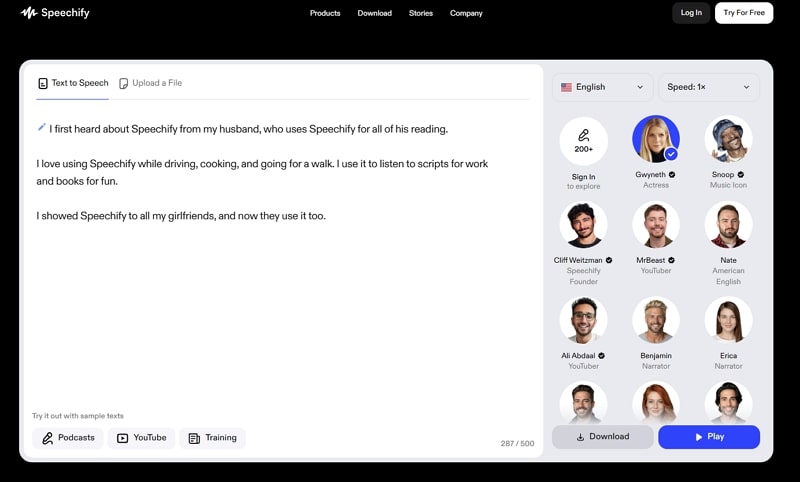
Speechify offers 200+ lifelike AI voices for natural and human-like free TTS API experiences. Moreover, it has 60+ languages, and text-to-speech can be accessed by different users worldwide. Furthermore, it can work with various types of texts such as documents, emails, websites, and PDFs. Users also preview and share downloaded audio files with others to entertain them. It can even highlight text and keep users engaged, preventing them from losing track.
Key Features
- Adjustable playback speed up to 4x for personalized listening preferences and faster absorption.
- OCR Technology allows scanning physical text and instantly converting it into audio.
- Supports multiple accents to ensure natural pronunciation and comprehension in different languages.
9. ReadSpeaker
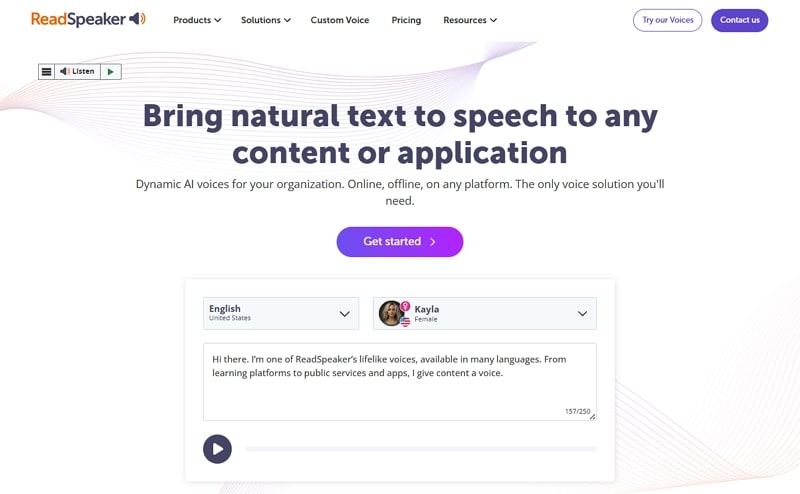
This is another text-to-speech API that converts digital files such as PDFs into natural speech spoken words with simple playback functionality. Besides, it offers an efficient voice plug-in to read and translate web content in real time. Plus, ReadSpeaker supports MRCP standard-based B2B voice solutions for enterprise-grade deployment. You can even preview your generated voices before saving them in MP3 format to your device for tone and accent clarity.
Key Features
- Offers over 200 realistic AI voices supporting more than 50 different languages globally.
- Enables offline document reading without needing continuous internet access for users.
- Protects sensitive information with encrypted storage and industry-standard security measures.
10. Amazon Polly
Amazon Polly is a cloud-based text-to-speech API that converts written text into lifelike speech using deep learning models. It supports dozens of languages and voices, making it suitable for global applications such as e-learning, voice assistants, and accessibility tools.
Developers can generate speech in real time or asynchronously and export audio in formats like MP3, OGG, or PCM. Amazon Polly also supports SSML, allowing fine-grained control over pronunciation, pauses, and speaking styles for more natural output.
Key Features
- Supports multiple neural voices across many languages and regions
- Provides real-time and batch speech synthesis through a scalable API
- Integrates seamlessly with other AWS services for production-ready deployment
How ZEGOCLOUD Helps Build Real-Time Voice AI Experiences
Text-to-speech APIs play a key role in generating natural AI voices, but voice generation alone is not enough to deliver real-time, interactive experiences. To build voice AI applications that feel responsive and conversational, developers also need low-latency audio transmission, session management, and scalable real-time infrastructure.
ZEGOCLOUD focuses on this real-time layer of voice AI. Instead of replacing text-to-speech engines, ZEGOCLOUD works alongside them by delivering AI-generated speech through stable, low-latency voice channels. This allows applications to move from static voice output to live, interactive conversations.
With ZEGOCLOUD conversational AI, developers can build real-time voice interactions for AI tutors, voice assistants, and conversational agents. The platform supports one-on-one and group voice sessions, enabling AI agents to participate naturally in live conversations rather than responding with delayed audio playback. Its global real-time communication network helps ensure consistent performance across regions, which is essential for voice-driven applications with international users.
In addition, ZEGOCLOUD simplifies integration by providing SDKs and APIs that connect real-time audio, conversational AI logic, and user interaction within the same workflow. This makes it easier for teams to combine existing text-to-speech solutions with live voice interaction, creating voice AI experiences that feel immediate, engaging, and scalable.
Conclusion
In short, using a text-to-speech API helps apps talk clearly and easily. It also improves learning and accessibility for all kinds of digital platforms. So, developers can choose APIs with features such as multilingual voices and low latency. Modern voice tools make online communication more personal and enjoyable for every user. For developers wanting smooth and real‑time voice interaction, ZEGOCLOUD offers perfect and smart conversational performance.
FAQ
Q1. What is the best text-to-speech API?
There is no single best text-to-speech API for all use cases. The right choice depends on factors such as voice quality, latency, language support, customization options, and how easily the API integrates with your application.
Q2. Which text-to-speech API sounds the most natural?
APIs that use neural text-to-speech models generally provide the most natural-sounding voices. Many modern TTS APIs focus on expressive tone, smooth pacing, and realistic pronunciation rather than robotic output.
Q3. Are there free text-to-speech APIs available?
Some text-to-speech APIs offer free tiers or limited usage for testing and small projects. However, most production-ready APIs use usage-based pricing once you exceed the free quota.
Q4. What should developers look for when choosing a TTS API?
Developers should consider voice quality, supported languages, latency, API stability, pricing model, and whether the API supports streaming or real-time audio generation for interactive use cases.
Let’s Build APP Together
Start building with real-time video, voice & chat SDK for apps today!
