








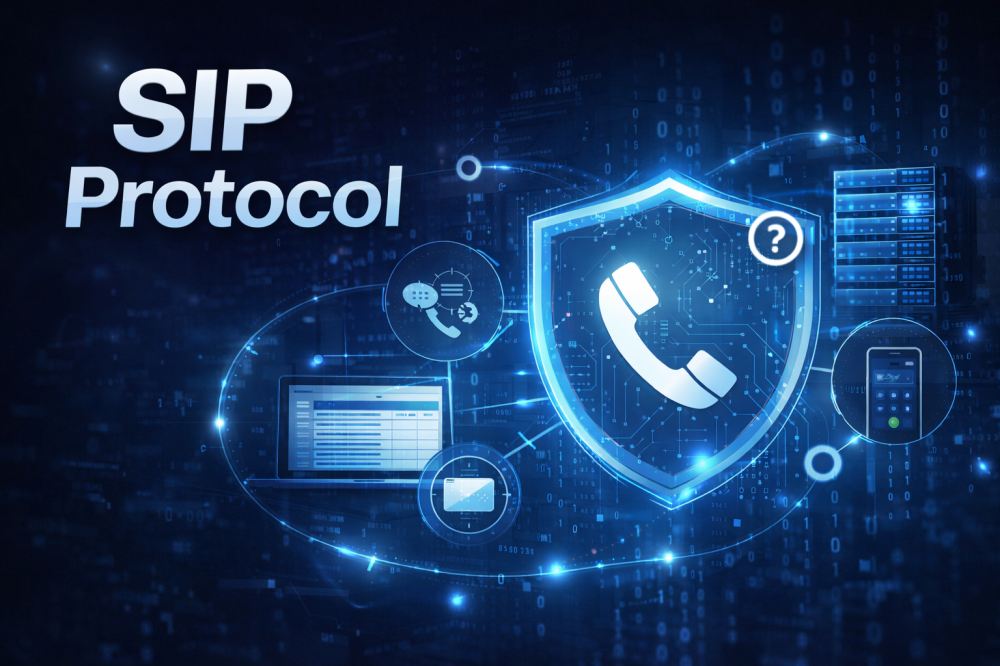
Effective digital communication relies on high-quality voice or video connections, and the SIP protocol enables them. Its flexibility allows calls and conferences to function smoothly across complex networks, making it essential for VoIP today. As a result, enterprises are upgrading their communication systems to SIP and experiencing reliable, scalable connectivity. Thus, to transform your communication, increase your knowledge of SIP protocols with the guide that follows.
What is SIP?
SIP (Session Initiation Protocol) is a set of rules that helps start, manage, modify, and end real‑time communication sessions such as voice/video calls over the internet. It’s a “call organizer” on IP networks, which sends invitations to other people and agrees on how you will communicate. In addition, it checks others’ availability and tracks the session until someone hangs up.
However, SIP itself doesn’t carry the actual audio or video; instead, it works together with other protocols like RTP. It follows a request-response style similar to HTTP, using methods like “invite,” “ack,” “bye,” and “register.” Thus, they are considered key building blocks for VoIP, the internet telephony, and many current conferencing apps.
How SIP Protocol Works
To get into details, explore how the SIP Session Initiation Protocol handles communication sessions from the start and maintains them:
1. SIP Sends Requests and Gets Responses
The SIP works like a polite conversation between devices, where one side sends a request and the other answers it. Moreover, each method gets a response with a status code similar to HTTP, so both sides know what’s happening. It uses methods like start a call, confirm, end a call, cancel a ringing call, and ask what is supported.
2. SIP Sets Up the Call with INVITE and SDP
When you start a voice or video call, your device sends an “INVITE” message to the other person using SIP. In an INVITE, SIP usually carries an SDP that describes the media you can use (audio, video). Now, your device sends an “ACK” to confirm, fully setting up the call and allowing media to flow over RTP.
3. SIP Controls and Changes the Session
During the call, SIP can change the session by sending a new INVITE (called re-invite) if you want to invite another participant. However, the same SDP exchange happens, updating the media parameters without dropping the call. When someone wants to hang up, their device sends a “BYE” request, and the other side replies with “OK.”
4. SIP Uses Servers to Find People and Route Calls
This SIP protocol is not just device-to-device; it also uses servers to help route messages. A REGISTER request tells a registrar server where a user is currently reachable (their current IP and device). Moreover, Proxy servers then use this registration data to forward INVITE requests to the right place, even when the user has moved networks.
Key Features of SIP Protocol
Having a clear concept of what the SIP protocol is, read the listed key features to grasp its purpose and capabilities:
- Supports Many Types of Real‑Time Sessions: SIP can start, manage, and end various real‑time sessions, such as voice calls over an IP network. This makes it a flexible protocol for modern apps that integrate audio, video, and chat in a single conversation.
- Works Like a Clear Request‑Response System: It uses a simple HTTP-like request-response model with methods such as INVITE, ACK, and OPTIONS. Each request gets a status code (1xx to 6xx), so both sides always know whether a call is ringing or ended.
- Separates Signaling from Media: The SIP protocol only handles signaling (who is calling whom) and does not carry audio or video itself. Moreover, it uses SDP inside SIP messages to describe media details, while separate protocols like RTP/RTCP are used.
- Easy to Modify Ongoing Sessions: They can change an existing call without dropping it by using a re-INVITE. For instance, you can upgrade a voice call to a video call or add more participants by renegotiating media parameters mid-session.
- Built‑in Security Options: Its signaling can be protected with TLS for encryption and S/MIME for message integrity and confidentiality. However, it commonly uses HTTP Digest for authentication and can integrate security controls like SBCs and firewalls.
- Collabs with NAT Traversal and Other Protocols: This protocol can work with STUN, TURN, and ICE to address NAT and firewall issues, helping sessions connect across different networks. Additionally, it can integrate with Diameter for AAA and use WebSocket transport, often through gateways for browser calling.
Advantages and Disadvantages of SIP
For an informed decision about adopting the SIP Session Initiation Protocol, weigh both its strengths and limitations, as discussed:
Advantages of SIP
- Seamless Audio and Video Communication: SIP keeps voice, video, and messaging sessions in sync so people can talk and see each other in real time.
- Simple, Text‑Based Format: Its messages are text (like HTTP), which are easy to read, debug, and understand for developers and network engineers.
- Easy Setup and Maintenance: The command set (INVITE, BYE, ACK, etc.) is straightforward, making configuration and troubleshooting simpler in apps and servers.
- Highly Scalable for Many Users: It can be deployed to millions of users and works well for big companies, call centers, and large communication platforms.
- Works with Many Real‑Time Apps: This protocol supports VoIP calls, video conferencing, file transfers, and live streaming, all using the same core signaling.
Disadvantages of SIP
- Depends on Good Bandwidth: The session depends on the network capacity of users’ devices; long video calls or many parallel chats can put pressure on bandwidth.
- Needs Extra Mechanisms to Share Bandwidth: On busy networks, you need QoS or other controls to divide bandwidth fairly between different SIP endpoints and media streams.
- Vulnerable Without Strong Security: If SIP is not protected with good encryption and authentication, it can be exposed to attacks and call hijacking.
- Extra Work to Secure VoIP Traffic: To ensure SIP protocol security, developers must implement TLS and end-to-end encryption, which increases setup complexity.
- Interoperability Issues Between Vendors: Different vendors may implement SIP features in slightly different ways, and making all systems work can require extra testing or configuration.
Use Cases of SIP
Gaining clarity on what the Session Initiation Protocol SIP is reveals the diverse use cases that make communication faster. However, we will discuss a few use cases below to see how this technology is applied across different industries:
1. File Transfer in Apps
SIP enables quick, reliable, and efficient file transfers between users across web and mobile applications. This makes it easier for chat apps to add secure file‑sharing on top of their existing SIP‑based calling or messaging features. According to the Enterprise File Synchronization analysis, this type of integrated file transfer is expected to exceed 40 billion USD in 2030.
2. Voice and Chat in Online Gaming
Online games use SIP to coordinate real‑time voice and, sometimes, video chat among multiple players. Moreover, SIP sets up the communication sessions so that players can talk in teams, switch channels, and join/leave voice rooms. As SIP is designed for low-latency, real-time communication, it is well-suited for gaming, where minor audio delays can affect teamwork.
3. Livestreaming and Broadcasts
In live streaming, SIP protocols help the host start and control a live audio or video broadcast to many viewers. Additionally, it can signal when a stream goes live, when it ends, and when to change settings, like adding more speakers. As per the Statista report, live streaming now reaches roughly a quarter to a third of all internet users worldwide.
4. Video Conferencing and Virtual Meetings
Video conferencing platforms (like virtual meeting or webinar tools) use SIP to set up, manage, and end multi‑party video calls. SIP handles invitations, response handling (accept, reject, busy), and session updates when someone mutes or leaves. Furthermore, it helps different devices and services (desk phones or browsers) join the same meeting room smoothly.
5. Instant Messaging and Attachments
The protocol can power real-time text messaging between users, along with sharing attachments such as images, documents, and short clips. It sets up a messaging session, negotiates capabilities, and then coordinates how and when messages or files are delivered. Thus, it allows developers to build rich chat features such as read receipts and file sharing on the same SIP infrastructure.
SIP vs VoIP
Not to confuse Session Initiation Protocol and VoIP, review the given tabular comparison to analyze where they differ:
| Major Aspects | SIP | VoIP |
|---|---|---|
| What It Is | A signaling protocol that sets up, manages, and ends communication sessions. | A technology for sending voice over the internet instead of phone lines. |
| Main Role | Controls calls and sessions (who calls whom, how, and when) | Carries the actual voice data as IP packets. |
| Media Types | Supports voice, video, messaging, presence, and file sharing | Primarily focused on voice (some apps add extras on top). |
| Scope of Use | It’s part of the system used inside many communication platforms. | The overall phone service is delivered over IP. |
| Flexibility It Offers | Very flexible; used for unified communications and SIP trunking. | Good for basic calling; fewer built‑in options for advanced multimedia. |
| How They Work Together | SIP sets up and manages sessions, then VoIP transports the voice | Uses SIP or other signaling methods underneath to establish IP calls. |
How SIP and ZEGOCLOUD Support Your Business Communication
SIP Session Initiation Protocol gives your business a common “language” for setting up and managing internet-based calls or messages. ZEGOCLOUD then builds on this kind of real-time communication stack by providing ready-made voice and video SDKs. Its APIs allow you to integrate one-on-one and group video calls, and livestreams with ultra-low latency. Furthermore, you can integrate the In-app Chat SDK to enable users to create, join, and leave group chats.
Whereas low‑code UIKits and well‑documented APIs help teams ship these features in days rather than months. Most importantly, developers can monitor call quality in real time and address any related issues. Besides this, built‑in security, privacy controls, and analytics keep communication reliable and compliant as your user base grows. This combination lets you use SIP‑style signaling standards, while ZEGOCLOUD handles the heavy lifting of media quality or global delivery.
Conclusion
In summary, it’s clear now that the SIP protocol shapes modern communication with smooth, voice and video interactions. Its ability to support flexible connections, reduce costs, and scale with business needs makes it a smart alternative to competitors. However, when combined with ZEGOCLOUD, it enables developers to build a communication system using existing cloud-based connections across different devices.
FAQ
Q1: What is the SIP protocol?
SIP, or Session Initiation Protocol, is a signaling protocol used to establish, manage, and terminate real-time communication sessions over IP networks. It is widely used in voice calls, video conferencing, VoIP systems, and messaging applications.
Q2: What is SIP used for?
SIP is mainly used to initiate and control communication sessions such as voice calls, video calls, and instant messaging. It handles tasks like user registration, call setup, call routing, and session termination.
Q3: Is SIP the same as VoIP?
Not exactly. VoIP refers to the technology that enables voice communication over the internet, while SIP is one of the protocols commonly used to set up and manage those calls. In simple terms, SIP is often the signaling layer within a VoIP system.
Q4: What port does SIP use?
SIP typically uses port 5060 for unencrypted traffic and 5061 for secure SIP over TLS. The exact port may vary depending on the service provider or network configuration.
Q5: What is the difference between SIP and RTP?
SIP is responsible for signaling and session control, such as starting and ending calls. RTP, or Real-time Transport Protocol, is used to carry the actual audio and video data during the call.
Let’s Build APP Together
Start building with real-time video, voice & chat SDK for apps today!
