







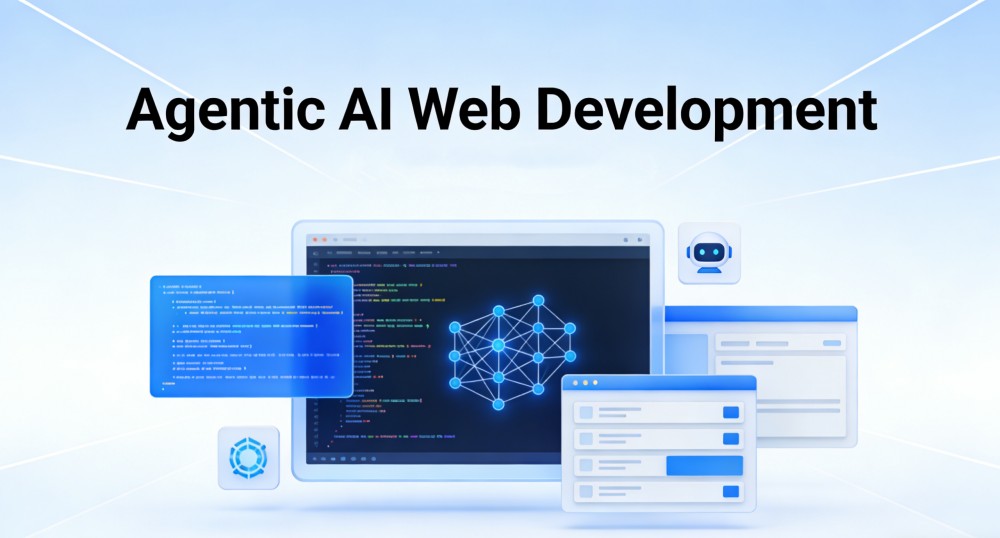
All businesses desire a site that is smarter and faster, yet have to cope with sluggish updates, inadequate automation, and restricted customization. Therefore, the solution to this is in agentic AI web development that allows websites to behave autonomously, make decisions, and automatically respond to users. Thus, this guide will show developers how to create efficient and adaptive websites without complicated manual code that can be developed through agentic AI.
What is Agentic AI?
Agentic AI is a kind of artificial intelligence that has the ability to take actions on its own and achieve a goal, plan the steps, and make decisions. Besides, it utilizes the tools without any oversight by a human. This technique involves independent agents, which comprehend circumstances, observe conditions, and perform multi-step activities when engaging with tools or software systems.
Therefore, this contrasts with the normal AI that is merely responsive or dictated by a preset of rules. In developing an agentic AI system, the agents operate by establishing goals, breaking down large tasks into smaller ones, and modifying plans when circumstances vary. Therefore, they are able to directly utilize other systems like apps, APIs, or databases, and different agents to do work.
Why Businesses Are Investing in Agentic AI?
According to the LandBase report, 79% of organizations already use AI agents, and 96% plan to expand in 2025. So, if you want to understand the hype around agentic AI in web development, follow the listed reasons. These will highlight why global investors are pouring resources into it to boost efficiency.
1. Higher Efficiency and Lower Costs
Agentic AI can handle complete workflows, such as order processing, case management, or IT operations, without constant human work. Thus, this reduces mistakes, shortens task times, and cuts costs, and many companies see big savings and higher productivity when AI agents handle repetitive or exception-driven tasks.
As a result, Emarketer reports that by 2028, 33% of enterprise software will use agentic AI, up from less than 1% in 2024, according to Gartner.
2. Faster and Better Decisions
AI agents analyze live data, evaluate options, and make or suggest decisions within seconds. This helps businesses react to market changes, risks, or customer needs quickly instead of waiting for slow human decisions.
Thus, due to this factor, the OneReach AI report says that agentic AI could make almost 30% of enterprise software revenue by 2035, exceeding $450 billion. Moreover, AI spending is expected to grow 31.9% yearly from 2025 to 2029, according to IDC.
3. Better Customer Service
Support system 24/7, personal recommendations, and self-service channel management are examples of tasks that agentic AI development services can perform. In this way, customers receive quick responses, and increased satisfaction and loyalty are enhanced without necessarily having to employ additional personnel. According to Gartner, by 2029, agentic AI will resolve 80 percent of common customer care problems independently and reduce operational expenses by 30 percent.
4. New Opportunities and Advantages
Companies can use agents to create new services, test ideas, or offer smart products. As a result, early users gain an edge through faster innovation, better responsiveness, and data-driven decisions. Besides, Daniel O’Sullivan of Gartner says that agentic AI is a game-changer for customer service. This will enable autonomous, effortless customer experiences, which is another reason for attracting investors.
5. Scalability and Resilience
AI agents can grow with business demand, work together across departments, and handle heavy loads. Hence, this keeps operations smooth, maintains quality, and supports business growth even as tasks and data increase.
How Does Agentic AI Differ from Other AI?
Agentic AI developers and experts now believe that agentic AI is more autonomous and goal-oriented than traditional AI. Thus, 66.4% of the market prefers multi-agent systems over single-agent setups, according to the LanBase report. Focusing on that, this section further highlights how agentic AI outshines other AIs:
- Autonomy vs. Prompt-Driven Behavior: Traditional AI or generative AI waits for a prompt, question, or data, then provides a single answer. Nevertheless, agentic AI relies on natural language processing and large language models. It is a self-directed AI agent that requires a goal and fulfills several steps without additional input.
- Goals and Multi-Step Workflows vs Single Outputs: Single-task AI can be either predictive or standard and can be used to rank, forecast, or classify. Instead, agentic AI targets a goal, divides it into smaller jobs, and oversees the entire workflow. They may apply techniques such as Chain of Thought or ReAct to plan sequences and adapt actions when needed.
- Acting in The World vs Just Computing Answers: Generative AI writes, creates images, or code, but it is up to humans to determine the next step. Nonetheless, agentic AI relies on tools, applications, databases, and bots to update records, send messages, and perform actions automatically. They also have access to the outside world via external tools, e.g., by searching the web, calling software APIs, reading databases, or sending emails.
- Adaptation and Continuous Operation vs Fixed Logic: Traditional AI uses fixed rules or models that break down when conditions vary. In comparison, agentic AI modifies the strategies in real time, traces the events, and is a continuous digital assistant. Agents improve their strategies through reinforcement learning or feedback loops.
- Relationship to Other AI Types: Agentic AI does not replace generative or predictive AI; it coordinates them. Predictive AI forecasts, generative AI drafts content, and agentic AI decides how to act on that information across systems.
How Agentic AI Transforms Web Development
Emarketer report says that by 2028, one-third of enterprise software will include agentic AI, up from under 1% in 2024, says Gartner. Thus, this will let AI handle 15% of routine daily decisions automatically. If you want to further know how this AI is transforming agentic AI software development services, review the given details:
1. Planning and Starting Projects
A high-level request, such as building a course platform with login, dashboard, and payments, can be broken down into pages, APIs, data models, and tasks by an agent. Subsequently, it creates the project structure, folder hierarchy, structures, dependencies, environment variables, and simple CI/CD pipelines automatically.
2. Writing Frontend and Backend Code
For the frontend, the agent generates React or Vue components, manages routing, wires forms, and optimizes performance, SEO, and accessibility. However, for the backend, it designs data models, builds API endpoints, and writes authentication and authorization logic. It also translates natural-language queries into SQL or ORM code. The agent keeps context across files, pulls everything together into working features, refactors code, and fixes UI or logic errors as they appear.
3. Testing, Quality Checks, and Debugging
Agents generate unit tests, integration tests, and end-to-end tests from specifications or existing code. Moreover, they run tests in CI pipelines, analyze failures using logs, stack traces, and recent commits, propose fixes, update tests, and re-run the pipeline. Hence, this reduces manual work, ensures consistent software quality, and keeps debugging continuous and structured.
4. DevOps, Deployment, and Runtime Management
In an agentic AI development company, agents then configure and build pipelines, provision cloud resources, and deploy new versions automatically. Furthermore, they can roll back when errors occur, monitor traffic and performance in real time. Besides, they scale infrastructure up or down, and apply “self-healing” actions when services degrade. Deployment becomes continuous and agent-managed rather than a risky, manual operation.
5. Continuous UX and Product Improvement
Later, Agents analyze user behavior, A/B tests, and analytics to suggest UI changes, content tweaks, or workflow improvements. Then, they apply small updates, measure impact, and repeat the process. Hence, they do so to create a self-optimizing loop that improves engagement, conversion rates, and the overall user experience over time.
The Future of Agentic AI in Web Applications
As far as the future of agentic AI development is concerned, it is expected to make web applications more adaptive, autonomous, and agent-friendly. Moreover, by 2028, at least 15% of daily work decisions will be made autonomously through agentic AI, up from 0% in 2024, says Gartner.
Not just that, by 2028, 33% of enterprise software is expected to feature agentic AI, up from under 1% in 2024. Based on this growth, websites will start working not just for humans but also for AI agents, such as:
- They will provide clear APIs and structured data so agents can query, transact, and complete tasks directly.
- Pages will use “agent-responsive” designs with simple layouts and clear interactions so agents can navigate and act reliably.
- Web apps will also personalize content, layout, and flows automatically for each visitor.
- On the contrary, embedded agents will monitor behavior, run tests, and adjust experiences to improve engagement and results.
As a result, Secondtalent says that in 2026, 40% of enterprise software will have task-specific AI agents, up from less than 5% in 2024. Also, 40% of jobs in Global 2000 companies will work directly with AI agents as workflows are redesigned.
How ZEGOCLOUD Supports agentic AI Web Development
ZEGOCLOUD supports agentic AI web development by providing real-time voice, video, and chat APIs for your AI agents to interact. Hence, developers can focus on LLMs and logic, while ZEGOCLOUD conversational AI handles streaming, audio capture, transcription, and text-to-speech, so conversations feel natural and live. For that, one can leverage its 20+ pre-built UIKits rather than developing from scratch.
Furthermore, the platform supports multiple agents, multi-speaker rooms, and real-time events for turn-taking and responsiveness. It manages WebRTC, media servers, global routing, and scaling so apps can serve many users without extra infrastructure. This lets you build AI tutors, customer support agents, or companions quickly and reliably in the browser. Above all, you can achieve an average global latency of 300ms, with a best-in-class 79ms, unlike any other platform.
Conclusion
In a nutshell, this guide has explained agentic AI web development and has highlighted why it’s becoming the center of attention for investors. Additionally, its operation is discussed, and a detailed comparison with traditional AI is provided to assess its value. However, for real-time voice, video, and chat for AI agents, ZEGOCLOUD is suggested as it offers a reliable way to build scalable, interactive agentic web experiences via APIs.
FAQ
Q1: What is agentic AI in web development?
Agentic AI in web development refers to AI systems that can plan, decide, and act autonomously within a web application. Instead of responding to single prompts, agentic AI can execute multi-step tasks, manage workflows, call tools or APIs, and adapt its behavior based on context and goals.
Q2: How is agentic AI different from traditional AI chatbots?
Traditional chatbots are mostly reactive and prompt-based. Agentic AI is proactive and goal-driven. It can maintain long-term context, break tasks into steps, make decisions, and trigger actions such as database queries, API calls, or UI updates without constant human input.
Q3: What are common use cases of agentic AI in web applications?
Common use cases include AI assistants, customer support agents, workflow automation tools, developer copilots, data analysis dashboards, and AI-driven SaaS platforms where the system needs to reason, act, and iterate rather than just answer questions.
Q4: What technologies are typically used to build agentic AI web apps?
Agentic AI web apps often combine large language models, tool-calling frameworks, memory systems, backend APIs, and real-time communication technologies. Frontends are usually built with modern frameworks like React or Next.js, while the backend coordinates AI logic, state management, and execution.
Q5: What are the main challenges of agentic AI web development?
Key challenges include controlling autonomous behavior, managing long-term context, ensuring reliability, preventing unintended actions, and balancing flexibility with safety. Proper system design and monitoring are critical for stable deployments.
Let’s Build APP Together
Start building with real-time video, voice & chat SDK for apps today!
