








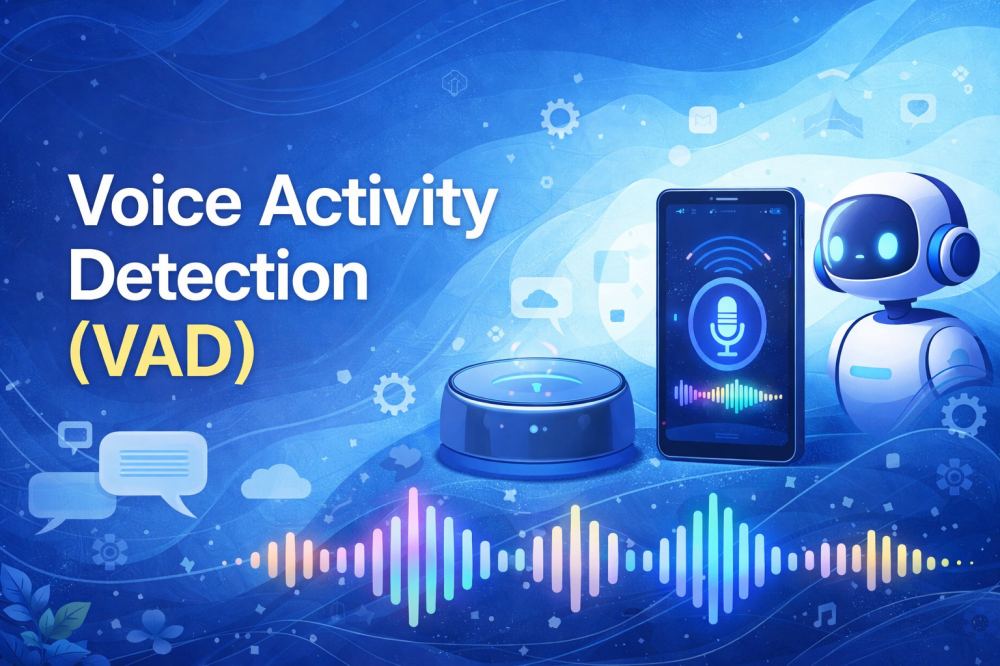
Voice Activity Detection, or VAD, is a core technology in modern voice applications. It helps systems determine whether an audio stream contains human speech or non-speech sounds such as silence, background noise, or other acoustic events.
As real-time communication, AI voice assistants, and conversational platforms continue to evolve, VAD has become an essential part of building responsive and efficient voice experiences. Modern VAD systems have moved far beyond simple energy-based detection. Today, many solutions use machine learning and richer signal analysis to perform reliably in noisy and dynamic environments.
For developers, understanding how VAD works and where it matters is important when building speech-enabled applications. In this guide, we will look at what Voice Activity Detection is, how it works, its main use cases, common challenges, and the metrics used to evaluate performance.
What is Voice Activity Detection?
Voice Activity Detection is a preprocessing technology that identifies speech segments in an audio signal and separates them from non-speech sounds. In practice, this means detecting when a user starts speaking, when they stop, and which parts of the audio should be treated as meaningful speech input.
A VAD system usually analyzes multiple signal features, such as energy level, zero-crossing rate, spectral features, and pitch-related information. The goal is to determine whether a given audio frame contains speech or not.
In most modern systems, VAD works in three main stages:
1. Feature Extraction
The system extracts useful information from the incoming audio stream. This may include features such as spectral flux, Mel-frequency cepstral coefficients (MFCCs), short-term energy, or pitch estimation.
2. Classification
The extracted features are then passed to a detection model. Depending on the system, this may be a rule-based detector, a statistical model, or a machine learning model trained on large speech and non-speech datasets.
3. Decision Smoothing
Raw frame-level predictions can switch too quickly between speech and silence. To avoid unstable behavior, the system smooths the output and applies logic that makes transitions between speech and non-speech more natural.
Why Voice Activity Detection Matters
VAD is important because many voice systems do not need to process every part of an audio stream equally. By detecting only the segments that contain speech, developers can reduce unnecessary computation, lower bandwidth usage, and improve downstream tasks such as ASR, transcription, and conversational AI.
A well-designed VAD system can help:
- reduce false triggers
- improve speech recognition accuracy
- lower processing cost
- Reduce latency in real-time interaction
- create more natural turn-taking in voice interfaces
In short, VAD helps voice applications become faster, cleaner, and more efficient.
Common Use Cases of Voice Activity Detection
Voice Activity Detection is widely used across communication, media, AI, and smart device applications. Its role may vary by scenario, but the goal is usually the same: identify speech accurately and respond at the right moment.
Speech Recognition
VAD is often the first processing layer in speech recognition systems, AI assistants, and voice bots. It helps determine when speech begins and ends, which improves recognition accuracy and reduces unnecessary processing.
In modern applications, VAD can also support multi-speaker environments by helping systems detect active speech segments more clearly. This is especially useful in dynamic settings where users speak naturally rather than in fixed command patterns.
Speech-to-Text and Live Transcription
In transcription applications, VAD helps segment speech into meaningful chunks. This improves readability, supports better sentence boundaries, and helps transcription systems process speech more accurately.
It is also useful for detecting pauses, speaker transitions, and overlapping speech. In real-time transcription platforms, this makes the final text more structured and easier to interpret.
Smart Home Devices
Smart speakers and home automation systems rely on VAD to distinguish real voice commands from environmental noise. This reduces false activation and helps improve both responsiveness and energy efficiency.
More advanced implementations can adapt to different distances, room conditions, and background noise levels. This makes voice activation more reliable in real household environments.
Video Conferencing
In video meetings and real-time communication platforms, VAD can be used to optimize audio transmission by sending audio only when speech is detected. This helps reduce bandwidth usage and supports features such as active speaker detection and automatic mute behavior.
Low-latency VAD is especially important in live meetings because delayed detection can interrupt the natural flow of conversation.
Media and Content Applications
VAD is also useful in media creation, AI video generation, subtitle timing, and content moderation workflows. It helps identify the parts of an audio track that contain actual speech, making editing and synchronization easier.
In long recordings, VAD can also help identify speaking moments for clipping, indexing, or highlight generation.
Challenges of Voice Activity Detection
Although VAD has improved significantly, building a reliable VAD for real-world applications is still challenging. Performance can vary depending on the acoustic environment, use case, and system constraints.
Background Noise
Environmental noise remains one of the biggest challenges for VAD. Office chatter, traffic sounds, music, fans, and crowd noise can all interfere with speech detection.
Modern systems use adaptive noise handling, but maintaining stable performance across different environments is still difficult.
Latency Trade-Offs
Real-time applications need VAD to respond quickly, but better detection often requires more analysis. This creates a trade-off between speed and accuracy.
For interactive voice systems, even small delays can make the experience feel unnatural. Developers often need to balance detection quality with response time.
Edge Cases and False Positives
Non-speech sounds such as coughing, laughter, keyboard clicks, or mechanical noise may be mistakenly classified as speech. At the same time, soft or distant speech may be missed.
These edge cases are difficult to eliminate completely, especially in open and unpredictable environments.
Resource Consumption
High-quality VAD can require significant processing power, especially when multiple audio streams are analyzed at the same time. This is particularly challenging for mobile apps, embedded devices, and battery-sensitive products.
Multi-Speaker Environments
Detecting speech in overlapping conversations is still a difficult problem. Group calls, open meetings, and noisy shared spaces create more complex acoustic patterns, making reliable detection harder.
Key Performance Metrics for Voice Activity Detection
Evaluating a VAD system involves more than a single accuracy number. Developers usually look at several performance indicators depending on the target application.
1. Accuracy
Accuracy in VAD often includes several related measurements. Two of the most important are:
- False Acceptance Rate (FAR): how often non-speech is incorrectly classified as speech
- False Rejection Rate (FRR): how often real speech is missed
A common balancing point is the Equal Error Rate (EER), where false acceptance and false rejection are equal. A good VAD system aims to keep both types of error low while staying stable across different environments.
2. Latency
Latency measures how quickly the system detects speech after it begins. This is a critical metric for real-time applications such as AI voice agents, live meetings, and interactive assistants.
If detection is too slow, users may experience delayed responses or clipped speech. For conversational systems, low latency is just as important as detection quality.
3. Runtime Efficiency
Runtime efficiency includes CPU usage, memory consumption, and power usage. These factors matter most in large-scale systems, mobile environments, and resource-limited edge devices.
Efficient VAD implementations often use strategies such as:
- dynamic feature extraction
- selective processing during silence
- confidence-based computation
- optimized handling of multiple audio streams
For cloud-based voice systems, runtime efficiency also affects scalability and operating cost.
Best Practices for Using VAD in Applications
To get better results from VAD, developers should think beyond the detection model itself. The right implementation strategy often depends on the product scenario.
A few practical recommendations include:
- Choose latency targets based on the real interaction flow
- Test with real background noise, not only clean audio
- Tune thresholds for the target environment
- Consider user distance and microphone quality
- Evaluate both false triggers and missed speech
- Combine VAD with noise suppression when needed
For conversational AI and real-time communication products, VAD works best when it is part of a larger audio pipeline rather than treated as an isolated module.
Building Better Voice Experiences with ZEGOCLOUD
As voice applications become more interactive, VAD is becoming more important in real-time audio and AI-powered communication scenarios. Choosing the right implementation can directly affect speech quality, responsiveness, and the overall user experience.
With years of experience in real-time engagement, ZEGOCLOUD applies VAD technology across areas such as real-time audio and video, AI agents, and digital humans. In real-time communication, VAD can be used differently depending on the scenario and interface requirements. In AI agent workflows, it can help with tasks such as far-field voice filtering, background noise reduction, and cleaner speech input processing.
For teams building voice-enabled products, combining VAD with a reliable real-time communication infrastructure can make the entire experience more natural, efficient, and production-ready.
Conclusion
Voice Activity Detection is a foundational technology for modern speech systems. It helps distinguish speech from non-speech, improves efficiency, and supports better performance in applications such as speech recognition, transcription, smart devices, video conferencing, and AI communication.
At the same time, VAD still faces practical challenges, especially in noisy, low-latency, and multi-speaker environments. That is why developers need to understand not only how VAD works, but also how to evaluate and implement it effectively.
As real-time voice interaction continues to grow, VAD will remain an important part of building responsive and reliable speech experiences.
FAQ
Q1. What is Voice Activity Detection in audio processing?
Voice Activity Detection, or VAD, is a technology used to determine whether an audio signal contains human speech or non-speech sounds such as silence or background noise.
Q2. What is VAD used for?
VAD is commonly used in speech recognition, live transcription, AI voice assistants, video conferencing, smart devices, and other voice-enabled applications.
Q3. Why is VAD important in real-time communication?
VAD helps real-time systems detect when a person is speaking, which can improve responsiveness, reduce bandwidth usage, and support cleaner voice interaction.
Q4. What are the main challenges of Voice Activity Detection?
Some of the biggest challenges include background noise, low-latency requirements, false positives, overlapping speakers, and limited device resources.
Q5. How do you measure VAD performance?
VAD performance is usually evaluated through metrics such as accuracy, false acceptance rate, false rejection rate, latency, and runtime efficiency.
Let’s Build APP Together
Start building with real-time video, voice & chat SDK for apps today!
