Talk to us
Talk to us
menu

How to Choose the Best Video File Formats

How to Choose the Best Video File Formats

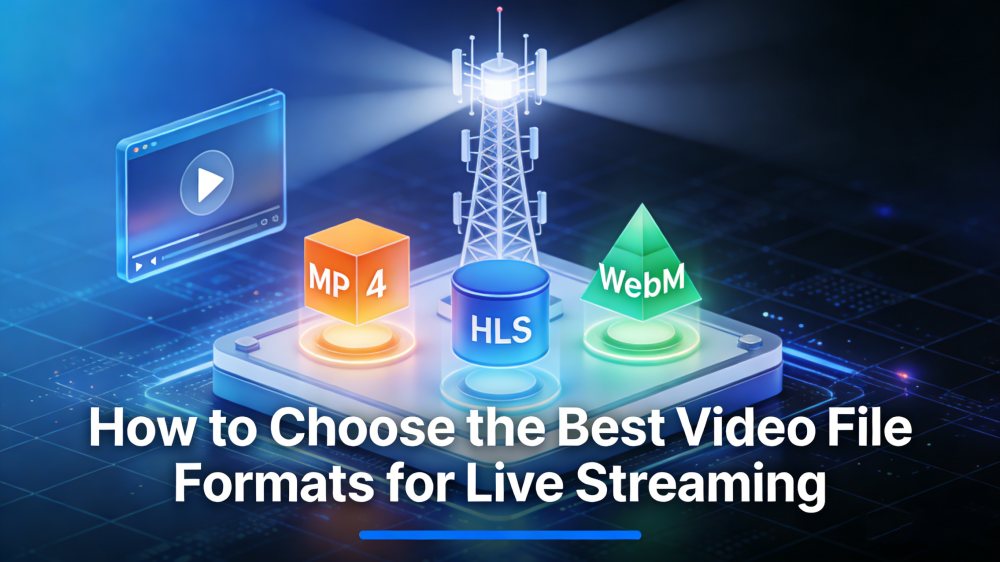
Do you know that live videos can fail fast if the wrong file format is used? Viewers may face lag or sudden stream drops. Thus, this makes the choice of video file formats important for live events, games, and online classes since they can control the quality, size, and device support. So, this guide explains how to choose the best video file formats for live streaming in clear and simple terms.

What are Video File Formats?

Video file formats are rules that define how video data is stored, saved, and played on devices. Hence, they decide how pictures, sound, and subtitles stay inside one file. Additionally, common video file formats include MP4, MOV, AVI, and MKV, and each format affects video quality, file size, and device support.

Some formats suit online platforms, while others fit editing or storage needs. Moreover, a video format works with a codec, which controls how video data is compressed. Thus, this choice affects how fast a video loads and how clear it looks. Not just that, choosing the best video file format helps videos play smoothly, use less space, and work on many devices without issues.

What Are the Common Video File Formats for Live Streaming?

The choice of video format impacts the streaming quality, compatibility, and performance across devices altogether. With this perspective, explore the list of some common video file formats essential for live streaming:

1. MP4 (.mp4)

It’s a default choice for most live and on-demand streaming platforms because it combines high compatibility with compression. Moreover, MP4 can store video, audio, subtitles, and metadata in a single file, delivering quality even over slow internet connections. This common file format for video supports progressive download and adaptive bitrate, adjusting quality according to network conditions.

Pros

  • Works on almost every device, browser, and player without extra plugins.
  • Delivers professional-quality performance in a compact size, helping steam loads quickly.

Cons

  • Less flexible than MKV for many tracks, advanced subtitles, and special features.
  • Some newer codecs in MP4 (like H.265) can involve licensing and patent considerations.

2. WebM (.webm)

Another common video file format, WebM, focuses on efficient, high-quality video at low bitrates. Additionally, it uses P8, VP9, or AV1 codecs plus Opus audio, which means it can deliver clear audio using less bandwidth. WebM is tightly integrated with HTML5 and is well-suited for modern browsers, working smoothly with adaptive streaming setups.

Pros

  • No licensing fees for container and main codecs, making it a convenient choice.
  • Very efficient compression so videos stay sharp while file and bandwidth usage stay low.

Cons

  • Support is weaker on some Apple devices and older systems compared with MP4.
  • Some legacy players and hardware encoders do not fully support WebM yet.

3. MKV (.mkv)

MKV (Matroska) is a very feature-rich container that can hold almost any codec, with plenty of audio and subtitle tracks. Furthermore, it’s great for complex high-quality content such as multilingual movies, HDR videos, and archival files. For live streaming, MKV is less common but can still be used in workflows that need multiple tracks or advanced features.

Pros

  • Supports virtually any codec plus unlimited audio and subtitle tracks in one file.
  • Surprisingly, it plays the remaining content even if any part is damaged.

Cons

  • Not widely supported in browsers, users prefer to change the video file format.
  • Files can be larger and more complex, making simple live streams unnecessary.

4. MOV (.mov)

This is Apple’s QuickTime container format, widely used in professional video production and editing. A common video file format that can store multiple video/audio tracks and subtitles, often at high quality, using ProRes. Moreover, live streaming content is usually produced or edited in MOV, then transcoded to MP4 or other web formats.

Pros

  • Preserves very high-quality video and audio, suitable for editing and color grading.
  • Support rich metadata, helping in complex post-productions and broadcast setups.

Cons

  • Larger file sizes and heavier bitrates make MOV less efficient for live streaming.
  • Compatibility across non‑Apple devices and basic players is weaker than MP4.

5. AVI (.avi)

AVI (Audio Video Interleave) is a container format introduced that stores audio and video together for synchronized playback. In addition, it uses little or no compression by default, preserving substantial visual and audio detail. Notably, it’s the best video file format that supports multiple codecs and can store multiple audio tracks.

Pros

  • Delivers extremely high video and audio quality, often uses lossless compression.
  • Works on most desktop systems and media players, especially in a Windows environment.

Cons

  • Large file size due to less compression makes it costly for storage and bandwidth.
  • Limited for modern web streaming because it lacks native support for streaming protocols.

6. FLV (.flv)

Another small video file format built for delivering video over the internet using Adobe Flash Player. Most importantly, it uses a tagged packet structure that allows progressive downloads, letting viewers watch before complete loading. Today, FLV still appears in older archives, training libraries, or legacy RTMP streaming workflows being migrated to newer formats.

Pros

  • Integrates naturally with RTMP/Flash streaming servers used by older systems.
  • Massively supported in early video platforms, still, much content is stored in FLV.

Cons

  • It depends on Adobe Flash Player, which is now entirely discontinued.
  • Limited native support on mobile devices, smart TVs, and HTML5 Players.

7. HEVC/H.265

HEVC, also known as H.265, is a modern video compression designed to deliver the same or better video quality. Furthermore, it supports high-resolution formats such as 4K and HDR video, making it attractive to streaming platforms. This common video file format for videos can reduce buffering and improve playback on slower or congested networks.

Pros

  • Can keep similar visual quality to H.264 while reducing bitrate and file size.
  • Smaller streams reduce CDN and data usage, benefiting both providers and viewers.

Cons

  • Multiple patent pools cover HEVC, so commercial use often requires paying royalties.
  • Moreover, encoding and decoding are more complex than H.264, causing playback issues.

How to Choose a Video File Format for Live Streaming

When one sees the massive list of video file formats, they get baffled, and the need to pick the right one arises. Therefore, this section highlights 5 key criteria to consider when selecting the ideal format.

  • Check Device and Platform Support: Choose a video format and codec that works on most phones, browsers, and platforms. Hence, MP4 with H.264 and AAC is the safest choice for wide support. Before a live event, confirm that the platform clearly supports your chosen format to avoid playback issues for viewers.
  • Balance Quality and Internet Limits: Pick a format that keeps good video quality without extensive data use. Thus, H.264 works well for most cases, while H.265 or AV1 suit 4K video but need newer devices. However, for a weak internet, efficient codecs help keep a clear video at lower data rates.
  • Think About the Delay Needs: Interactive events like games or live classes need very low delay, and formats with fast response settings work better for such cases. Additionally, heavy compression can introduce additional latency, so testing is important when a quick response is critical.
  • Support Quality Change by Network Speed: Use formats that allow automatic quality change based on the viewer’s internet speed, as this helps avoid pauses and keeps the video smooth. Hence, standard formats like MP4 with H.264 make this process easier across many devices.
  • Match the Format to Your Work Process: If you plan later changes, choose formats that video tools handle easily. For long-term storage, larger high-quality files work well, while delivery systems can later create lighter versions for live use.

How Developers Build Real-Time Live Streaming with ZEGOCLOUD

Choosing the right video file format is only one part of live streaming. For developers, building a real-time live streaming experience involves capturing media instantly, delivering streams with minimal delay, and supporting interaction across different devices and regions. This is where ZEGOCLOUD fits into the workflow.

zegocloud live streaming sdk

Instead of relying on pre-encoded video files, ZEGOCLOUD captures audio and video directly from user devices and transmits them to global servers in real time. Streams are then delivered to viewers with very low latency, often under 600 milliseconds, which is critical for live interaction, co-hosting, and audience engagement.

Beyond basic streaming, developers can combine multiple hosts into a single live room and deliver content across web, mobile, and TV platforms without manually handling different output formats. The platform supports common live streaming protocols such as RTMP, HLS, and FLV, while abstracting most of the complexity at the application layer.

ZEGOCLOUD also provides built-in interactive capabilities, including real-time chat, likes, virtual gifts, co-hosting, screen sharing, and cloud recording. These features allow teams to focus on product logic and user experience rather than building real-time infrastructure from scratch. Prebuilt UIKits further reduce development time by enabling fast setup of complete live rooms.

To ensure stable playback at scale, the platform includes adaptive bandwidth control, global routing, and reconnection handling. Live sessions can be recorded and reused for video on demand, while advanced features such as virtual avatars, spatial audio, and live status synchronization support more immersive live experiences.

For developers, this approach means video file formats become an implementation detail rather than the core challenge. By handling real-time capture, delivery, interaction, and scalability at the platform level, ZEGOCLOUD enables teams to build live streaming applications that go far beyond traditional video formats.

Conclusion

To wrap up, this guide has given detailed information on video file formats with guidance on how to choose one. Get to know which format is best since the article has covered detailed pros and cons. However, for seamless, low-latency, and interactive live streaming, ZEGOCLOUD is the recommended platform. It also supports real-time scalability for large audience broadcasting.

FAQ

Q1: Which video file format is best?

There is no single best video file format for all use cases. The best option depends on where and how the video is used. For general playback and online sharing, MP4 is widely preferred due to its compatibility and efficiency.

Q2: What type of file is best for videos?

For most applications, MP4 is considered the best all-around video file type because it offers good quality, reasonable file size, and broad support across devices and platforms.

Q3: Is .MOV or .MP4 better?

MP4 is generally better for distribution and streaming because it produces smaller files and works on more devices. MOV can offer high quality, but is often larger in size and more suitable for editing rather than delivery.

Q4: Which is better quality, MPEG or MP4?

MPEG refers to a family of standards, while MP4 is a container format. In practice, MP4 with modern codecs can deliver excellent quality at lower bitrates, making it more efficient for most use cases.

Let’s Build APP Together

Start building with real-time video, voice & chat SDK for apps today!

Talk to us

Take your apps to the next level with our voice, video and chat APIs

Free Trial
  • 10,000 minutes for free
  • 4,000+ corporate clients
  • 3 Billion daily call minutes

Stay updated with us by signing up for our newsletter!

Don't miss out on important news and updates from ZEGOCLOUD!

* You may unsubscribe at any time using the unsubscribe link in the digest email. See our privacy policy for more information.