







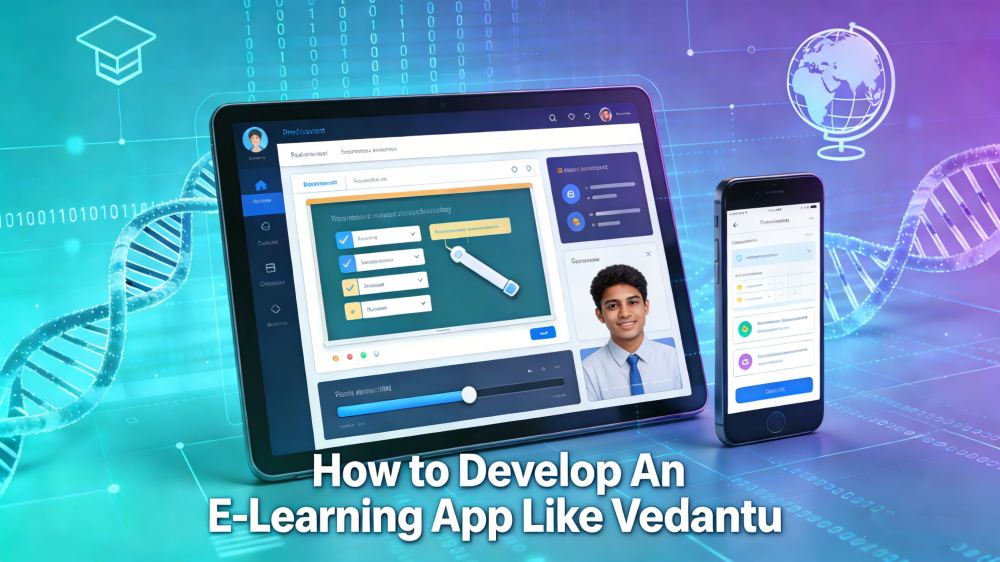
The current shift towards digital learning has created an urgent need for platforms that make education engaging and accessible. Students today need something more than textbooks; they want interactive lessons and instant doubt-solving, exactly what Vedantu offers. Given this, developing an e-learning app like Vedantu is a way to meet the growing demand for smarter learning solutions. Therefore, continue reading the guide below for complete guidance on developing a Vedantu-like app.
What is Vedantu?
Vedantu app is an online learning platform that delivers live, interactive classes for school students (from 6-12 classes). It positions itself as an “entire school in your pocket,” combining recorded concept videos and a library of study materials. Classes are taught by experienced master instructors from top engineering and media colleges in India. Moreover, the app is used by more than 2.2 million enrolled students from over 30 countries.
Beyond content, Vedantu focuses on personalized learning and exam-preparation support through features built into the app. In addition, students can use the Ask Doubt feature to click a picture of a problem in their studies. It even offers test modules, mock tests, and All-India test series for boards or entrance exams. Besides this, it’s available on both Android and iPhone, helping learners with step-by-step help from academic experts.
Key Features of Vedantu
To build a competitive solution, first closely examine the key elements that drive the Vedantu learning app’s immersive experience:
- Live Interactive Classes: Delivers real-time online classes for grades 1-12 and JEE/NEET with two‑way audio/videos and in-class chat. Plus, the classes are available for ICSE, state boards, and CBSE exams using Vedantu’s in-house WAVE technology.
- Instant Doubt-Solving Functionality: “Ask Doubt” and the in-class doubt tool enable students to submit questions for stepwise guidance. Additionally, AI mentor “VED” and InstaSolve provide 24/7 resolution of doubts and contextual answers during class replays.
- Provide Comprehensive Study Material: Offers chapter-wise NCERT solutions, previous-year papers, and solutions to standard books like RD Sharma. Essentially, structured notes and SmartNotes are generated from lectures via LectureLens, breaking classes into timestamped segments.
- Test, Quizzes, and Performance Tracking: Provides students with personalized topic tests, a complete syllabus test series, and All-India mock tests for boards, with detailed solutions. Furthermore, daily VQuizzes and in-class gamified quizzes or the ScoreBooster tool help track progress, identifying weak areas.
- Personalized and AI-Driven Learning: AI mentor “VED” analyzes attempt patterns, test data, and class history to build personalized improvement plans. Plus, LearnList recommends custom content paths, while ScoreBooster focuses on score-gaining topics and skills.
- One-to-One or Group Tuitions: It offers 1-to-1 tuition or small-group classes with master teachers from IITs and other top institutions. Impressively, the teachers are specially trained and have collectively delivered millions of teaching hours to students in different countries.
- Multiple Device Access and Flexibility: Vedantu’s online teaching services are available via web and mobile apps, enabling students to attend sessions from anywhere. These recorded sessions, conceptual videos, and flexible schedules allow learners to revisit topics at any time.
- Extra-Curricular and Super Kids Program: Co-curricular and skill-building courses are offered through Vedantu Super Kids, including coding and other enrichment topics. Notably, themed programs and summer camps make learning more engaging beyond the core syllabus.
Benefits of Creating an Educational App Like Vedantu
The underlying benefits of the Vedantu website will help you understand why investing in an e-learning solution is valuable:
- For Wider Reach and Accessibility: Students can learn anytime, anywhere with just a phone or laptop, removing distance and time constraints. Moreover, an app lets you reach learners across cities and countries, growing far beyond a local tuition center.
- Personalized Learning at Scale: Adaptive content, quizzes, and AI-based recommendations can tailor lessons to each student’s strengths and weaknesses. Plus, one-to-one or combined live sessions offer more focused attention that is hard to achieve in large offline classrooms.
- Promotes Better Engagement and Results: Interactive tools such as live chat, whiteboards, and gamified quizzes make classes more engaging than passive instruction. Also, continuous practice tests, instant feedback, and detailed reports facilitate users to track progress and improve exam performance.
- Rich Data and Continuous Improvement: Detailed analytics on usage, completion, and grades allow you to see what content works and where your kid struggles. Moreover, data-driven insights help refine control, personalized marketing, and demonstrate learning impact to parents.
- Strong Business scalability and Lower Costs: Once built, an e-learning app can serve thousands of students simultaneously without needing classrooms or printed materials. Plus, it’s easy to add new courses, exam segments, or upsell premium plans, increasing revenue potential.
Technology Stack for an E-Learning App Like Vedantu
Before diving into development, it is important to understand the technology stack required to build a robust Vedantu online classes substitute. So, review the given insights below to plan the app architecture, choose the right tools, and ensure smooth performance:
| Layer | Options (Vedantu‑style) |
|---|---|
| Mobile Frontend | React Native or Flutter for cross‑platform apps. |
| Web Frontend | React.js, Vue.js, or Angular |
| Backend | Node.js, Python (Django/Flask), or Java Spring Boot. |
| Database | PostgreSQL or MySQL for relational data; MongoDB for flexible content. |
| Real‑time/Live Classes | WebRTC‑based service or SDK (e.g., ZEGOCLOUD, custom WebRTC). |
| Video Storage/Vod | AWS S3, Google Cloud Storage, or Azure Blob + HLS/DASH streaming. |
| Auth & Security | JWT/OAuth 2.0, HTTPS, role‑based access control. |
| Notifications | Firebase Cloud Messaging, Apple/Android push, email/SMS gateways |
| Analytics & Logging | Google Analytics/Mixpanel + ELK/CloudWatch/Stackdriver. |
| Cloud/Infra | AWS, Google Cloud Platform, or Microsoft Azure. |
How to Build an E-Learning App Like Vedantu
If you want to build a better education platform than Vedantu, you need basic development knowledge. Therefore, this section explains how to create an e-learning application that delivers more interactive lessons, live classes, and student engagement features.
1. Define Your Learning Model
First, decide who will use your platform, and focus on school students (K–12), test preparation, skill development, or corporate training. Next, decide how classes will be delivered and consider options such as one-on-one sessions, small group lessons, or large webinars. Additionally, choose a business model that fits your users, such as free live classes, subscription courses, or bundles with tests and mentorship.
2. Core Features to Include
While building the foundation, conduct market research and list the features that some renowned apps lack. Ideally, your platform should have live two-way classes with a virtual whiteboard, teacher video, and student audio or video. Additionally, add chat tools and a hand-raise or doubt system so students can ask questions.
In your Vedantu app alternative, also support your live classes with recorded lectures, quizzes, assignments, notes, performance tracking, and exam-style tests with reports. Hence, these features make the learning experience complete and organized.
3. Architecture and Tech Stack
Use mobile apps built with React Native or Flutter for both iOS and Android. Additionally, for Backend options, include Node.js, Java, or Python, and databases like PostgreSQL or MySQL store user data, class information, and results. In addition, use separate services for live classes, content storage, payments, notifications, and analytics. Thus, this approach helps the platform scale and remain stable during peak periods such as exam season.
4. Have Real-Time Classes with ZEGOCLOUD
For live teaching, know that interaction is the key, and no other platform than ZEGOCLOUD handles it well with its intuitive APIs. So, use ZEGOCLOUD to provide low-latency audio and video and add an interactive whiteboard, screen sharing, and real-time chat. This setup makes online classes feel interactive and close to real classrooms.
5. Set Teacher and Student Workflows
Give teachers the ability to schedule classes, upload study materials, run polls and quizzes, track attendance, and review recorded sessions. Also, in your Vedantu live class substitute app, enable students to browse courses, join live sessions, watch recordings, take quizzes, and track their progress. Thus, these workflows help both teachers and students use the platform efficiently.
6. Quality, Compliance, and Scaling
Finally, optimize the video for low bandwidth so students with weak internet access can still join. Offer offline downloads and a simple user interface, and add security through role-based access, secure payments, and data privacy controls. In addition, track platform performance with logs and analytics to improve class quality.
Cost of Developing an E-Learning App Like Vedantu
Sometimes, when you are out to make a better Vedantu substitute, the first thought that comes to mind is “How much will it cost?” Hence, this section answers the query by providing an estimated overall app development cost.
| Cost Item | Estimated range (USD) |
|---|---|
| Platform Choice (Android, iOS, Web) | $20,000 – $70,000 |
| UI/UX Design | $5,000 – $20,000 |
| Features & Functionality (Live Classes, Tests, etc.) | $15,000 – $100,000+ |
| Backend Development | $15,000 – $30,000 |
| Testing & QA | $5,000 – $20,000 |
| Third‑party Integrations (Video, Payments, Analytics) | $5,000 – $15,000 |
| Marketing & Launch | 15–20% of the total build cost |
| Annual Maintenance (Post‑Launch) | 15–20% of total build cost |
| Overall Estimated Total | $65,000 – $250,000+ for a full‑featured app |
Future Trends in E-Learning App Development
Future e-learning apps like Vedantu are moving towards a highly personalized, data-driven experience powered by AI. A 2025 review estimates that the education apps market is over USD 7 billion. Besides, the online education market is already worth more than $200 billion, and learning apps are among the fastest-growing segments. Therefore, these micro-lessons delivered via smartphones/laptops facilitate students to fit learning into their busy schedules.
Another major trend is social learning, using AR/VR, gamification, or collaborative features inside the apps. Thus, augmented and virtual reality enable interactive labs or a safe practice environment, making complex topics easier to manage. Studies show that mobile learning can help people learn faster and remember more than in school classes. It can even improve productivity by around 43%, with more than 60% of students now relying on e-learning daily.
How ZEGOCLOUD Powers E-Learning Apps Like Vedantu
When you make a Vedantu tutor alternate, try to add interactive features with ZEGOCLOUD, an ideal solution to make learning fun. This tool offers 20+ prebuilt UIKits to reduce the hassle of building from scratch, making development seamless for beginners. Additionally, the platform provides SDKs like Video and Audio to enjoy 4K quality, with spatial sound and noise reduction features to have a clear and immersive online class experience.
Moreover, this innovative platform ensures lag-free audio interaction within 300ms, with the ability to share screens and record sessions automatically via VOD. On the contrary, you can add push notifications, media attachments, user invitations, and group management facilities via the In-App Chat API. Hence, these aspects make the learning experience organized, where one can chat with AI (Solo or in a group) within 500ms to get tailored assistance.
Conclusion
In conclusion, developing an e-learning app like Vedantu is a strategic step toward delivering interactive education. While reviewing the key possibilities and benefits such apps offer, you can significantly improve learning outcomes while scaling effectively. However, the process of development can be enhanced when done via ZEGOCLOUD through its video and voice SDKs.
FAQ
Q1. How to create an eLearning app?
Start by defining your target users and learning goals. Then design key features such as courses, videos, quizzes, and progress tracking. Build a basic version first, test it with users, and improve it step by step.
Q2. How much does it cost to develop an eLearning app?
The cost depends on features and scale. A simple eLearning app usually costs $20,000–$40,000, while more advanced apps with live classes or analytics can cost $60,000–$100,000+.
Q3. How to build an EdTech app?
Identify a real education need, design an engaging learning experience, and develop core features like content delivery and assessments. Many teams launch an MVP first, then add advanced functions later.
Q4. How to start an e-learning platform?
Choose a clear niche, prepare quality content, decide on a business model, and launch the platform. After launch, keep improving content and features based on user feedback.
Let’s Build APP Together
Start building with real-time video, voice & chat SDK for apps today!
