








The growing demand for human-computer interaction has positioned speech recognition as an indispensable technology. It enables users to communicate with devices in natural language, reducing reliance on manual input methods such as typing. Moreover, it opens new possibilities for individuals with physical challenges, allowing them to interact with technology more independently. As expectations for smarter and personalized communication continue to grow, there’s much more you’ll discover through this guide.
What is Speech Recognition?
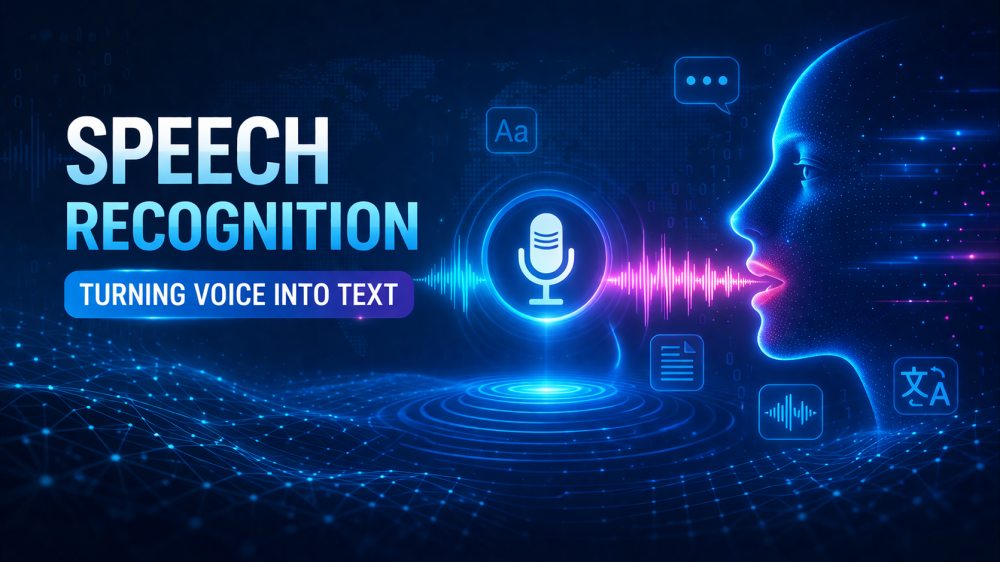
Speech recognition is the process of converting spoken language into written text so computers can understand and respond to what we say. Simply, speech recognition technology listens to your voice, breaks the sound into patterns, and matches those patterns to words. Additionally, it differs from voice recognition, which focuses on identifying who is speaking rather than what is being said.
Today, this technology uses AI and machine learning to accurately handle multiple accents, speaking speeds, and background noise. These systems are now built into many of the tools we use every day, including virtual assistants and car navigation systems. In fact, it helps people control devices and enter information by voice rather than typing.
Key Features of Speech Recognition
With the involvement of voice-driven technologies, it’s equally important to explore what makes them so reliable. Thus, look at the following features to understand how speech recognition software shapes human-computer interactions more naturally:
- Understands and Converts Spoken Words to Text: A feature of this technology is its ability to turn spoken language into written text that a computer can use. Furthermore, it listens to your voice, breaks the sound into small pieces, and uses models or dictionaries to interpret it.
- Uses AI and Machine Learning: Current systems use these technologies to improve over time. Precisely, they learn from multiple voice samples, helping them navigate different accents, speaking rates, and background noise.
- Learns Grammar and Language Patterns: Automatic speech recognition technology not only hears words but also understands grammar, sentence structure, and word patterns. Therefore, it guesses what you most likely mean and delivers results more naturally in real-time conversations.
- Customization for Different Industries: Many solutions allow companies to tailor the system to their needs, such as by adding industry-specific terms or brand-specific phrases. Thus, it’s useful in areas such as healthcare and customer service, where specialized vocabulary is common.
- Works in Everyday Devices and Apps: Speech recognition software is now built into smartphones, car systems, call centers, and medical dictation tools. This widespread use helps people search the web and create notes or reports by speaking instead of typing.
- Measured by Accuracy and Speed: Two important features are accuracy and speed, often measured by word error rate and response time. Moreover, a professional system aims to achieve human-level accuracy while still responding quickly enough to feel natural in conversation.
Benefits of Speech Recognition
Specifically, speech-recognition voice technology enables users to interact with devices, delivering a range of practical advantages. Therefore, highlighting the benefits below demonstrates how they simplify everyday tasks and improve user engagement:
- Saves Time and Effort: The technology lets people speak rather than type, which is much faster and easier, especially for long notes.
- Makes Technology Easier to Use: With speech recognition, users can control phones, computers, and smart devices with simple voice commands.
- Improves Accessibility: It’s valuable for people with disabilities who have difficulty typing, giving them more independence at work.
- Helps in Many Jobs and Industries: Doctors, call center agents, and other workers use this technology to reduce paperwork, speed up tasks, and improve safety.
- Supports Better Customer Service: In sales and other areas, it automatically turns phone calls into text and helps virtual agents understand customer requests.
How Does Speech Recognition Work?
To avail speech recognition technology, a complete understanding of the process helps deliver more improved, actionable commands or text. Moreover, examining how it works reveals the sophisticated mechanism behind its accuracy and prompt responses:
1. Listening to Your Voice
When you speak, the system uses a microphone to listen and capture your voice as sound waves. These sound waves are then turned into digital data so the computer can process them. Furthermore, it records how loud and clear your voice is, helping to separate it from the surrounding noise.
2. Cleaning and Breaking the Sound into Pieces
The system removes as much background noise as possible so your voice stands out clearly. It then cuts the sound into many small segments and analyzes each segment to identify basic speech sounds. Therefore, the computer makes fewer mistakes when it later guesses your words and delivers precise answers.
3. Matching Sounds with a Dictionary
It now compares the detected sound to a large pronunciation dictionary to determine which sound patterns correspond to which word. This helps speech recognition voice by identifying which word fits the sound it just heard. However, if several words sound similar, it keeps a list of possible matches instead of choosing too quickly.
4. Using Grammar and Context for Best Words
Afterward, language models and grammar rules evaluate which word combinations make the most sense. In addition, the system analyzes word order and common phrases to correct minor sound errors. This is why speech recognition works better in full sentences than in random, disconnected words.
5. Turning the Result into Text or Actions
Finally, the system turns the chosen words into either text you can see or a command the app can use. Moreover, generated text might be saved in a document, shown on screen, or passed to another program. In many apps, this last step is what you notice most, even though several hidden steps came before it.
Speech Recognition vs Voice Recognition
When analyzing speeches for recognition, it is essential to recognize that speech recognition and voice recognition serve distinct functions. To further clarify this difference, review the tabular comparison below to understand their purposes and application broadly:
| Main Aspects | Speech Recognition | Voice Recognition |
|---|---|---|
| Major Purpose | Converts what you say into written text or commands. | Identifies who is speaking based on their unique voice. |
| Main Focus | What the words are. | Who the person is. |
| Primary Use | Dictation, voice typing, voice search, and virtual assistants. | Login, unlocking devices, and voice‑based security checks. |
| Output | Text or an action (e.g., send a message, start a search). | A confirmed user identity (e.g., “this voice matches the owner”). |
| Core Technology | ASR (automatic speech recognition), language, and acoustic models. | Speaker recognition/verification and voice pattern matching. |
| Key Success Measure | Word accuracy and how well it understands sentences. | How reliably can it tell one person’s voice from another’s? |
Speech Recognition Algorithms
A complete knowledge of the underlying algorithms is important to understand how automatic speech recognition systems achieve high accuracy. In this context, the algorithms discussed form the backbone of technologies that convert spoken language into brief outputs:
1. Hidden Markov Models (HMMs)
This model is used in early speech recognition systems, where speech is treated as a chain of small sound “states.” Each state represents a basic sound pattern, and the model stores the likelihood of transitioning from one state to another. Moreover, it combines these probabilities with the audio input and guesses which sequence of states matches the recorded sound.
2. Gaussian Mixture Models (GMMs)
Gaussian Mixture Models are used to describe how different speech sounds are distributed in a mathematical “space” such as pitch. It treats each sound as a mixture of several smaller Gaussian (bell-shaped) blobs, which more closely matches real human speech. For each audio sample, the algorithm identifies the best-fitting Gaussian mixture and maps it to a phoneme.
3. Deep Neural Networks (DNNs)
DNNs use many stacked layers of artificial “neurons” to automatically learn patterns in raw or lightly processed audio. Instead of hand‑designed rules, they learn from huge amounts of recorded speech and transcriptions, discovering important features for word recognition. Moreover, it captures very subtle differences between speakers, accents, and background noise, outperforming older GMM or HMM systems.
4. Recurrent Neural Networks (RNNs) and LSTMs
These models in speech recognition technology are designed to process sequence data, passing information from one step to the next. LSTMs (Long Short‑Term Memory networks) are a special kind of RNN that can remember important details for longer. Additionally, RNNs and LSTMs are used in acoustic and language models to predict the next word in a sequence.
5. End‑to‑End (Sequence‑to‑Sequence) Models
End‑to‑end models aim to map raw audio directly to final text through a single large neural-network pipeline. Precisely, rather than designing feature extraction, pronunciation modeling, and language modeling separately, all are covered collectively. In addition, these models can reach or exceed the accuracy of more traditional multi‑stage systems.
Speech Recognition Use Cases
As organizations and individuals seek more natural ways to interact with speech recognition, its application continues to grow. Therefore, examining these scenarios, you’ll have a clear concept of how this technology improves everyday experiences:
- Safer, Hands‑Free Driving (Automotive): In cars, speech recognition lets drivers control navigation, calls, and media by voice, reducing the need to touch the screen. This helps keep their eyes on the road and improves safety while still giving access to important functions.
- Virtual Assistants and Smart Devices (Technology): On phones and smart speakers, speech recognition powers virtual assistants like Siri and Alexa. According to a PR Newswire report, speech recognition is projected to reach USD 29.28 billion in 2026, driving growth in mobile applications.
- In medical notes (Healthcare System), doctors and nurses use speech recognition to dictate patient notes and reports directly into the electronic health record. According to the EHR Speech Recognition Market analysis, the market value is expected to reach USD 62.9 billion by 2035.
- Smarter Call Handling (Sales and Customer Service): Call centers use speech recognition technology to transcribe calls, understand customer intent, and support virtual agents. This makes it easier to spot common issues, answer questions faster, and provide help even when human agents are busy.
- Voice‑Based Authentication (Security): Some systems use speech recognition together with voice recognition to let people prove their identity by speaking. According to Fortune Business Insights, AI-driven customer experiences will grow up to USD 24.02 billion by 2032.
Challenges of Real-Time Speech Recognition
While automatic speech recognition offers remarkable convenience, its implementation in real-time scenarios presents the following challenges:
- Handling Background Noise: Real‑time speech recognition struggles in the presence of strong background noise, such as people talking or music.
- Dealing with Accents and Pronunciation: In real time, speech recognition technology has little time to adapt, increasing the likelihood of errors with strong accents.
- Keeping Word Error Rate Low: Human‑level accuracy is hard to reach because small changes in pitch and volume can easily confuse the model.
- Understanding Context in Live Conversations: The system infers meaning from grammar and language, and an incorrect guess can disrupt the entire sentence.
- Protecting Privacy and Data Security: When a real-time system sends voice data to cloud servers for processing, it raises privacy challenges for many users.
Building Real-Time Speech Recognition Apps with ZEGOCLOUD
ZEGOCLOUD helps developers develop speech recognition software by providing ready-made cloud ASR and real-time communication SDKs. Its real-time Cloud ASR service offers ultra-low latency (about 300ms on average), AI noise reduction, and echo cancellation. You can combine this with its APIs to enable Live Video/Audio calls, keeping the conversation convenient and in sync. Moreover, incorporate spatial audio to deliver an immersive audio experience for metaverse users.
Importantly, you can plug speech recognition technology directly into web, mobile, or desktop apps with simple integration steps. This means developers can focus on using transcripts, triggering actions, or feeding text into conversational AI. Additionally, it can support up to 1,000,000 active participants in your real-time speech recognition app. Compared to building everything from scratch, setting up audio servers, choosing and scaling ASR models, ZEGOCLOUD saves significant time.
Conclusion
In conclusion, speech recognition has become a pivotal technology, enabling natural communication between humans and digital systems. Its applications range from improving productivity and accessibility to powering smarter business operations and enhancing user experiences. However, it faces some challenges. Incorporating ZEGOCLOUD into its development lets teams ship reliable, real‑time speech apps much faster.
FAQs
Q1: What do you mean by speech recognition?
Speech recognition is the technology that allows a system to listen to spoken language and convert it into text or commands. It is commonly used in voice assistants, transcription tools, customer service bots, and real-time communication apps.
Q2: How do I turn on voice recognition?
It depends on the device or app you are using. On most smartphones, tablets, or computers, voice recognition can be enabled in system settings, accessibility options, or within a specific app that supports voice input. In software products, developers usually enable it by integrating a speech recognition API or SDK.
Q3: What is an example of speech recognition?
A common example is using a voice assistant like Siri or Google Assistant to ask a question or give a command. Another example is automatic captions in video meetings, where spoken words are turned into text in real time.
Q4: Is ASR considered AI?
Yes, ASR, which stands for Automatic Speech Recognition, is generally considered a form of AI. It uses machine learning and language models to recognize spoken words, process audio, and generate text.
Let’s Build APP Together
Start building with real-time video, voice & chat SDK for apps today!
