Talk to us
Talk to us
menu

Scaling Globally with Superior RTC Packet Loss and Jitter Handling

Scaling Globally with Superior RTC Packet Loss and Jitter Handling

In the real-time engagement (RTE) industry, the gap between a successful interaction and a churned user is often defined by how well a platform handles poor network conditions. This is where RTC packet loss and jitter handling becomes critical. Whether it’s a social discovery app, a telehealth platform, or a conversational AI agent, the reality of the public internet remains the same: it is inherently unpredictable.

For platforms aiming for a global footprint, the “last mile” is often the most treacherous. When data travels across borders and through congested local networks, the stability of the experience hinges entirely on a provider’s sophisticated RTC packet loss and jitter handling.

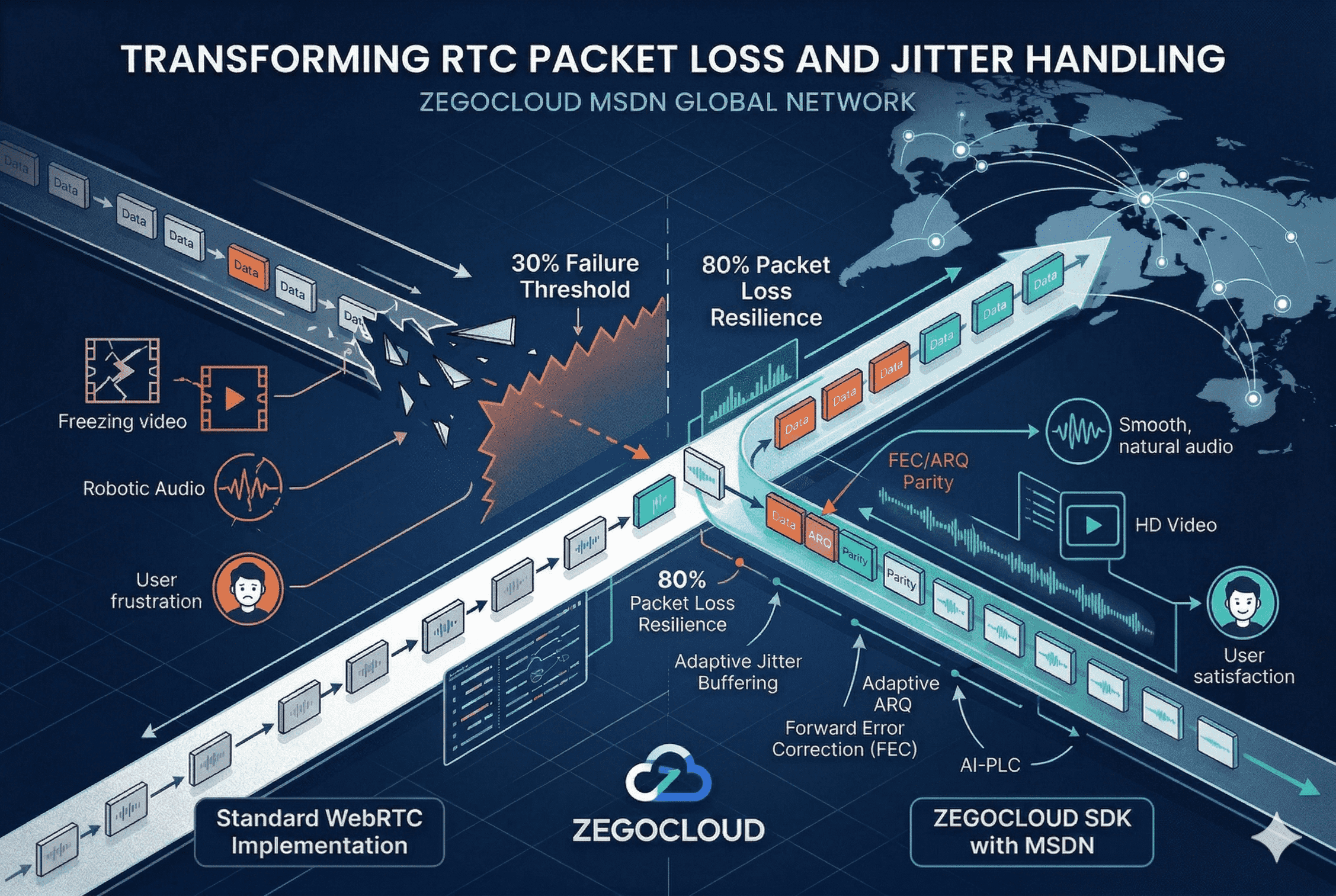
While most RTC systems degrade significantly beyond 20–30% packet loss, ZEGOCLOUD’s internal testing shows usable communication can still be maintained under extreme conditions through layered recovery strategies.

What RTC Packet Loss and Jitter Handling Really Means for Call Quality

To build a resilient product, we must first quantify the physics of network degradation.

Packet Loss: Missing Information in a Continuous Stream

In real-time communication, audio and video are transmitted as a continuous stream of small data packets. When some of these packets are lost, the system must decide how to handle incomplete information.

At low levels, packet loss is barely noticeable. But as it increases, the impact becomes more obvious:

  • Audio begins to sound clipped or robotic
  • Words may drop out entirely
  • Video frames freeze or become pixelated

In practical terms, most systems follow a similar pattern:

Packet LossUser Experience
0–2%Clear and stable
2–5%Minor artifacts
5–10%Noticeable degradation
>10–15%Difficult to use

The key issue is that lost packets cannot be fully recovered in real time. The system must compensate on the fly.

According to the ITU (International Telecommunication Union), once packet loss exceeds a nominal percentage, the Mean Opinion Score (MOS) begins a sharp decline, leading to immediate user frustration.

Jitter: When Timing Becomes Unstable

Jitter is less visible but equally disruptive. It refers to variation in packet arrival time.

Even if all data arrives, it may not arrive in the correct rhythm. For real-time media, timing is just as important as completeness.

When the jitter increases:

  • Audio becomes uneven or “wavy”
  • Video playback stutters
  • Synchronization between audio and video can drift

Industry guidelines typically consider jitter below 20–30 milliseconds acceptable. Beyond that, users begin to notice inconsistency.

The Threshold of Failure: At What Point Does RTC Quality Collapse?

There is no single universal cutoff, but real-world behavior is consistent across RTC systems.

According to ITU-T G.107 (E-model), MOS scores decline rapidly once packet loss exceeds 10–15%, the experience becomes unreliable:

  • Audio gaps interrupt conversation flow
  • Video loses continuity
  • Adaptive mechanisms struggle to compensate

At this stage, systems often shift strategy. Instead of maintaining full quality, they prioritize keeping the connection alive, sometimes reducing video quality significantly or falling back to audio-first communication.

This ability to degrade gracefully is a defining characteristic of a mature RTC system.

Why RTC Packet Loss and Jitter Handling Is Fundamentally Difficult

It’s easy to assume that better infrastructure alone solves these issues. In reality, the challenge is more complex.

Real-time communication must operate across:

  • Wi-Fi, 4G, 5G, and enterprise networks
  • Different geographic regions
  • Devices with varying capabilities

More importantly, these conditions can change during a session.

A user may start a call on stable Wi-Fi and then move to a congested mobile network. The system must adapt instantly, without interrupting the conversation.

This is why RTC systems are not just transmission tools—they are adaptive systems.

How Modern Systems Approach RTC Packet Loss and Jitter Handling

Rather than relying on a single solution, modern RTC platforms combine multiple techniques to maintain usability.

1. Continuous Network Monitoring

The system constantly measures:

  • Packet loss rate
  • Jitter
  • Latency

This data feeds into real-time decision-making. Instead of reacting after failure, the system adjusts proactively.

2. Adaptive Bitrate and Media Adjustment

When network conditions worsen, the system reduces the amount of data being transmitted.

This can include:

  • Lowering video resolution
  • Reducing frame rate
  • Adjusting bitrate

The goal is not to preserve visual quality, but to maintain continuity. A lower-quality stream is still better than a broken one.

3. Jitter Buffers

To handle timing inconsistencies, RTC systems use buffers that temporarily store incoming packets.

This allows the system to:

  • Reorder packets
  • Smooth playback
  • Reduce visible jitter

The trade-off is latency. Larger buffers improve stability but introduce delay. Modern systems dynamically adjust this balance.

4. Packet Loss Concealment

When packets are lost, some systems attempt to reconstruct missing data.

For audio, this might involve:

  • Interpolating missing samples
  • Repeating previous frames

For video, techniques are more limited, but some smoothing is still possible.

5. Protocol Adaptation

Different networks behave differently. UDP is typically preferred for low latency, but it is not always reliable or allowed.

When necessary, systems can switch to TCP to maintain connectivity, even if latency increases.

How ZEGOCLOUD Delivers Advanced RTC Packet Loss and Jitter Handling

At ZEGOCLOUD, we treat network volatility as a baseline, not an exception. Our SDK architecture is built on a triple-layer defense to ensure that your users never feel the “bump” in the digital road.

1. Adaptive Jitter Buffering (AJB)

Our intelligent jitter buffer doesn’t just store packets; it predicts them.

By calculating the optimal playback timing in real-time, the SDK minimizes the “lag” associated with buffering while maximizing smoothness.

This is a cornerstone of our RTC packet loss and jitter handling strategy.

2. Hybrid Recovery: FEC and ARQ

We utilize a dynamic duo of recovery mechanisms:

  • Forward Error Correction (FEC): Proactively sending redundant data that allows the receiver to reconstruct lost packets mathematically without needing a re-transmission.
  • Adaptive ARQ (Automatic Repeat Request): Intelligently requesting the sender to re-send missing packets only when the network’s Round Trip Time (RTT) allows, preventing further congestion.

3. The ZEGOCLOUD MSDN Advantage

Beyond the SDK, our Massive Serial Data Network(MSDN) acts as a global fast-lane. With over 500+ nodes worldwide, the network automatically reroutes traffic around regional congestion, significantly reducing the “raw” packet loss before the SDK even begins its recovery process.

Performance Benchmarks: Redefining the Performance Ceiling

Numbers define the limits of what a product can achieve. Below is how ZEGOCLOUD elevates the standard for RTC packet loss and jitter handling.

Technical MetricStandard Industry CeilingZEGOCLOUD ResilienceCompetitive Advantage
Audio Packet Loss30% – 40%Up to 80%Clear AI transcription in low-signal areas.
Video Packet Loss20% – 25%Up to 70%Consistent “presence” for global social apps.
Network Jitter200msUp to 600msTotal elimination of “stutter” on congested Wi-Fi.
End-to-End Latency400ms+< 300msTrue real-time interactivity across continents.

Industry Use Cases: Stability in Action

1. Conversational AI and Voice Bots

For AI to be effective, it must “hear” perfectly. If a user’s network drops 40% of packets, standard ASR (Automatic Speech Recognition) systems fail, leading to AI hallucinations. Superior RTC packet loss and jitter handling ensures the AI receives a high-fidelity stream, maintaining high Word Error Rate (WER) accuracy.

2. Global Live Streaming and E-commerce

During peak traffic events like flash sales, local networks often spike in jitter. Our SDK auto-adapts to these spikes, scaling resolution dynamically so the host’s voice and the “Buy” button remain active, even as bandwidth fluctuates.

3. Social Voice Applications

In regions where mobile networks dominate, packet loss and jitter are common.

Users expect conversations to continue even when network quality fluctuates. Systems that cannot adapt will experience frequent drop-offs.

Effective RTC packet loss and jitter handling ensures that communication remains stable, even under poor conditions.

4. Online Education and Remote Collaboration

In professional or educational environments, communication quality impacts productivity.

Poor audio clarity can make it difficult to follow discussions, while unstable video reduces engagement.

Reliable RTC systems ensure that sessions remain effective, even under varying network conditions.

Conclusion

In real-time communication, building features is relatively straightforward. Maintaining stability is not.

Packet loss and jitter are unavoidable in global networks. The difference between a basic implementation and a production-grade system lies in how these challenges are handled.

RTCpacket loss and jitter handling is ultimately about adaptation—continuously adjusting to ensure that communication remains usable, even when conditions are far from ideal.

ZEGOCLOUD’s combination of global infrastructure, adaptive routing, and real-time optimization reflects this approach.

The goal is not perfect quality in perfect conditions, but reliable communication in the environments where users actually are.

For more information on our global infrastructure and the science behind our Massive Serial Data Network(MSDN), visit ZEGOCLOUD.com.

Let’s Build APP Together

Start building with real-time video, voice & chat SDK for apps today!

Talk to us

Take your apps to the next level with our voice, video and chat APIs

Free Trial
  • 10,000 minutes for free
  • 4,000+ corporate clients
  • 3 Billion daily call minutes

Stay updated with us by signing up for our newsletter!

Don't miss out on important news and updates from ZEGOCLOUD!

* You may unsubscribe at any time using the unsubscribe link in the digest email. See our privacy policy for more information.