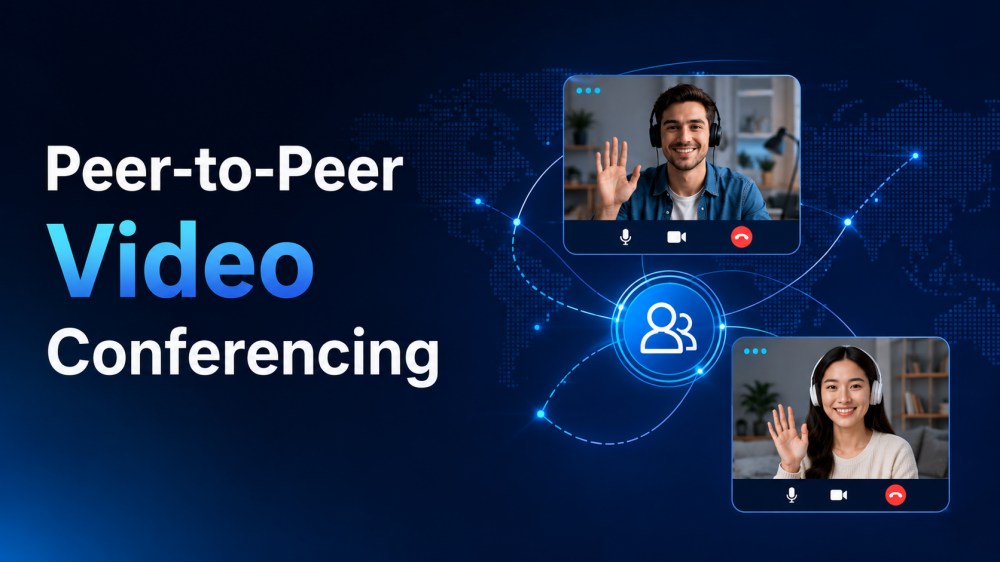
While virtual communication becomes central to how people work, learn, and collaborate, the need for video connections eventually grows. Here, peer-to-peer video conferencing serves as a solution for delivering real-time interactions with lower latency and improved performance. Additionally, from teams conducting daily meetings to educators holding live classes, this technology helps create better digital experiences. To introduce such direct connections on your platform, improve your knowledge with the article below.
What Is Peer-to-Peer Video Conferencing?
A peer-to-peer video call is a technology in which your device talks directly to the other person’s device, without sending audio and video through central servers first. It uses a browser technology called WebRTC to help 2 or more devices find each other on the internet. Moreover, the media goes directly between participants, often with lower latency, making group or one-on-one calls feel more natural.
However, P2P video conferencing also has its limits, especially as the number of people on a call grows. As you add more participants, each device must send and receive separate video or audio streams to each device. Due to this, a lot of internet bandwidth and processing power are being used. Just because of this, larger video meetings often use other architectures (like an SFU server) instead of P2P.
How Does Peer-To-Peer Video Conferencing Work?
To understand how peer-to-peer video chat delivers fast and reliable communications, look at the process involved behind it:
1. Get Permission for Camera and Mic
Your app will first ask if it can use your camera or microphone; this is the “Allow camera and mic” popup. Once you press “Allow,” the app starts capturing your live video and audio, which is ready to be sent. Behind the scenes, WebRTC uses this captured media as tracks that it will later attach to the connection between devices. However, if you click “Block,” the app cannot start a call.
2. Say “Hello” Using a Signaling Server
Next, your device needs to “introduce” itself to the other device, but at this point, they still cannot talk directly. Both devices send setup messages through a small helper server called the signaling server, which only passes messages without touching video. Now, one device creates an “offer,” and the other creates an “answer” to agree on common settings. When this offer-and-answer exchange is done, each peer is ready to connect directly.
3. Find the Best Path Through the Internet
After the handshake, each device tries to discover all possible paths to reach the other device across different networks. They gather “ICE candidates,” which are possible connection paths; local addresses, public addresses from routers, or paths through helper servers. Moreover, a STUN server helps each device learn its IP and port, which is needed when you’re behind a router.
4. Create a Direct Peer‑to‑Peer Connection
Once both sides have exchanged their ICE candidates, they start testing these possible routes to see which path works best. When a working route is found, WebRTC creates a secure, encrypted peer‑to‑peer video call between devices. Thus, the main job of the signaling server is finished; it is no longer in the media path. For a one‑to‑one call, this means a direct connection between you and the other person.
5. Send Video and Audio Between Peers
With the connection established, each device attaches its camera and microphone tracks to the peer-to-peer links and sends media packets. Therefore, your device receives the other person’s media packets, decodes them, and shows the video on your screen. Just because the media flows directly between devices, the delay (latency) is lower than with big central servers.
6. Keep the Call Alive and Handle Changes
During the call, networks can change; you might switch from WiFi to mobile data, and your signal can weaken. Plus, WebRTC keeps monitoring the connection quality and can switch to another ICE candidate path to find a working one. However, if the connection breaks, the peers restart the process to try to resolve the call without redialing.
Advantages and Disadvantages of Peer-to-Peer Video Conferencing
For better evaluation of peer-to-peer video conferencing, review both its strengths and limitations to determine whether it’s the right fit:
Advantages of Peer-to-Peer Video Conferencing
- Simple, direct connections between users and audio or video don’t go through central media servers.
- Often lower delay (latency) and smoother calls, because data travels directly between devices.
- Better call quality in the best case, with fewer bottlenecks and less packet loss.
- Lower cost for businesses, because they do not need to buy or maintain heavy server infrastructure.
- Media is more secure and can be end-to-end encrypted from one device to another.
Disadvantages of Peer-to-Peer Video Conferencing
- Puts load on user devices, handling encoding, decoding, encryption, and sending/receiving all media streams themselves.
- Call quality depends on each person’s device power and internet speed; weak internet and older phones can cause lag.
- Hard to scale to larger groups because each new participant adds more connections and bandwidth.
- Can lead to degraded performance and battery drain on low‑end devices during longer video calls.
- Complex to build from scratch, as handling WebRTC, signaling, NAT traversal, and connection management is difficult.
P2P Video Conferencing vs Cloud-Based Computing
A clear, concise comparison between peer-to-peer video chat and cloud-based computing highlights how different systems handle data flow:
| Key Considerations | P2P Video Conferencing | Cloud‑Based Video Conferencing |
|---|---|---|
| Media Path | Media goes directly from one user’s device to another (no central server). | It’s sent from each user to a cloud server, then to the participant. |
| Latency | Very low latency because there is no extra media hop. | Slightly higher but still low latency optimized by global servers. |
| Scalability | Does not scale well; each participant adds more connections and bandwidth. | Scales well because the cloud server handles routing. |
| Infrastructure Cost | Very low or zero server media costs. | Higher, because you pay for powerful cloud servers. |
| Reliability and Stability | More sensitive to weak user networks; quality is only as good as each person’s connection. | Stable overall; servers can smooth out differences in user networks. |
| Features | Convenient for one-to-one calls; features like recordings and large-scale moderation are harder. | Easier to add features like cloud rendering, moderation tools, and multi-room events. |
Benefits of P2P Video Conferencing for Your Business
Businesses today are constantly seeking communication solutions that are faster, more reliable, and cost-effective. In this context, a brief knowledge of peer-to-peer conferencing helps unlock the practical benefits it offers that improve daily operations:
- Lower Infrastructure and Cloud Costs: With P2P, media travels directly between users’ devices; thus, businesses don’t need powerful media servers to process. You only pay for light services like signaling and STUN/TURN, which help run many one-to-one calls much more cheaply.
- Better Call Quality and Lower Latency: Just because data does not go through a large central media server, P2P calls can have lower delay (latency). However, in good network conditions, employees and customers experience smoother video and clearer audio.
- Higher Privacy and Security Potential: In a P2P setup, there is no single central media server that sees every video and audio stream. This reduces the risk of that server being hacked or misused, making it easier to design systems with end-to-end media.
- Convenient for Small, High-Value Meetings: P2P works best for small meetings, usually from 1 to about 4 people in a conference. Hence, many business conversations are exactly this size, including customer support calls, client demos, or internal syncs.
- Faster Time to Market for Simple Apps: If your product only requires basic one‑to‑one or very small-group calls, a P2P architecture can be simpler to launch. Moreover, it helps businesses ship features faster and test video calling in their product with less up-front investment.
Business Use Cases for Peer-to-Peer Video Calls
Review this section to explore how peer-to-peer video chat helps different professional scenarios collaborate and connect directly:
- In‑App Customer Support Calls: Many apps let users start a live video call with support directly in the app, for example, to resolve account issues. With P2P, the call can be quick because the customer and support agent connect directly without sending videos over the server.
- One‑to‑One Sales and Demo Calls: Businesses can embed P2P video calls into their websites or mobile apps, allowing salespeople to talk face-to-face with leads. According to a report by GreetNow, about 70% of customers prefer to learn about products or services through video.
- Telehealth and Remote Consultations: Doctors, therapists, and other healthcare professionals can use P2P video calls for remote one‑to‑one consultations with patients. Moreover, a direct connection can help reduce latency and improve privacy when sharing personal medical information.
- Remote Interviewing and Hiring: HR teams and recruiters can use P2P video calls embedded in their hiring platform to interview candidates. This peer-to-peer video conferencing keeps each call lightweight and cost-effective, running many short interviews every week.
- Tutoring, Consulting, and In-App Coaching: Apps for online learning, language tutoring, fitness coaching, and personal consulting often rely on one-to-one sessions between coach and clients. Thus, P2P video calls are here because each session is small, high-value, and needs clear audio or video.
Top 6 P2P Video Conferencing Platforms
With an immense demand for more direct communication, businesses look for solutions built for efficiency. In this context, go through the top platforms for peer-to-peer video chat that deliver both strong performance and better connectivity:
1. ZEGOCLOUD

ZEGOCLOUD improves peer-to-peer communication by providing direct, low-latency audio and video connections between users. Its real-time technology enables smooth interactions for online meetings, customer support, virtual consultations, and remote collaboration. This platform also offers reliable connectivity, adaptive network performance, and flexible SDK integration. Besides, these features help developers quickly build secure and efficient communication applications that deliver stable conferencing experiences across web, mobile, and desktop platforms.
2. Retroshare

Retroshare is a free, open-source communication platform that uses a fully peer-to-peer, friend-to-friend network, including voice and video calling. When you make a video call in Retroshare, your device connects directly to your friend’s device over an encrypted connection. Plus, there is no company server to record or inspect it, and all calls are protected by strong encryption.
3. Whereby

Whereby is a browser-based video meeting platform that uses WebRTC and a hybrid design, relying on peer-to-peer video conferencing. In a typical one-to-one or very small call, your computer connects directly to the other person’s computer, improving call quality. However, if more people join or you run a larger session, the call automatically switches to server-cloud (SFU) mode.
4. Twilio Video

Another developer platform, Twilio, that lets you add real-time video calling to your app, includes peer‑to‑peer (P2P) rooms as one of its options. In a Twilio P2P or “Go” room, participants’ browsers or mobile apps send their audio and video directly to each other. However, its servers mainly handle signaling and room management, while media streams remain end-to-end encrypted between participants.
5. GetStream Video

GetStream Video is built on WebRTC, so it can support peer‑to‑peer style connections when that makes sense. In very small rooms, the architecture can be configured to enable participants to exchange media directly between their devices. If your app will always have a small, fixed number of participants per call, the platform will guide you through setup.
6. Tox Chat

Tox Chat is built as a peer-to-peer video calling system, which means your device connects directly to your contact’s device. When you start a video call in a Tox client, the app sets up an encrypted P2P connection. All video and audio are end‑to‑end encrypted using the Tox protocol, so only the people on the call can access them.
How to Build a P2P Video Conferencing Platform with ZEGOCLOUD
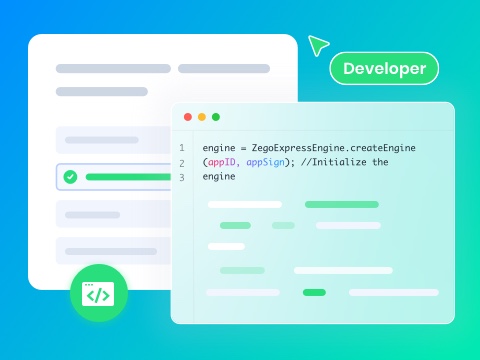
To build a peer-to-peer video chat platform with ZEGOCLOUD, incorporate its WebRTC-based video call SDKs. Simply, you set up its app, connect to its APIs, create user logins, and let the SDK manage call setup. Moreover, it’s useful for P2P-style one-to-one or very small calls because ZEGOCLOUD supports direct call scenarios and cross-platform apps. Plus, it’s readymade 20 UIKits support low-latency communication, making development much faster.
Regarding video conferencing, it supports network adaptation and the WebRTC features required for real-time audio and video exchange. Additionally, the platform helps with signaling, connection stability, and handling weak networks, so developers can focus on their app design. It delivers ultra-low latency with an average delay of around 300ms for video calls under 1 second. Offers built-in handling of weak networks and packet loss, using adaptive bitrate and smart routing.
Conclusion
In conclusion, currently, peer-to-peer video conferencing has become an essential part of digital communications, offering more effective ways to connect. Moreover, businesses that continue to prioritize virtual communication should invest in the right video conferencing architecture to create a strong foundation. For organizations planning to build their solution, use ZEGOCLOUD boundless UIKits, which offer unlimited customization and high-quality conferencing experiences.
FAQ
Q1: Is peer-to-peer video conferencing secure?
Peer-to-peer video conferencing can be secure when encryption protocols like SRTP and DTLS are used. However, security still depends on signaling protection, authentication, and network configuration.
Q2: What are the limitations of peer-to-peer video conferencing?
P2P video conferencing can struggle with large group calls, unstable mobile networks, and high bandwidth usage because each participant must manage multiple direct connections.
Q3: When should you use peer-to-peer video conferencing?
Peer-to-peer video conferencing is best for one-to-one calls, small meetings, and low-latency communication scenarios where reducing server costs is important.
Let’s Build APP Together
Start building with real-time video, voice & chat SDK for apps today!