Talk to us
Talk to us
menu

What is OTT Streaming?

What is OTT Streaming?

Over the past decade, OTT streaming has evolved from a simple alternative to cable television into a core infrastructure for global video delivery. Today, OTT streaming platforms support live events, on-demand libraries, enterprise broadcasts, online education, and interactive experiences across web, mobile, and connected TV devices.

From a developer perspective, OTT streaming is no longer only about delivering video files efficiently. It is about building a scalable streaming system that balances playback quality, latency, monetization, analytics, and user interaction.

This article explains what OTT streaming means, how OTT streaming platforms work at a technical level, the monetization models they support, and how OTT streaming architecture is evolving to meet modern application requirements.

What is OTT Streaming?

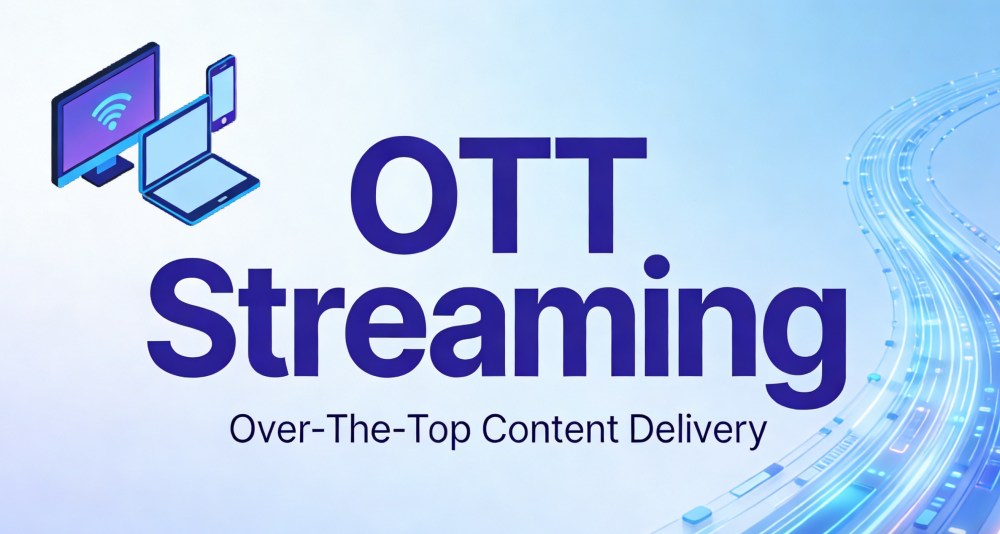
OTT stands for “Over the Top” and refers to the delivery of video and media content directly over the internet, without relying on traditional cable, satellite, or broadcast infrastructure.

OTT platforms allow users to access content on demand or in real time through connected devices such as browsers, smartphones, smart TVs, and streaming boxes. Instead of fixed broadcast schedules, users control when and where they watch content.

While OTT streaming originally described consumer-focused video services, its scope has expanded significantly. Today, OTT represents a complete streaming ecosystem that includes:

  • Live and on-demand video delivery
  • Cloud-based video processing and storage
  • Content delivery networks
  • Cross-device video playback
  • Monetization and analytics systems

By 2026, OTT will have become a professional streaming framework used by media companies, enterprises, educators, sports organizations, and event producers worldwide.

How OTT Streaming Platforms Work

OTT streaming platforms rely on internet protocols rather than broadcast signals to deliver video at scale. Most modern OTT systems use adaptive bitrate streaming and distributed delivery infrastructure to ensure stable playback across devices and network conditions.

At a system level, a typical OTT workflow includes the following stages.

1. Content Ingestion and Encoding

Live or pre-recorded video is ingested into the platform and encoded into multiple bitrate and resolution profiles. This enables playback systems to switch video quality dynamically based on device performance and network conditions.

Encoding pipelines often run in cloud environments to support parallel processing and rapid scaling during traffic spikes.

2. Adaptive Bitrate Streaming

Adaptive bitrate streaming allows video players to adjust quality in real time. When bandwidth drops, the player switches to a lower profile to prevent buffering. When conditions improve, higher quality streams are selected automatically.

Advanced platforms apply AI-driven optimization to anticipate network changes and improve overall playback quality.

3. Streaming Protocols

OTT streaming relies primarily on HTTP-based protocols for compatibility and scalability. Commonly used protocols include HLS, MPEG-DASH, CMAF, and low latency variants designed to reduce end to end delay.

For scenarios that require near real-time interaction, some OTT architectures integrate real-time communication protocols alongside traditional streaming delivery.

4. Content Delivery Networks

CDNs distribute video segments through geographically distributed edge servers. Multi-CDN strategies are now common and allow platforms to route traffic based on performance, cost, and regional demand.

Efficient CDN routing plays a key role in reducing latency, improving startup time, and maintaining consistent playback quality.

5. Playback and Client Delivery

Video content is delivered to users through HTML5-based players or native application SDKs. These players handle adaptive playback, subtitles, digital rights management, analytics reporting, and monetization logic.

Cross-platform consistency is critical, especially for applications targeting web, mobile, and connected TV environments.

6. Analytics and Optimization

Modern OTT platforms collect real-time playback data to monitor performance and user behavior. Metrics such as startup time, buffering frequency, bitrate switches, and session duration are used to optimize delivery and improve user experience.

Client Media Common Data provides a standardized way for players to share playback telemetry with CDNs and streaming platforms without relying on proprietary systems.

Device Compatibility and OTT Application Ecosystems

One of the defining strengths of OTT streaming is device flexibility. In 2026, device support is not only a technical requirement but a core product decision.

OTT platforms are designed to support consistent playback across:

  • Desktop and mobile browsers
  • iOS and Android devices
  • Smart TVs and connected TV platforms
  • Streaming boxes and gaming consoles

This compatibility is achieved through standardized protocols, adaptive streaming logic, and flexible client SDKs that adapt to hardware capabilities and network conditions.

Benefits of Modern OTT Platforms

Modern OTT platforms offer more than video playback. They provide a unified streaming environment that integrates delivery, monetization, analytics, and security.

advantages of ott platform

1. Global Reach Across Devices

OTT platforms enable content distribution without dependence on specific network providers. This allows developers to target global audiences while maintaining consistent playback behavior across devices.

2. Playback Optimization

Adaptive streaming minimizes buffering and playback interruptions, particularly during high-traffic live events or in regions with unstable connectivity.

3. Content Control and Branding

Professional OTT solutions allow full control over branding, player behavior, access rules, and distribution channels. Content owners retain ownership of user data and viewing environments.

4. Flexible Monetization

OTT platforms support subscription access, advertising, transactional viewing, and hybrid combinations. Developers can experiment with pricing strategies and adapt to audience behavior.

5. Integrated Analytics

Built-in analytics provide insight into engagement, retention, playback performance, and geographic distribution. These metrics inform product decisions and revenue optimization.

6. Security and Access Management

Security mechanisms such as tokenized playback, domain restrictions, password protection, and DRM help protect premium and private content.

7. API and Workflow Integration

Modern OTT platforms expose APIs that integrate with existing systems, enabling automated publishing, content management, and monetization workflows.

OTT Monetization Models and Platforms

OTT platforms support multiple service and revenue models. Many organizations combine several approaches within a single platform.

Subscription Video on Demand

  • Users pay recurring fees to access a content library.
  • Common use cases include entertainment catalogs, training programs, and membership-based services.
  • This model provides predictable revenue and encourages long-term engagement.

Advertising Supported Video on Demand

  • Content is offered free or at a reduced cost and monetized through ads.
  • Ads can appear before, during, or after playback.
  • Server-side ad insertion is often used to avoid playback disruption.

Transactional Video on Demand

  • Users pay for individual assets or live events.
  • Common scenarios include sports events, virtual conferences, and time-sensitive releases.
  • This model allows precise control over pricing and access.

FAST Channels

  • Scheduled programming is delivered over the internet with ad-based revenue.
  • Content follows a linear format rather than an on-demand playback format.
  • This approach is often used to monetize existing content libraries.

Hybrid Monetization

  • Hybrid setups allow platforms to adapt to different user behaviors.
  • Multiple revenue models are combined within a single service.
  • Examples include subscription access with ad-supported tiers or paid live events followed by free replays.

From Traditional OTT to Interactive Streaming

Traditional OTT architectures focus on one-way content delivery. However, modern OTT streaming applications increasingly require user participation rather than passive viewing.

Modern OTT platforms are integrating interactive features such as:

  • Live host and guest participation
  • Audience messaging and reactions
  • Virtual events and social viewing
  • AI-driven presenters and assistants

These scenarios require low-latency communication layers that operate alongside standard streaming delivery rather than replacing it.

How OTT is Reshaping Media and Entertainment

OTT has changed the media and entertainment industry at a structural level. It has not only altered how video is delivered, but also how content is produced, monetized, measured, and optimized. What started as an alternative distribution method has become a core infrastructure used by broadcasters, publishers, and independent creators.

From a technical perspective, OTT replaces fixed broadcast pipelines with software-driven systems that are easier to scale, observe, and iterate. This shift affects every stage of the media lifecycle.

1. From Linear Scheduling to On-Demand Access

Traditional media distribution depends on fixed schedules and broad audience assumptions. OTT platforms move control to the viewer by supporting on-demand access, flexible playback, and viewing across devices.

This change has raised expectations. Users now expect instant playback, consistent behavior across web, mobile, and TV environments, and recommendations based on their viewing history rather than general programming rules.

As a result, content strategies have shifted toward digital-first delivery. OTT platforms are no longer secondary channels. They are the primary entry point where content is released, updated, and tested.

2. Data as the Basis for Content Decisions

A key difference between OTT and traditional broadcasting is data visibility. OTT platforms expose detailed information about how users interact with content, including viewing duration, engagement patterns, playback issues, and drop-off points.

These signals influence decisions throughout the content pipeline. Teams use analytics to adjust content libraries based on actual usage, identify where users disengage, and test new formats or pricing models with measurable outcomes.

For developers, this creates a continuous feedback loop where delivery systems, players, and analytics are tightly connected rather than isolated components.

3. AI and Automation in Media Workflows

OTT has accelerated the use of AI and automation across media workflows. AI systems are commonly used for content tagging, recommendation logic, subtitle generation, translation, and playback optimization.

Automation also supports scheduling, distribution, and monetization processes. These tools reduce manual work and allow teams to manage large content libraries and multiple delivery channels more efficiently.

From an engineering standpoint, this trend increases the importance of reliable data pipelines and backend services that can adapt as content volume and audience size grow.

4. Changes in the Creator and Rights Ecosystem

OTT lowers the barrier for creators and rights holders to reach global audiences without relying on traditional broadcasters. This has enabled direct distribution models and services focused on specific regions, topics, or communities.

At the same time, established media companies use OTT platforms to extend the lifespan of existing content, reuse archives, and experiment with new formats without rebuilding their entire delivery stack.

OTT now acts as a shared layer where different production and distribution models coexist rather than compete.

5. Beyond Entertainment Use Cases

OTT is no longer limited to entertainment content. Organizations use OTT platforms for internal communication, training, live events, and controlled content access.

These scenarios place stronger emphasis on access control, branding consistency, and predictable performance instead of maximum audience reach. As a result, OTT has become a general streaming framework that supports a wide range of professional use cases.

The Future of OTT Streaming

OTT streaming continues to evolve beyond on-demand video. It is becoming a flexible and data-driven system that supports new distribution models, revenue structures, and forms of user interaction. The future of OTT is shaped less by individual platforms and more by how streaming technologies align with infrastructure choices, business goals, and changing user expectations.

From a development perspective, this evolution reflects a shift toward systems that can adapt in real time rather than rely on static delivery pipelines.

1. AI-Driven Personalization and Automation

AI is becoming a central part of how OTT platforms operate. It is widely used for content discovery, recommendation logic, automated tagging, subtitle generation, and language translation. These capabilities improve accessibility and reduce the effort required for users to find relevant content.

Automation also plays a growing role behind the scenes. It simplifies content scheduling, quality monitoring, and performance optimization. As content libraries expand, automated workflows reduce operational complexity while allowing personalization to scale across large audiences.

For developers, this trend places greater emphasis on data processing pipelines that can support continuous analysis and adaptive behavior.

2. Edge Delivery and Low Latency Streaming

As live and interactive content becomes more common, latency has become a key technical concern. OTT platforms are increasingly adopting edge-based delivery approaches that move processing closer to the user.

Reducing the distance between users and the streaming infrastructure helps lower delay and improve playback stability. This shift supports use cases such as live sports, online auctions, interactive events, and real-time collaboration, where even small delays can affect engagement and outcomes.

From a system design standpoint, this change encourages hybrid architectures that combine traditional streaming delivery with communication layers designed for near real-time interaction.

3. Efficiency and Sustainable Streaming Infrastructure

The growth of streaming has increased attention on energy usage and infrastructure efficiency. As a result, sustainability has become an important consideration in OTT system design.

Techniques such as more efficient encoding, smarter CDN routing, and adaptive delivery reduce data transfer and infrastructure load. These optimizations lower operating costs while supporting more responsible scaling of streaming services.

For engineering teams, efficiency is no longer only about performance but also about long-term resource management.

4. Expansion of Enterprise and Professional OTT

OTT is no longer limited to entertainment audiences. Organizations in education, sports, and events are building dedicated OTT services for both internal and external use.

This shift reflects a broader move toward owned streaming systems where control over branding, access, data, and monetization is prioritized. Rather than relying entirely on public platforms, organizations are developing their own distribution environments that fit specific operational needs.

These use cases reinforce OTT as a general streaming framework rather than a single-market solution.

5. Emerging Monetization and Access Models

Revenue strategies continue to diversify. Alongside subscriptions and advertising, OTT platforms are experimenting with mixed access models, flexible pricing, and event-based monetization.

As audience behavior becomes more fragmented, adaptable monetization systems allow content owners to respond quickly and test new approaches without restructuring their entire platform. From a technical standpoint, this requires billing, access control, and analytics systems that can evolve alongside content strategies.

How ZEGOCLOUD Supports Interactive OTT Streaming

ZEGOCLOUD supports OTT streaming platforms by providing a low-latency real-time communication infrastructure designed for interactive video applications. It enables developers to add live audio and video interaction to existing OTT workflows without redesigning their streaming architecture.

Common use cases include multi-host live streaming, audience participation, real-time commentary, and AI-powered interactive experiences. ZEGOCLOUD SDKs support web, mobile, and connected devices, allowing OTT platforms to scale interaction alongside content delivery while maintaining stable performance and global reach.

Conclusion

OTT streaming has evolved into a core foundation for modern video applications. What began as a way to distribute on-demand content has grown into a flexible streaming framework that supports live delivery, interaction, monetization, and data-driven optimization across devices and use cases.

For developers, building OTT streaming platforms is no longer just about video playback. It involves designing systems that balance delivery quality, latency, analytics, security, and user engagement while remaining adaptable to changing product and business requirements.

As OTT continues to expand beyond entertainment into education, events, and professional communication, the ability to combine scalable streaming delivery with real-time interaction becomes increasingly important. Platforms that integrate these capabilities can move from passive viewing experiences toward more engaging and responsive applications.

Understanding how OTT streaming works at a technical level provides a clearer path for building systems that are resilient, extensible, and ready for future demands.

FAQ

Q1: What is streaming in OTT?

Streaming in OTT refers to delivering video content over the internet using streaming protocols rather than traditional broadcast or cable networks. It allows users to watch content in real time or on demand across connected devices without downloading full video files.

Q2: What is OTT in streaming?

OTT in streaming describes a distribution model where video content is delivered directly to users over the internet. It relies on technologies such as adaptive bitrate delivery, content delivery networks, and media players to ensure consistent playback across devices and network conditions.

Q3: Is Netflix an OTT service?

Yes. Netflix is an example of an OTT service because it delivers video content directly to users over the internet without relying on traditional cable or broadcast infrastructure.

Q4: What does an OTT platform do?

An OTT platform manages the full streaming workflow, including content ingestion, encoding, delivery, playback, monetization, analytics, and access control. It enables content owners to distribute video at scale while maintaining control over user experience and data.

Let’s Build APP Together

Start building with real-time video, voice & chat SDK for apps today!

Talk to us

Take your apps to the next level with our voice, video and chat APIs

Free Trial
  • 10,000 minutes for free
  • 4,000+ corporate clients
  • 3 Billion daily call minutes

Stay updated with us by signing up for our newsletter!

Don't miss out on important news and updates from ZEGOCLOUD!

* You may unsubscribe at any time using the unsubscribe link in the digest email. See our privacy policy for more information.