Talk to us
Talk to us
menu

Media Over QUIC: How It Works & When to Use It

Media Over QUIC: How It Works & When to Use It

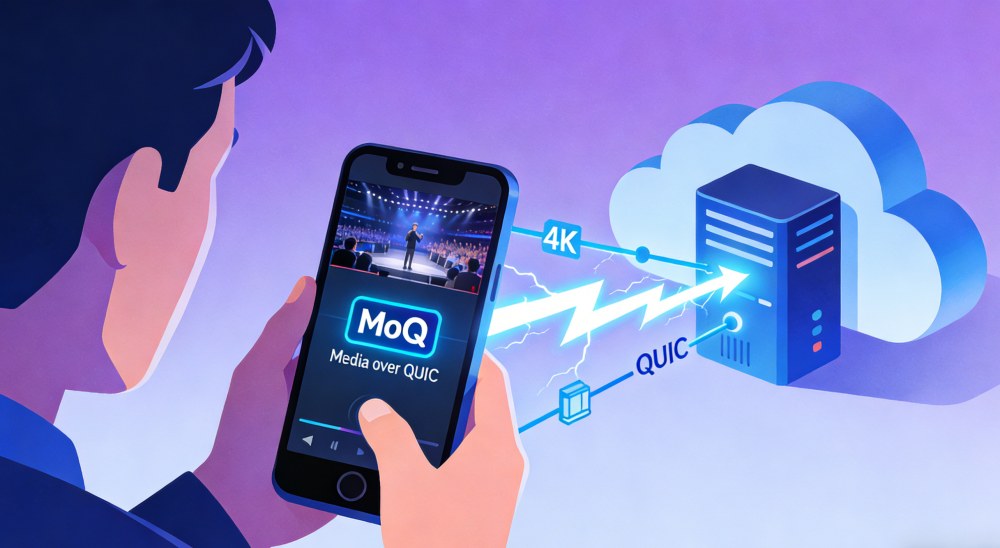
Media over QUIC, or MoQ, is an emerging media transport protocol designed for low latency and scalable media delivery. It builds on modern web transport technologies and targets live and interactive streaming scenarios that struggle with traditional approaches. As real-time media applications grow in scale and complexity, existing protocols often face limits in latency, reliability, or operational cost. MoQ introduces a new way to deliver media streams efficiently across changing network conditions.

What is MoQ?

MoQ is a media transport protocol that focuses on streaming audio and video as real-time data flows rather than static files. It aims to deliver media with low latency while supporting large audiences and flexible playback behavior.

Instead of optimizing for peer-to-peer interaction, MoQ treats media delivery as a transport and distribution problem. This design allows applications to handle live playback, delayed viewing, and replay scenarios within a single system.

MoQ fits use cases where one or a few publishers send media to many consumers and where consistent performance matters more than direct interaction between all participants.

What is QUIC?

QUIC, short for Quick UDP Internet Connections, is a transport protocol originally developed by Google and later standardized by the IETF. It runs over UDP and addresses several limitations found in TCP-based protocols such as HTTP/2.

Traditional TCP connections introduce higher connection overhead and suffer from head-of-line blocking. They also recover slowly under unstable network conditions. QUIC improves connection setup time, supports true multiplexing without blocking, and applies more advanced congestion control.

These characteristics make QUIC a strong foundation for modern media delivery, especially for applications that require low latency and stable real-time communication.

Why MoQ Uses QUIC?

MoQ builds on QUIC to take advantage of its transport-level improvements. By using QUIC, MoQ avoids many issues that appear in TCP-based streaming systems under real-world network conditions.

QUIC allows multiple media streams to share a single connection without blocking each other. It also handles network changes more gracefully, such as IP address switches between mobile and Wi-Fi networks. These behaviors help MoQ maintain stable playback and predictable latency.

By combining QUIC with WebTransport and modern browser APIs, MoQ aligns media delivery with how the web platform continues to evolve.

How MoQ Works?

MoQ runs over QUIC and WebTransport to deliver media streams efficiently. Publishers send media data as streams, while consumers receive and render those streams in near real time.

The protocol avoids session-based negotiation and focuses on continuous media delivery. This approach reduces startup delay and improves time to first frame. It also allows applications to prioritize important media tracks and adapt to network conditions dynamically.

Because MoQ treats media as streams rather than calls, it supports live playback, delayed viewing, and replay without switching protocols.

Key Advantages of MoQ

MoQ was designed to address the limitations of existing media delivery protocols under real-world network conditions. Its advantages focus on reducing latency, improving reliability, and supporting scalable media experiences without adding unnecessary complexity.

1. Lower Latency

The protocol reduces end-to-end latency compared to traditional large-scale streaming solutions. It maintains low delay while supporting standardized playback features.

2. Stable Connections

QUIC allows MoQ to keep connections alive during network changes. This improves playback stability and reduces interruptions for end users.

3. Stream Multiplexing

Multiple media streams can travel over a single connection without interfering with each other. Applications can also prioritize critical streams when needed.

4. Improved Packet Loss Handling

This approach adapts retransmission behavior based on real-time network conditions. This helps preserve media quality in less reliable environments.

5. Scalability

MoQ was designed to support large audiences from the start. Its architecture handles growth more naturally than session-based real-time protocols.

6. Media Flexibility

MoQ supports live playback, delayed viewing, and replay within one delivery model. It also works with different codecs and integrates well with WebCodecs.

MoQ vs WebRTC

MoQ and WebRTC often appear together in discussions about low-latency media, but they solve different problems.

WebRTC was designed for real-time interaction. It excels in scenarios where participants actively talk, respond, and exchange media. Video calls, voice chat, and collaborative tools fit this model well.

MoQ focuses on scalable media delivery. It aims to deliver media streams efficiently to many users while keeping latency low and behavior predictable. This makes it better suited for live streaming and broadcast-style experiences.

In-depth Comparison: MoQ vs WebRTC

DimensionWebRTCMoQ
Core design intentReal-time interaction between participantsLow-latency media distribution at scale
The higher the audience growsHow users talk to each other in real timeThe primary problem it solves
Connection modelSession-oriented communicationStream-oriented media delivery
Typical latency focusLowest possible peer-to-peer delayConsistent low latency across large audiences
Startup behaviorRequires negotiation before media flowsFaster startup due to simpler transport
Scaling approachScales with SFU-based architecturesDesigned to scale by default
Operational complexityCalls, meetings, gaming, and collaborationLower for large-scale delivery
Media flexibilityBest for live interaction onlySupports live, replay, and delayed viewing
Browser support todayFully supported and production-readyEmerging support based on modern web APIs
Best fit scenariosCalls, meetings, gaming, collaborationLive streaming, events, interactive broadcasts
Long-term roleStable foundation for real-time communicationFuture-facing transport for scalable media

When to Use MoQ vs WebRTC

MoQ and WebRTC serve different purposes in real-time media systems, and choosing the right one depends on whether interaction or distribution is the primary requirement.

When to Use WebRTC

Use WebRTC when direct interaction is the core requirement. It works best for video calls, voice chat, online meetings, and collaborative tools where participants actively communicate with each other.

When to Use MoQ

Use this approach when low-latency media delivery to many users is the primary goal. It fits live streaming, large virtual events, interactive broadcasts, live commerce, and scenarios that require replay or delayed viewing.

When to Use Both Together

Many modern platforms combine both technologies. WebRTC handles interaction for hosts or participants, while MoQ delivers streams efficiently to large audiences. This approach balances interactivity with scalability.

Future of MOQ

MoQ remains under active development and has not reached full standardization yet. The protocol aims to support both browser and non-browser endpoints while improving scalability and efficiency.

Developer communities and major industry players continue to invest in MoQ-related tooling and experimentation. As the ecosystem matures, MoQ may become a core building block for large-scale real-time media delivery.

Conclusion

Media over QUIC introduces a new way to approach real-time media delivery by focusing on scalable streams rather than session-based communication. It complements existing technologies instead of replacing them, especially in systems that need both interaction and efficient distribution.

WebRTC remains the best choice for real-time communication between participants. MoQ addresses a different challenge by enabling low-latency media delivery to large audiences with more predictable performance. Understanding the design goals behind each protocol helps teams choose the right tool for each part of their system.

From an industry perspective, real-time platforms increasingly separate interaction from distribution to improve scalability and user experience. As a real-time communication infrastructure provider, ZEGOCLOUD follows this evolution closely and explores how emerging protocols like MoQ can work alongside established real-time technologies in production environments.

Let’s Build APP Together

Start building with real-time video, voice & chat SDK for apps today!

Talk to us

Take your apps to the next level with our voice, video and chat APIs

Free Trial
  • 10,000 minutes for free
  • 4,000+ corporate clients
  • 3 Billion daily call minutes

Stay updated with us by signing up for our newsletter!

Don't miss out on important news and updates from ZEGOCLOUD!

* You may unsubscribe at any time using the unsubscribe link in the digest email. See our privacy policy for more information.