










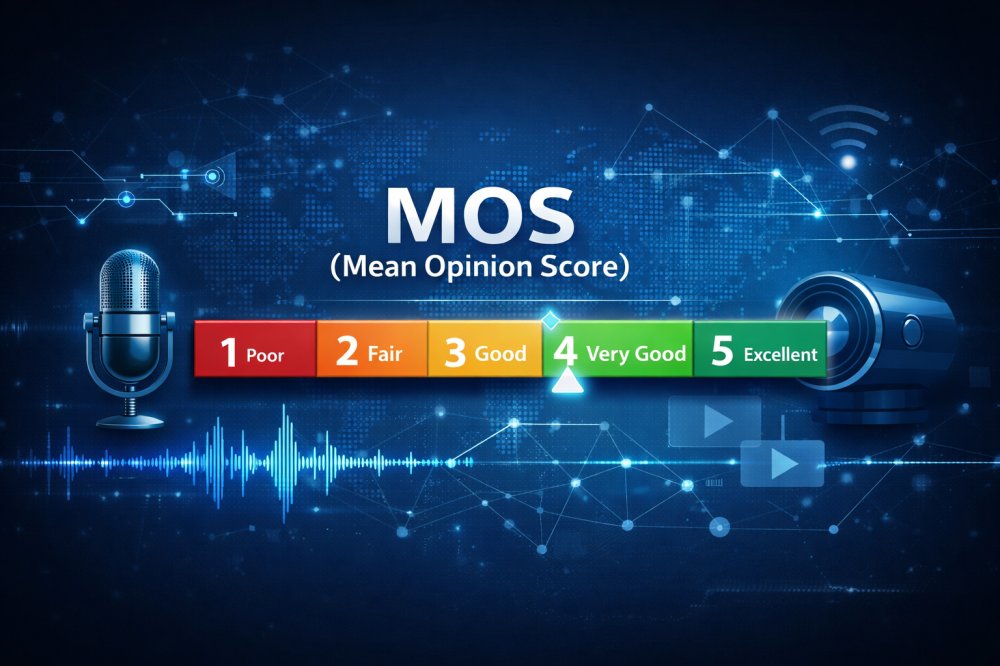
In voice and video communication systems, technical indicators such as bitrate or bandwidth do not fully represent user experience. A connection may appear stable at the network level while users still perceive distortion or delay. To bridge this gap between measurable metrics and perceived quality, the industry relies on MOS, or Mean Opinion Score.
What is MOS?
MOS, short for Mean Opinion Score, is a standardized metric used to represent perceived audio or video quality. The score typically ranges from 1 to 5, where 1 indicates poor quality and 5 indicates excellent quality.
Originally, this score was derived from controlled listening or viewing tests. Participants evaluated communication sessions in quiet environments and rated their experience. The final MOS was calculated as the average of these human ratings.
Today, MOS is most often estimated using objective models that approximate human perception. These models analyze measurable parameters such as packet loss, latency, jitter, and distortion, then map them to a predicted quality score that reflects expected user experience.
Where is MOS Commonly Used?
MOS is widely used in digital communication and media systems where perceived quality matters. It is applied when evaluating audio codecs such as MP3, AAC, and Opus, as well as video codecs like H.264, H.265, and VP8. In streaming and real-time communication environments, the metric helps measure how network conditions affect call quality. It is also commonly used in text-to-speech development to compare model performance and track improvements across versions.
Because MOS reflects perception rather than raw performance, it is particularly valuable in real-time voice and video systems.
How is MOS Determined for Audio and Video?
Historically, MOS was determined through subjective testing. Panels of listeners or viewers rated audio or video samples under controlled conditions. These tests formed the basis of early quality standards.
Modern systems rely on objective measurement models. Standards such as ITU-T P.800 describe methodologies for subjective and objective voice quality assessment. ITU-T P.863, also known as POLQA, is commonly used for speech evaluation, while recommendations such as ITU-T J.247 address video quality.
The most widely adopted rating scale is the Absolute Category Rating scale, which ranges from 1 to 5:
5 – Excellent
4 – Good
3 – Fair
2 – Poor
1 – Bad
In practical deployments, a MOS between 4.3 and 4.5 is generally considered an excellent target. When the rating falls below approximately 3.5, quality degradation becomes noticeable. Scores under 3.0 typically indicate unacceptable communication quality.
What Causes a Low MOS in Real-Time Calls?
Quality degradation can occur at multiple points in the communication chain, from capture devices to playback hardware. However, network-related factors are the most common and measurable causes.
Packet loss removes portions of audio or video data, leading to missing words or frozen frames. Jitter causes irregular packet arrival times, which may result in distortion or uneven playback. Latency increases conversational delay, reducing natural interaction flow. Poor codec configuration or insufficient bandwidth can further reduce clarity.
Because these factors are quantifiable, real-time monitoring systems can estimate MOS dynamically and detect issues before they escalate.
How to Improve MOS in Real-Time Communication Systems
Improving MOS requires addressing both network conditions and system design.
Reducing packet loss through optimized routing and adaptive bitrate strategies can significantly enhance perceived quality. Minimizing jitter and latency by using real-time transmission protocols and deploying geographically distributed infrastructure improves conversational flow.
Efficient codec selection and proper encoding configuration also contribute to clarity and stability. Continuous monitoring of performance metrics such as round-trip time, packet loss rate, and jitter allows teams to adjust system parameters proactively.
Maintaining a high score is not solely about increasing bandwidth. It requires balanced optimization across infrastructure, encoding, and network management.
Real-Time MOS Monitoring in ZEGOCLOUD SDK
Starting from version 2.16.0, ZEGOCLOUD RTC SDK provides a MOS field in the onPlayerQualityUpdate callback. This value represents a real-time estimation of audio playback quality, allowing developers to monitor perceived sound performance during live streaming or real-time communication sessions.
The MOS value ranges from -1 to 5. A value of -1 indicates that the score cannot be calculated, typically due to abnormal playback conditions. Values between 0 and 5 represent valid quality estimates.
Perceived audio quality generally corresponds to the following ranges:
- 4.0 to 5.0 indicates clear and stable audio quality.
- 3.5 to 4.0 indicates good quality with minor distortion.
- 3.0 to 3.5 indicates average quality with occasional interruptions.
- 2.5 to 3.0 indicates noticeable degradation.
- 2.0 to 2.5 indicates poor clarity and reduced intelligibility.
- 0 to 2.0 indicates severe distortion and communication breakdown.
By combining MOS monitoring with network quality metrics, developers can better understand how real-time conditions influence user perception and adjust system performance accordingly.
Conclusion
MOS remains one of the most practical indicators of perceived audio and video quality. Although it originated from subjective human evaluation, modern objective models allow scalable estimation in real-time systems.
For teams building voice or video applications, tracking the quality score alongside measurable network metrics provides actionable insight into user experience. Maintaining a consistently high MOS score is not only a technical objective but also a direct indicator of communication reliability and user satisfaction.
FAQ
Q1: What is a good MOS score?
A good MOS score depends on the use case, but in real-time voice and video communication, a score above 4.0 is generally considered high quality. In many production environments, a MOS between 4.3 and 4.5 is viewed as excellent. When the score drops below approximately 3.5, users typically begin to notice degradation. Values under 3.0 usually indicate unacceptable communication quality.
Q2: What is the DMOS score?
DMOS stands for Degradation Mean Opinion Score. Unlike MOS, which measures absolute perceived quality, DMOS measures the perceived difference between a reference signal and a processed signal. It is commonly used in testing scenarios to evaluate how much quality has been lost due to compression, transmission, or other processing steps.
Q3: How is MOS (Mean Opinion Score) calculated?
Originally, MOS was calculated by averaging scores given by human listeners or viewers who evaluated audio or video samples under controlled conditions. Each participant rated quality on a scale from 1 to 5, and the final MOS was computed as the mean of all responses. Today, most systems estimate MOS using objective algorithms that analyze measurable factors such as packet loss, latency, jitter, and distortion to approximate human perception.
Q4: What is the range of MOS scores?
The standard MOS scale ranges from 1 to 5, where 1 represents poor quality and 5 represents excellent quality. In real-time communication systems, scores typically fall between 2.5 and 4.5. Values above 4.0 indicate strong perceived quality, while scores below 3.0 suggest significant degradation.
Let’s Build APP Together
Start building with real-time video, voice & chat SDK for apps today!
