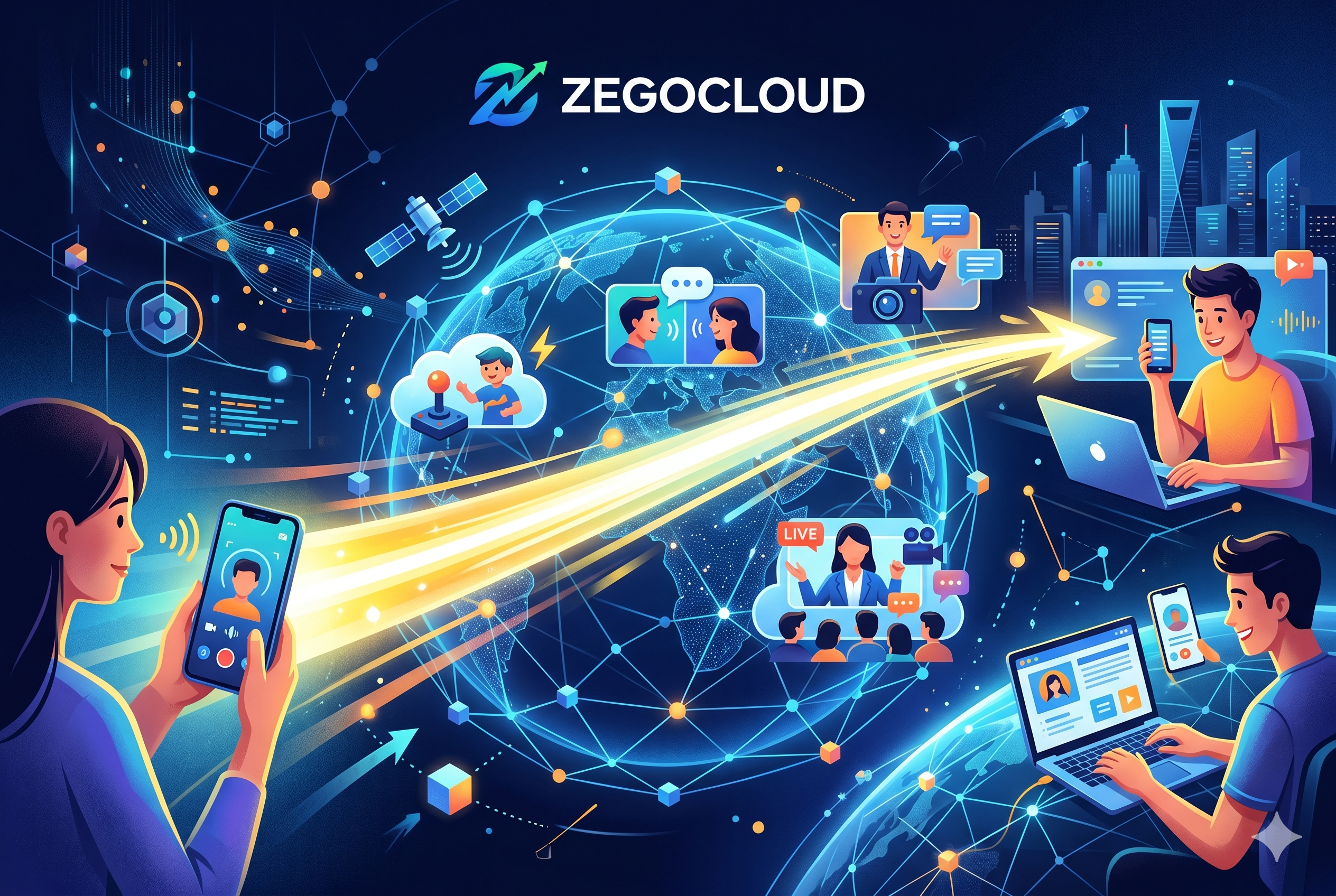
Real-time communication used to be a niche requirement reserved for gaming or video conferencing. Today, it sits at the center of almost every modern digital experience.
Voice AI agents respond conversationally. Live shopping platforms depend on instant audience interaction. Multiplayer social apps require synchronized audio and video. Remote collaboration tools now compete on responsiveness as much as features.
According to Grand View Research, the global conversational AI market is projected to continue growing rapidly over the next decade, driven largely by demand for real-time customer interaction. At the same time, studies from Google have repeatedly shown that even small delays in digital experiences can significantly reduce user engagement and retention.
In the hyper-competitive digital landscape of 2026, “instant” is no longer a feature—it is a requirement. As real-time interactions move from simple text to high-definition video and AI-driven voice, the technical challenge shifts to one critical metric: End-to-End (E2E) Latency. That’s why more teams are now trying to reduce real-time app latency before scaling products globally.
The Industry Reality: Why Every Millisecond Counts
The demand for real-time engagement is surging. According to Fortune Business Insights, the global WebRTC market is projected to reach $13.07 billion in 2026, growing at an explosive CAGR of 32.21%. This growth is fueled by a shift where 92% of internet users now consume digital video, and nearly 30% engage with live-streaming weekly.
However, with increased volume comes increased scrutiny. A 2025 report by Ericsson ConsumerLab revealed that 68% of cloud gamers rank latency as their single most important satisfaction driver. In the B2B sector, PwC’s Global Telecom Outlook highlights that as 5G-Advanced rolls out, the “gold standard” for interactive realism has dropped below the 100ms threshold.
Latency Thresholds & User Impact
| Latency Range | Experience Level | Typical Use Case | User Sentiment |
| < 50ms | Ultra-Low | Cloud Gaming, Remote Surgery | “Imperceptible” |
| 50ms – 150ms | Real-Time | 1-on-1 Video, Voice AI | “Natural & Fluid” |
| 150ms – 300ms | Near Real-Time | Global Conferencing | “Noticeable but usable” |
| > 400ms | High Latency | Social Live Streaming | “Frustrating / Unusable” |
What Actually Causes Latency in Real-Time Apps
Latency in modern applications is rarely caused by a single bottleneck.
Instead, it accumulates across an entire delivery chain.
A typical real-time interaction pipeline
| Stage | Potential Latency Source |
| Audio/video capture | Device processing |
| Encoding | Compression overhead |
| Network transmission | Physical distance |
| Routing | Congested network paths |
| Server processing | Business logic / AI inference |
| Packet recovery | Jitter & loss handling |
| Decoding & playback | Rendering delay |
The hidden complexity of “real time”
Many teams underestimate how quickly delays accumulate.
A voice AI interaction, for example, may involve:
- speech capture
- real-time transmission
- speech recognition
- model inference
- text-to-speech generation
- playback streaming
Even if each step adds only 50–100ms, the total experience can easily exceed the threshold where interactions feel natural.
This is why attempts to reduce real-time app latency require system-level optimization, not isolated tuning.
The Five Most Effective Ways to Reduce Real-Time App Latency
1. Reduce Physical Network Distance
The laws of physics still matter.
The farther data travels, the longer interactions take.
This is why global real-time systems increasingly rely on distributed edge infrastructure instead of centralized servers.
Traditional cloud architectures are optimized for throughput and scalability. Real-time communication requires something different:
- regional routing
- edge acceleration
- intelligent node selection
Platforms like ZEGOCLOUD address this by operating a global real-time communication network spanning 200+ countries and regions, allowing traffic to route through geographically optimized paths closer to users.
The goal is simple: Reduce the physical distance between interaction participants.
2. Prioritize Stability Over Perfect Quality
One of the biggest misconceptions about RTC architecture is assuming the highest possible quality creates the best experience.
In reality, continuity matters more.
A perfectly sharp video stream that freezes frequently feels worse than a slightly lower-quality stream that remains stable.
Modern systems therefore use:
- adaptive bitrate
- dynamic resolution scaling
- frame rate adjustment
Instead of treating quality as fixed, the system continuously adapts to changing conditions.
This is one of the most important strategies to reduce real-time app latency without sacrificing usability.
3. Handle Packet Loss and Jitter Proactively
Real-world networks are unstable by default.
Users move between:
- Wi-Fi
- 4G / 5G
- congested public networks
- cross-border connections
This introduces:
- packet loss
- jitter
- inconsistent latency spikes
If the system reacts too slowly, conversations break apart.
Modern RTC platforms use several techniques simultaneously:
| Technology | Purpose |
| Jitter buffers | Smooth uneven packet timing |
| FEC (Forward Error Correction) | Recover missing packets |
| Adaptive retransmission | Minimize recovery delay |
| Packet loss concealment | Preserve audio continuity |
4. Optimize the Transport Protocol (UDP vs. TCP)
Standard TCP (Transmission Control Protocol) is built for reliability, not speed. It uses a “retransmission” mechanism that holds up data packets if one goes missing.
To reduce real-time app latency, developers must pivot to UDP (User Datagram Protocol). UDP prioritizes timely delivery over perfect ordering, which is essential for maintaining the “live” feel of a conversation even in fluctuating network conditions.
5. Continuously Adapted in Real Time
Perhaps the biggest shift in modern RTC architecture is this: static optimization no longer works.
Network conditions change constantly during live sessions:
- users switch networks
- bandwidth fluctuates
- regional congestion appears unexpectedly
Modern systems therefore rely on:
- real-time network monitoring
- dynamic traffic scheduling
- intelligent routing
- adaptive bitrate control
This is increasingly becoming the foundation of efforts to reduce real-time app latency at global scale.
How Modern RTC Infrastructure Approaches Latency Reduction
Rather than assuming stable conditions, modern RTC systems are increasingly designed around the expectation of instability.
This includes:
- dynamic route optimization
- distributed edge nodes
- adaptive bitrate control
- intelligent packet recovery
- real-time quality monitoring
ZEGOCLOUD’s foundation is its Massive Serial Data Network (MSDN). Unlike traditional CDNs, MSDN is a virtual overlay network designed specifically for real-time media.
- Ultra-Low Global Latency: MSDN achieves an average end-to-end latency of 300ms, with optimized paths reaching as low as 79ms.
- Rapid Synchronization: For interactive apps, ZEGOCLOUD facilitates a Time to First Frame (TTFF) of just 200ms, ensuring that users aren’t left staring at a loading spinner.
Besides, latency isn’t just about speed; it’s about stability.
ZEGOCLOUD’s algorithms are engineered to handle extreme network volatility:
- Adaptive Bitrate (ABR): Automatically adjusts video quality to prevent “stuttering” during bandwidth drops.
- Packet Loss Resilience: Proprietary technology allows for smooth audio and video even under 70% packet loss, a critical feature for users on unstable mobile connections.
Real-World Scenarios Where Latency Directly Impacts Experience
1. Conversational AI
Voice AI is highly sensitive to delay.
Even small latency spikes disrupt:
- conversational rhythm
- interruption handling
- perceived intelligence
This is why low-latency transmission is becoming foundational to AI interaction quality.
2. Live Streaming and Live Commerce
Audience engagement drops rapidly when:
- comments appear late
- interactions feel disconnected
- synchronization breaks between hosts and viewers
Low-latency infrastructure directly affects participation and conversion rates.
3. Social Voice Apps
In social audio environments, latency impacts:
- conversational overlap
- emotional flow
- group interaction dynamics
Poor synchronization makes conversations feel fragmented.
4. Remote Collaboration
For enterprise communication, delay affects:
- meeting efficiency
- speaker coordination
- perceived responsiveness
In collaborative environments, latency becomes a productivity issue—not just a technical one.
Conclusion
In 2026, your app’s performance is your strongest marketing tool. As shown by the industry’s shift toward 5G-Advanced and WebRTC, the technical ability to reduce real-time app latency directly correlates with user retention and ROI.
By offloading the complexity of global infrastructure to a specialized real-time network like ZEGOCLOUD, developers can focus on building immersive experiences while ensuring that “real-time” truly means instant.
Ready to optimize your app? Explore the ZEGOCLOUD Developer Documentation to learn more about integrating low-latency SDKs today.
Let’s Build APP Together
Start building with real-time video, voice & chat SDK for apps today!