







Digital applications in current times demand strong communication systems that can deliver data with greater accuracy. A custom delivery protocol is necessary when conventional transmission methods cannot meet the technical requirements of platforms. Moreover, applications that depend on real-time responses, uninterrupted connectivity, and optimized resource usage require a more specialized framework. So, from meaning to implementation, the article below is a complete guide to the custom delivery protocol.
What Is a Custom Delivery Protocol?
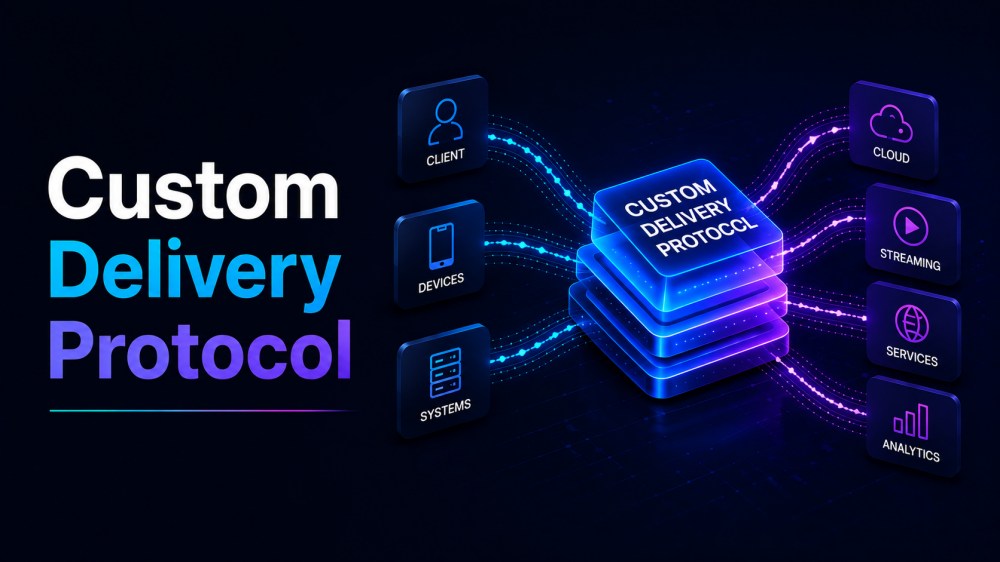
A custom delivery protocol service is a communication method that a company designs specifically for its own needs to send data between clients and the server. For this purpose, it does not rely on transport protocols such as UDP, TCP, WebSockets, or RTP. Additionally, it is “custom” because it can change how data is packed, sent, and confirmed, making it suitable for real-time video.
While controlling delivery rules, a custom delivery protocol can reduce delays, handle packet loss, and adapt to varying network conditions. Thus, it improves performance (lower latency), reliability, and sometimes security (custom checks or encryption layers). Due to this, vendors creating real-time streaming or communication platforms develop their own optimized protocols, rather than using standard protocols.
How Does a Custom Delivery Protocol Work?
To achieve better control and adaptability, many organizations choose to build a custom protocol to meet their operational requirements. In this context, we’ve demonstrated a complete workflow that highlights how a custom delivery protocol can be structured and implemented:
1. Prepares the Data
The program first determines what needs to be communicated immediately, such as chat messages or camera video frames. This data is analyzed by the protocol in order to identify the most and least significant information, which is then handled appropriately. Additionally, this stage acts as a priority suitcase, adding necessities and removing others if there is not enough room.
2. Breaks Data into Packets
Next, the protocol breaks the data into small units called packets, which are easier and safer to send across the internet. To help the recipient identify which packet belongs to them, each packet contains extra information, such as a sequence number. Thus, even if they arrive out of order, these packets are numbered envelopes with dates inscribed on them.
3. Chooses How to Send (Transport Layer)
Many custom delivery protocols sit on top of UDP rather than relying solely on TCP because UDP provides control over timing. On top of UDP, the protocol defines its own logic for when to send packets, or how fast to send them. Thus, it’s like building your own driving rules, where UDP is flexible, and protocols decide when to change lanes.
4. Checks for Errors and Loss
Checksums contained in packet headers are used by the recipient to verify that the data was not corrupted during transmission. The protocol determines whether to make another request if a checksum does not match, treating the packet as corrupted. Hence, waiting too long can cause the stream to lag, and the protocol may choose to skip broken packets.
5. Reorders and Rebuilds the Stream
Sequence numbers and timestamps are used by the protocol to reassemble packets because they may come out of order. The protocol reassembles the packets into a continuous stream of frames or samples after rearranging and filtering. Hence, even with inconsistent network delivery, the user perceives this as fluid visuals, crystal-clear audio, and real-time state updates.
6. Optimizes for Low Latency
For real-time apps, “being live” is more important than “being perfect,” so the protocol keeps the delay very low. That means it prefers to drop a few late packets rather than wait for them, because waiting would cause noticeable lag. Carefully choose which data to resend, which to skip, and how aggressively to send new packets and keep protocols instant.
Custom Delivery Protocol vs Standard Protocols
The right communication framework is essential for achieving reliable and flawless data transmission. Therefore, evaluate whether a standard solution is enough or if a custom delivery protocol service is better suited, through the table:
| Key Considerations | Custom Delivery Protocol | Standard Protocols |
|---|---|---|
| Design Goal | Tailored for one product or set of use cases (e.g., a specific real-time app). | Built as general standards to work for many apps and vendors. |
| Flexibility | Highly flexible; rules can be changed or extended. | Fixed behavior defined by specs; limited room to change core rules. |
| Performance Tuning | Optimized tightly for latency, bandwidth use, and specific traffic patterns. | Not perfectly tuned for every scenario. |
| Latency Focus | For interactive use, it can be pushed to extremely low latency. | Some are very low-latency (WebRTC, SRT); others are higher. |
| Error Handling | App-specific logic for congestion, packet loss, and retries. | Uses standardized error, recovery, and congestion behavior, depending on TCP, RTP, WebRTC, or SRT. |
| Compatibility | Usually works only within that vendor’s ecosystem/SDK. | Supported across devices, players, CDNs, and browsers. |
| Complexity to Build | Harder, requires protocol design, testing, and maintenance | Easier to adopt, just implement or reuse existing standards. |
Why Companies Build Custom Delivery Protocols
At present, many organizations build custom protocols and solutions that align more closely with their operational objectives. With this perspective in mind, we’ve outlined a few more reasons why traditional methods may no longer be sufficient:
- For Better Performance and Lower Latency: Companies build custom delivery protocols when standard options like HTTP cannot give them the exact speed they need.
- Adds Custom Security, Reliability, and Features: A custom protocol allows companies to create their own security and reliability rules instead of relying only on standard protocols.
- Handles Very Specific Use Case: Some apps have unusual needs that standard protocols were never designed for, like mixing real-time video with data.
- Works Better on Unstable Networks: Custom protocols can implement advanced tricks that keep apps usable and responsive even when the connection quality is poor.
- Control Costs and Infrastructure: With a custom delivery protocol, a company can choose how to route and optimize traffic, and which CDNs to use.
Common Use Cases of Custom Delivery Protocols
This versatility of custom delivery protocol is valuable across a wide range of applications where tailored data transmission is essential:
- Video Calls and Live Streaming: Live video calls, webinars, and streaming platforms heavily use custom delivery protocols to keep delays very low. In addition, they help send audio and video intelligently, prioritizing the latest frames and handling packet loss.
- Online Multiplayer Gaming: Every millisecond counts when it comes to player movement, shooting, and actions in online games. Moreover, custom delivery protocols let game servers send frequent, lightweight updates with low latency and decide when to drop outdated packets.
- Financial Trading and Market Data: High-frequency trading and live market dashboards need prices and orders delivered as close to “now” as possible. However, custom protocols can reduce latency, reduce jitter, and prioritize critical messages over less urgent data.
- IoT Devices and Sensor Networks: Many IoT devices send a lot of little messages and have limited power and bandwidth. To guarantee that readings arrive on time, this protocol can handle lossy networks, prioritize messages, and compress data.
- Remote Control, Drones, and Robotics: For remote-controlled robots, vehicles, and control commands, or live video, data must move more quickly and reliably. Thus, Custom delivery protocols help ensure control signals get top priority and that video/telemetry adjusts to changing link quality.
Challenges of Building a Custom Delivery Protocol
While custom communication systems offer greater flexibility and performance benefits, they also introduce a set of technical complexities. Thus, when developing a custom delivery protocol service, the listed challenges become more significant:
| Challenge | Why it’s Hard/Important |
|---|---|
| High Complexity | Requires deep networking expertise; mistakes can cause lag and data loss. |
| Long Development & Testing | Takes time, tools, and money to validate behavior under loss. |
| Continuous Maintenance | Ongoing effort is needed as networks, attacks, and requirements evolve. |
| Interoperability Issues | Often need gateways/adapters, adding complexity and introducing new failures. |
| Harder Adoption & Support | Onboarding teams and debugging in the field becomes harder |
| Trade‑Offs vs Standards | If performance gains are small, the extra complexity and cost may not be worth it. |
How Custom Delivery Protocols Improve Real-Time Communication
ZEGOCLOUD combines an optimized global edge network with video call SDKs to provide ultra-low-latency real-time communication. To make live experiences responsive, it also includes features like adaptive bitrate, AI-based audio/video improvement, and multi-platform support. In interactive scenarios, the platform’s live-streaming and voice-call SDKs are designed to maintain end-to-end latency of less than 300ms. Based on network conditions, its Web APIs can automatically modify frame rate and resolution.
It’s also optimized for low-bandwidth networks, enabling web-based audio and video calls with as little as 300 kbps. On the infrastructure side, ZEGOCLOUD runs on a large global real-time network, leveraging its self‑developed MSDN and intelligent SDN‑based routing. These capabilities, combined with its SDKs for In-App Chat, make it well-suited for custom delivery protocol applications. In addition, the platform is convenient for ultra-low-latency scenarios like multiplayer collaboration and live events.
Conclusion
In summary, a custom delivery protocol is a significant development in communication systems that provides an organized method of maximizing data transfer. It is extremely beneficial for dependability because, in contrast to conventional protocols, it is made to fulfill particular performance needs. For a consistent user experience, companies looking to improve real-time communications should take ZEGOCLOUD into consideration.
FAQ
Q1: What is a custom protocol?
A custom protocol is a communication method designed for a specific application, platform, or network environment instead of relying entirely on standard protocols like HTTP or RTP. Custom protocols are often built to optimize performance, reduce latency, improve security, or support specialized real-time communication scenarios such as live streaming, gaming, or IoT systems.
Q2: What is a delivery protocol?
A delivery protocol defines how data is transmitted from one system to another across a network. It controls aspects such as packet transmission, error handling, synchronization, and connection management. Common delivery protocols include TCP, UDP, HTTP, WebRTC, and RTP, each designed for different performance and reliability requirements.
Q3: What is a custom delivery?
Custom delivery refers to a tailored method of transmitting content or data based on specific business or technical requirements. In real-time communication and streaming systems, custom delivery mechanisms may optimize routing, reduce buffering, prioritize low latency, or improve media synchronization across different network conditions and devices.
Q4: How to create a custom protocol?
Creating a custom protocol typically involves defining how devices or systems exchange data, including packet structure, transmission rules, authentication, and error handling mechanisms. Developers usually start by selecting a transport layer such as TCP or UDP, then design message formats and communication logic based on application requirements. In real-time communication systems, factors like latency, scalability, encryption, and compatibility also play an important role in protocol design.
Let’s Build APP Together
Start building with real-time video, voice & chat SDK for apps today!
