








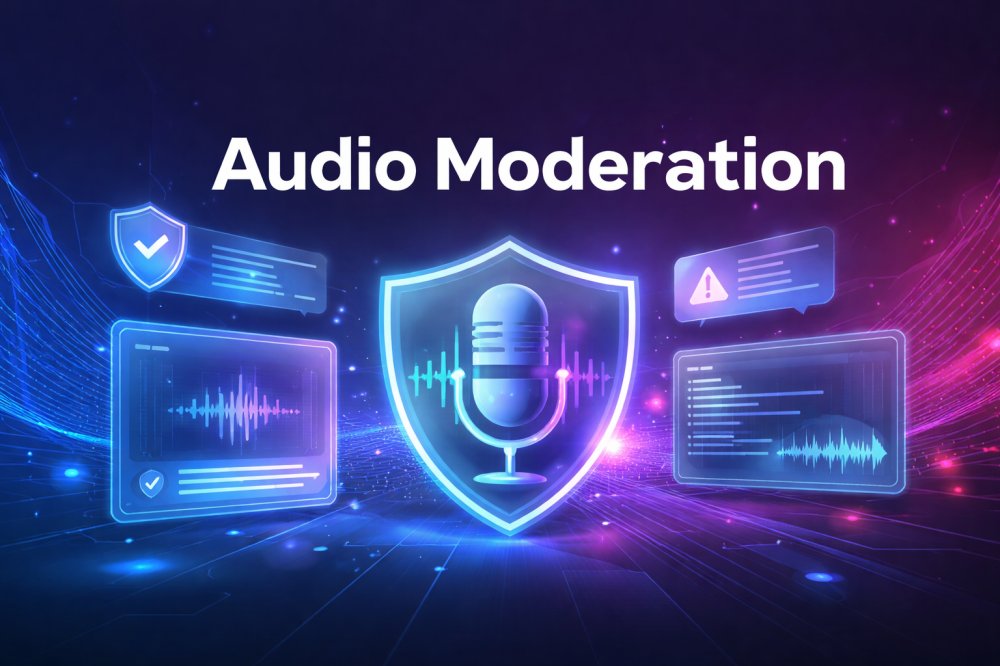
Audio has become a core interaction layer in modern applications. It is widely used in voice chat rooms, gaming platforms, online education, telehealth services, and smart devices. As more products rely on real-time voice communication, platforms are no longer only managing content. They are also managing live user behavior and interaction quality. This shift makes audio moderation an essential capability. It helps platforms control risk, maintain trust, and ensure a consistent user experience as they scale.
What is Audio Moderation
Audio moderation is the process of analyzing voice data to identify and handle content that does not comply with platform policies or legal requirements. It applies to both recorded audio and real-time voice streams.
Compared with text moderation, audio moderation introduces additional layers of complexity. Voice data must first be processed and interpreted before it can be evaluated. This creates a pipeline where both accuracy and response time directly affect the outcome.
In most systems, audio moderation follows a structured flow. The platform captures audio input, processes it to extract speech, converts it into text, and then applies classification models to determine whether the content should be flagged or filtered.
How Audio Moderation Works
In production environments, audio moderation is not a single step. It is a sequence of processes that transform raw audio into structured signals that can be analyzed.
The first stage focuses on audio processing. Real-world audio often contains background noise, overlapping speakers, and inconsistent input quality. To improve clarity, systems apply noise reduction, normalize volume levels, and filter out irrelevant frequencies. In group conversations or live streams, speaker separation is also required so that different voices can be analyzed independently. This step is important because poor audio quality at the beginning will affect every stage that follows.
The second stage is speech recognition. Once the audio signal is processed, it is converted into text. This allows platforms to reuse mature text moderation techniques. However, transcription accuracy depends on several factors. Accents, dialects, multilingual usage, and unstable network conditions can all reduce reliability. For global products, handling diverse language inputs is a baseline requirement rather than an advanced feature.
The final stage is content classification. After transcription, the system evaluates the text against moderation policies. This includes detecting abusive language, sensitive topics, or other forms of non-compliant content. Most systems combine machine learning models with rule-based filtering to improve precision. In real-time scenarios, these decisions must be made quickly so that actions can be taken without interrupting the user experience.
Where Audio Moderation Is Used
Audio moderation is widely used in applications where voice communication plays a central role. While the use cases vary, the goal remains consistent, which is to manage risk while supporting natural interaction.
Social Platforms and Gaming
In social platforms and gaming environments, voice chat is often used in real time. These spaces can involve anonymous users, which increases the likelihood of harmful behavior. Audio moderation helps platforms monitor voice messages, group conversations, and live sessions. Depending on the product design, moderation can be applied before content is delivered or after it is reported.
Online Education
In online education, moderation is closely tied to safety and learning quality. Platforms need to prevent harassment while maintaining a focused environment. Audio moderation can detect inappropriate language and reduce disruptions caused by background noise. It is especially important in scenarios involving younger users.
IoT and Smart Devices
In IoT and smart devices, voice is often the primary interface. Audio moderation in this context extends beyond content filtering. It also supports safety and privacy. For example, voice assistants must avoid generating unsafe responses, and in-vehicle systems need to ensure that voice interaction does not distract drivers. In wearable devices, audio signals can also be used to detect abnormal events such as distress or emergencies.
Telehealth
In telehealth scenarios, audio moderation supports both compliance and service quality. Voice interactions between patients and providers may need to meet regulatory standards. Moderation systems can assist in monitoring conversations, identifying high-risk situations in mental health support, and ensuring the accuracy of automated voice responses.
Challenges in Audio Moderation
Audio moderation presents several challenges that are difficult to solve with a single approach. Key challenges include:
- Real-time processing requirements: Moderation systems must analyze and respond to audio streams instantly. This requires tight integration with real-time communication infrastructure and efficient processing pipelines.
- Scalability at volume: Platforms generate large volumes of audio content continuously, which makes manual review impractical. Automated systems must handle this scale while maintaining consistent accuracy.
- Speech recognition variability: Differences in language, accent, and audio quality directly affect transcription results. Errors introduced at this stage can impact the final moderation outcome.
- Limited context understanding: Tone, intent, and conversational nuance are often lost when audio is converted into text. This can lead to false positives or missed violations, especially in informal conversations.
How ZEGOCLOUD Enables Audio Moderation
For applications built around live voice interaction, moderation cannot be treated as a separate layer. It needs to be embedded directly into the real-time communication pipeline so that content can be analyzed and handled as it flows. ZEGOCLOUD supports this by providing both offline and real-time audio moderation capabilities. Developers can process recorded audio for post-analysis or work directly with live audio streams when real-time control is required.
In real-time scenarios, moderation runs alongside audio transmission rather than after it. Speech recognition and audio analysis results are delivered through callbacks, allowing applications to react immediately. Based on these signals, developers can define custom handling logic such as filtering content, issuing warnings, or triggering moderation workflows.
This architecture allows platforms to maintain control over voice interactions without introducing additional latency. It ensures that moderation keeps pace with live communication, while still leaving flexibility for different product requirements.
Conclusion
As voice becomes a core part of modern applications, audio moderation is no longer optional. It plays a key role in maintaining safe environments, protecting users, and ensuring consistent communication quality across platforms.
While the underlying technologies continue to evolve, the main challenge remains the same. Platforms need to balance accuracy, scalability, and real-time responsiveness. This requires not only strong AI capabilities but also tight integration with the communication infrastructure itself.
For teams building voice-driven products, designing moderation as part of the system from the beginning can reduce risk and improve long-term stability. A well-structured approach makes it easier to scale, adapt to new scenarios, and maintain control as user interactions grow more complex.
FAQ
Q1. What is audio moderation?
Audio moderation is the process of analyzing voice content to detect and manage harmful, illegal, or non-compliant speech in audio or real-time voice communication.
Q2. How does real-time audio moderation work?
Real-time audio moderation works by analyzing voice data as it is transmitted. Audio is processed, converted into text, and evaluated instantly using AI models. Based on the results, systems can take immediate actions such as filtering content, issuing warnings, or flagging violations without interrupting the user experience.
Q3. What technologies are used in audio moderation?
Audio moderation typically relies on speech recognition, natural language processing, and machine learning models. These technologies work together to convert audio into text and analyze it for policy violations.
Let’s Build APP Together
Start building with real-time video, voice & chat SDK for apps today!
