









Selecting the proper audio codec is one of the most important technical decisions when building in-game voice chat. In multiplayer online games, voice communication is no longer optional. It directly affects teamwork, strategy coordination, and overall player engagement. Whether players are casually chatting or coordinating competitive gameplay, real-time voice interaction must be clear, responsive, and lightweight.
Integrating voice chat into a game requires more than simply adding a microphone input. Developers must consider audio quality, latency, bandwidth consumption, and system resource impact. The choice of audio codec ultimately determines how well the voice system performs under real-world conditions.
What is an Audio Codec in Game Voice Chat?
An audio codec is a software or hardware component that compresses and decompresses digital audio data for transmission over a network. In the context of in-game voice chat, the codec converts players’ voice signals into a compressed format that can be transmitted in real time, then reconstructs the audio on the receiving side.
Without audio codecs, raw audio data would consume excessive bandwidth and make large-scale multiplayer communication impractical. By reducing file size while preserving speech intelligibility, codecs enable efficient, low-latency voice interaction among players.
Different codecs are optimized for different purposes. Some prioritize music quality, while others are specifically designed for speech transmission under limited bandwidth conditions. For online games, speech-optimized codecs are typically preferred because they balance clarity, delay, and resource consumption.
Audio Requirements in Different Game Scenarios
Voice requirements vary across different types of games. The role of voice chat in casual social games differs significantly from its role in competitive or broadcast-integrated titles. Understanding these differences helps developers make more informed codec decisions.
Casual Social Games
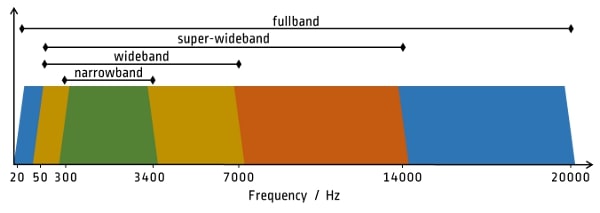
In casual social games such as card games, board games, or light entertainment apps, voice chat mainly supports conversation rather than high-speed coordination. Narrowband audio is usually sufficient because clarity matters more than high fidelity. Keeping the bitrate low helps control bandwidth costs and supports large numbers of concurrent users.
Competitive Multiplayer Games
In competitive games such as FPS, MOBA, or battle royale titles, latency becomes critical. Players rely on instant voice communication to coordinate tactics and react quickly. In these cases, low algorithm delay and stable transmission are more important than a wide audio frequency range. Even small delays can disrupt teamwork and affect gameplay outcomes.
Game + Live Streaming Hybrid Scenarios
Some games combine interactive voice chat with public live streaming or spectator broadcasting. In these hybrid scenarios, higher audio quality may be required to improve the listening experience. Wideband codecs can enhance clarity, but developers must balance improved fidelity with increased bandwidth usage and operational cost.
Common Speech Codecs for Game Voice
Several speech codecs are commonly used in low-bitrate real-time voice applications:
- Opus (SILK mode)
- Speex (NB, WB)
- G.729
- G.729.1
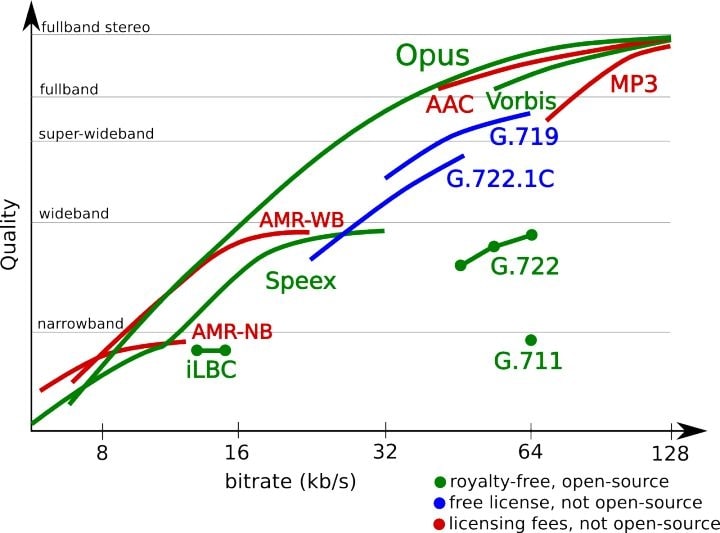
These codecs are optimized for speech and can maintain acceptable quality below 16 kbps. Among them, Opus is widely adopted due to its flexibility, low delay characteristics, and strong adaptability across network conditions.
Choosing the Right Audio Codec
The audio codec plays a critical role in determining the overall performance of in-game voice chat. Its design directly affects bitrate, algorithm delay, bandwidth consumption, and audio clarity. At the same time, codec complexity influences CPU usage, memory consumption, and power efficiency on user devices.
When selecting a codec for real-time gaming scenarios, developers should focus on several core characteristics.
Low Bitrate Efficiency
For large-scale multiplayer games, voice bitrate is typically kept below 16 kbps to maintain controllable bandwidth costs. For example:
- An 8 kHz sampling rate generally corresponds to about 8 kbps.
- A 16 kHz sampling rate generally corresponds to about 16 kbps.
Lower bitrate improves scalability while preserving sufficient speech intelligibility.
Low Algorithm Delay
Interactive voice communication requires minimal processing delay at the codec level. Algorithm delay should ideally remain under 60 milliseconds to support responsive real-time interaction within the broader voice transmission pipeline.
Low Computational Overhead
Because games consume significant system resources, the audio codec should operate efficiently without placing a heavy load on the CPU or memory. Lower algorithm complexity helps maintain stable game performance and reduces battery drain on mobile devices.
Several speech codecs commonly used in low-bitrate real-time scenarios include Opus (SILK mode), Speex, G.729, and G.729.1. Among these, Opus is widely adopted due to its balance of flexibility, low delay, and network adaptability.
However, codec selection should align with the specific interaction model of the game. Voice requirements in a casual social game differ from those in a competitive multiplayer environment. A well-designed real-time voice system considers not only codec performance but also network architecture, routing strategy, and playback behavior to ensure a consistent user experience.
Implementing Real-Time Voice with ZEGOCLOUD SDK
While selecting the right audio codec is essential, implementing a stable real-time voice system also requires robust transmission control, adaptive bitrate handling, and network resilience mechanisms. In practice, many development teams choose to integrate a dedicated real-time voice SDK rather than building the entire media pipeline from scratch.
For example, ZEGOCLOUD’s real-time voice SDK provides speech-optimized codec configurations, low-latency transmission based on UDP, adaptive bitrate adjustment, and built-in packet recovery strategies. ZEGOCLOUD allows developers to focus on gameplay logic while maintaining stable voice interaction across different network environments.
By combining appropriate codec selection with a well-architected real-time communication layer, game developers can deliver consistent voice performance even under high concurrency and fluctuating network conditions.
Conclusion
Choosing the right audio codec is fundamental to building a reliable in-game voice chat system. In multiplayer environments, voice communication must balance clarity, low latency, bandwidth efficiency, and system performance without affecting gameplay.
Speech-optimized codecs with low bitrate and low algorithm delay are typically the most suitable for real-time gaming scenarios. However, codec selection should never be made in isolation. It must align with the game’s interaction model, concurrency requirements, network conditions, and overall infrastructure design.
By carefully evaluating audio quality needs, cost considerations, and device performance constraints, developers can build voice systems that enhance teamwork, improve player engagement, and scale efficiently across diverse gaming environments.
FAQ
Q1: How do I find my audio codec?
You can find your audio codec by checking your device’s audio settings or by viewing the properties of an audio file in a media player. On Windows or macOS, file information panels typically display the codec format. In real-time communication applications, developers can check the configured codec within the SDK or audio engine settings. Network debugging tools may also show the codec being negotiated during transmission.
Q2: What is a codec in audio?
An audio codec is a technology used to encode and decode digital sound data. It compresses audio signals for storage or transmission and then reconstructs them for playback. In real-time voice communication, codecs are essential because they reduce bandwidth usage while maintaining acceptable speech clarity and minimizing delay.
Q3: How to fix codec issues?
Codec issues usually occur when a device or application does not support the required format. Updating the application, installing the necessary codec libraries, or converting the audio file to a supported format can resolve most problems. In real-time systems, ensuring that both the sender and receiver use compatible codec configurations is critical to maintaining stable communication.
Q4: What is the most popular audio codec?
For real-time voice communication, Opus is widely used because it offers low delay, flexibility, and strong performance under varying network conditions. For music streaming and general media distribution, AAC remains one of the most popular codecs due to its broad compatibility and high audio quality at moderate bitrates.
Let’s Build APP Together
Start building with real-time video, voice & chat SDK for apps today!
