







AI voice APIs promise natural, two-way conversations. However, many solutions fail in real-time scenarios due to high latency, delayed responses, or awkward interruptions. These APIs power interactive voice experiences like assistants and even live conversational systems. Yet, choosing the right API ensures low latency, realistic speech, and reliable real-time performance. Therefore, this article explains what AI voice APIs are and the top options in 2026.
What is an AI Voice API?
An AI voice API connects applications to cloud-based engines that manage complete, real-time voice conversations. It handles the full voice interaction loop, including listening, understanding, reasoning, and responding, without requiring teams to build complex audio pipelines from scratch.
Unlike traditional text-to-speech APIs that only read text aloud, an AI voice API processes live audio streams, detects user intent, manages call events, and generates natural voice responses in real time. Many platforms also support PSTN, VoIP, and in-app voice channels, allowing developers to build AI assistants, voice bots, and conversational support systems that interact naturally with users worldwide.
Key Features of AI Voice API
It provides specialized tools that control how AI voice apps operate. Therefore, these features determine response speed, audio quality, and how natural each real-time conversation feels:
- Real Time: It streams live audio to AI models and returns synthesized speech instantly. Therefore, users experience continuous two-way conversations without noticeable response delays.
- Programmable Calls: These APIs allow AI agents to place, receive, route, and control PSTN or VoIP calls through code. This also enables voice bots, automated campaigns, and AI-driven call handling.
- Call Flows: They manage dialogue states, IVR logic, agent handoff rules, and dynamic routing. Thus, AI agents follow intelligent conversation paths that improve resolution speed.
- Event Webhooks: An AI Voice API emits real-time events such as call start, user intent, sentiment changes, and call completion. Moreover, these signals trigger workflows, CRM updates, and AI memory storage.
- Low Latency: It maintains sub-second speech-to-speech processing for natural human-like conversations. Hence, AI agents respond instantly without breaking conversational flow.
How Does an AI Voice API Work?
Using the best AI voice API helps apps hear users, think fast, and speak naturally. Before that, this part explains how voice data moves through systems and becomes clear spoken replies:
1. Real-Time Audio Capture
Audio input starts when a user speaks into a phone or microphone. The client app captures this as a streaming audio signal rather than static files. Then, it sends it to the AI voice API over HTTP or WebSockets for low-latency handling. Thus, the service receives this stream and buffers it just enough to start recognition without adding noticeable delay.
2. Speech Processing and Transcription
First, the backend cleans the audio by removing noise and filtering echoes, so speech is easier to decode. Also, a streaming ASR engine then converts the incoming audio into partial and final transcripts while the user is speaking. Afterward, these transcripts feed downstream logic, such as an NLU or LLM, without waiting for the user to fully finish.
3. AI Intent Analysis and Reply Generation
Once text is available, dialogue logic or an LLM interprets intent and constructs a text response. Plus, this may involve querying databases or following predefined IVR-style flows before finalizing the reply text. In advanced setups, the model can stream partial responses so speech synthesis can begin early, reducing perceived latency.
4. Speech Synthesis and Barge-In Control
The system then sends the response text to a TTS engine, which converts it into natural speech using the chosen voice. Besides, the best AI voice API uses streaming TTS, so audio starts playing as soon as the first chunks are ready. During playback, the platform can monitor barge‑in, as if the user speaks. Here, it pauses or cancels output and returns control to ASR.
5. Event-Driven System Integration
Throughout the call or session, the AI voice API emits events like call started or call ended. Hence, your application receives these via webhooks or WebSockets and can log calls or adapt conversation flow. Moreover, this event-driven design lets developers arrange telephony and business logic around the same live voice interaction.
Text-to-Speech API vs AI Voice API vs AI Voice Generator API
Choosing the best AI Voice API depends on whether your app speaks only or fully converses. Hence, this part explains how voice APIs differ based on scope and usage purpose:
| Aspect | Text-to-Speech API | AI Voice Generator API | AI Voice API |
|---|---|---|---|
| Main Purpose | Converts written text into spoken audio only | Creates realistic or branded voices from text | Manages real-time speech-to-reasoning-to-speech conversations |
| Input Type | Text input | Text with optional voice samples | Live audio streams, text, intents, and call events |
| Output Type | Synthetic speech audio | High-fidelity or cloned voice audio | Speech audio, transcripts, intents, and call actions |
| Interaction Flow | One-way audio generation | One-way with advanced voice styling | Two-way real-time conversational interaction |
| Voice Control | Basic voice and language selection | Emotion, tone, pacing, and voice cloning | Voice control, barge-in handling, and dialog orchestration |
| Speech Understanding | Not included | Not included | Built-in ASR, NLU, and intent detection |
| Conversation Logic | Handled outside the API | Handled outside the API | Built-in dialog and flow orchestration |
| Telephony Support | Rarely available | Rarely available | Native PSTN and VoIP calling support |
Top 10 AI Voice APIs Online
Developers need reliable tools to build voice features that work smoothly every day. Below, we list the top 10 AI voice APIs with overviews and key strengths for quick choices:
1. ZEGOCLOUD
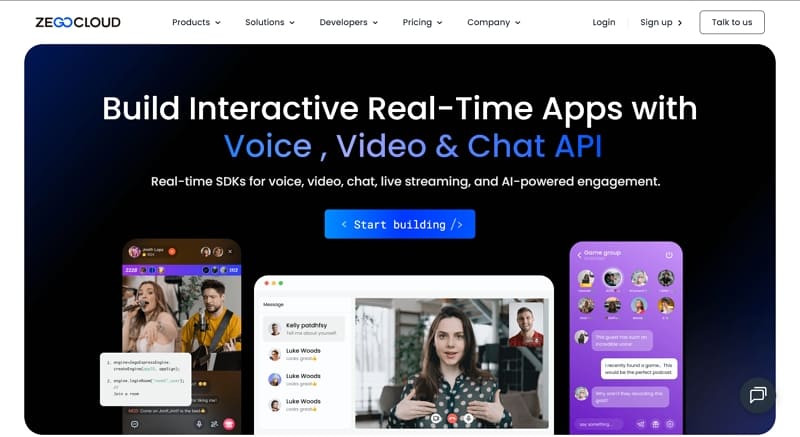
ZEGOCLOUD stands out as a high-performance AI voice API purpose-built for real-time conversational agents and enterprise-scale voice automation. Unlike platforms built on legacy telephony systems, ZEGOCLOUD is designed specifically for real-time AI voice conversations. Its Conversational AI API delivers a fully integrated speech-to-reasoning-to-speech pipeline, enabling live ASR, LLM-driven intent processing, and ultra-natural voice synthesis in a single real-time flow.
Additionally, this platform consistently maintains a speech-to-speech latency of under 300ms, supporting barge-in handling, interruption detection, and event-driven workflows. With a globally distributed real-time network spanning over 200 regions, ZEGOCLOUD enables highly stable and scalable AI voice agents for worldwide deployments.
Key Features
- Ultra-Low Latency Pipeline: Delivers sub-300ms speech-to-speech responses for natural, interruption-free conversations.
- Native LLM Orchestration: Built-in integration with large language models for intelligent, real-time dialog control.
- High-Fidelity Audio Engine: Supports studio-grade voice output for clear and immersive AI speech delivery.
- Global Real-Time Network: Optimized worldwide routing ensures consistent voice quality across regions.
- Advanced Agent Streaming: Enables full-duplex streaming between users and AI agents with precise barge-in control.
2. Deepgram
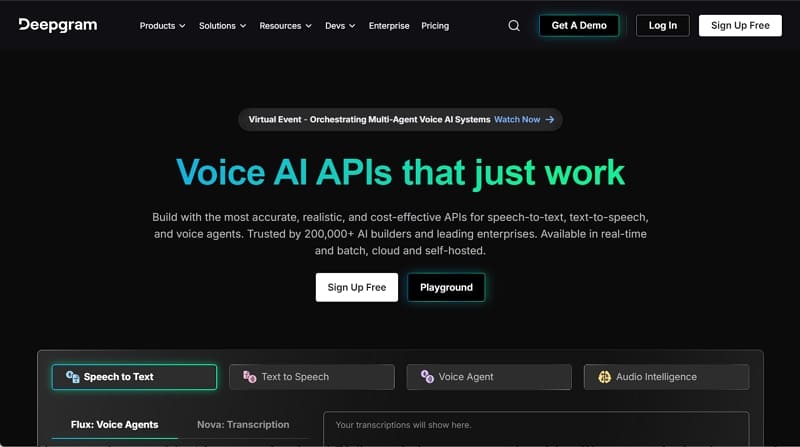
Being an AI-powered voice platform, it enables full-duplex, low-latency voice-to-voice conversational interactions in real time. Plus, its AI voice API instantly detects interruptions, letting the agent stop speaking mid-conversation. Moreover, intelligent runtime controls dynamically adjust agent behavior using AI reasoning during conversations seamlessly. It also supports event-based triggers for adaptive conversational logic and actions.
Key Features
- Predicts conversational turn-taking to avoid awkward pauses or overlapping speech moments.
- Maintains transcription quality even in noisy or complex acoustic environments.
- Tightly synchronized speech-to-speech flow improves conversational timing and realism.
3. Agora
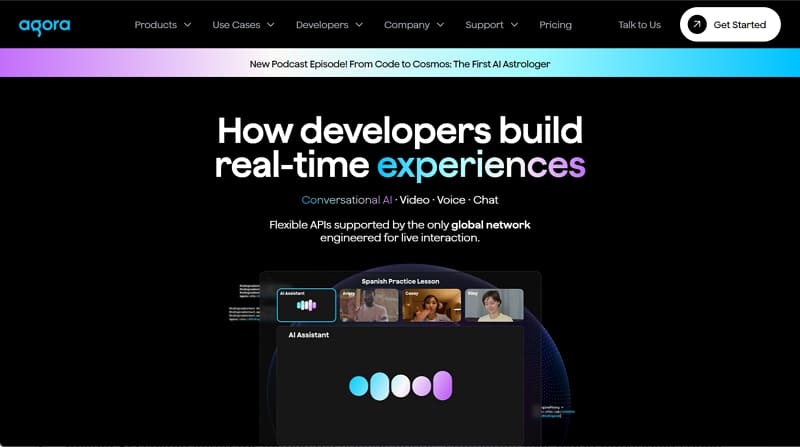
You can also use this AI-powered voice API for real-time conversational intelligence and adaptive speech responses. Additionally, it enables real-time AI interruption handling, allowing natural, human-like conversational voice interactions. Moreover, high-quality 48 kHz audio enhances AI speech recognition accuracy for reliable real-time understanding. Besides, its global real-time network ensures sub-second responses with echo cancellation for clear communication.
Key Features
- Enable multi-channel directional audio for clearer speaker separation during live AI conversations.
- Achieve ultra-low latency voice delivery using a global software-defined real-time network.
- Processes speech via ASR-to-LLM-to-TTS cascade for complete voice flow.
4. Twilio
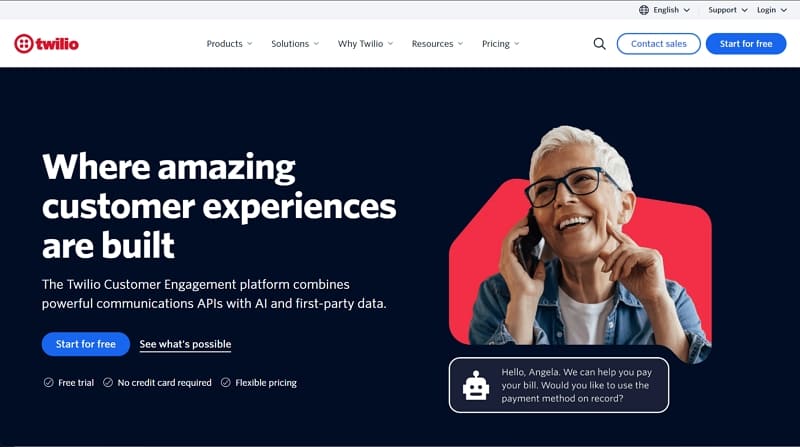
Twilio’s AI Voice API enables real-time conversational voice interactions by combining live calling with speech recognition, AI reasoning, and natural voice synthesis. It supports speech-to-text streaming, LLM-driven responses, and dynamic IVR logic during phone or VoIP calls. Moreover, Twilio provides interrupt handling, event-based workflows, encrypted call media, and global PSTN connectivity to build scalable AI voice agents.
Key Features
- Real-time speech-to-text, AI intent analysis, and natural voice replies for live conversational calls.
- Interrupt handling, dynamic IVR logic, and event-driven workflows for automated voice agents.
- Global PSTN and VoIP calling with encrypted media and caller authentication for secure AI voice interactions.
5. Vapi
It provides a real-time AI voice API that combines streaming speech recognition, LLM reasoning, and natural voice synthesis for full conversational control. The platform maintains response times under 500ms to keep conversations natural and fluid. Moreover, it supports two-way audio streaming through WebRTC, enabling ultra-low-latency voice interactions. Additionally, it allows A/B testing of prompts, voices, and dialog flows. Businesses can easily customize voices and conversation styles to match branding.
Key Features
- Supports over 100 languages to power multilingual AI voice agents and global customer interactions.
- Triggers real-time webhooks for events, enabling workflow automation and external system integrations.
- Applies intelligent noise handling to maintain transcription accuracy in challenging acoustic environments.
6. Bandwidth
Bandwidth provides one of the best AI voice APIs that enables programmable outbound and inbound calls, combined with speech recognition, AI reasoning, and natural voice synthesis. It even supports two-way streaming audio for conversational AI voice agents across scalable global interactions. Moreover, it offers call recording, barge-in handling, and event-driven workflows to orchestrate intelligent voice agents securely.
Key Features
- Supports real-time two-way streaming audio for live AI voice conversations and agent interactions.
- Triggers event webhooks for call control, workflow automation, and AI agent orchestration.
- Operates global PSTN and VoIP connectivity across more than 65 countries using Bandwidth’s owned IP network.
7. Retell
A production-ready AI voice API for building conversational voice agents that make and receive natural phone calls. Besides, it combines streaming speech recognition, customizable LLM reasoning, and telephony integrations to handle inbound and outbound conversations with low latency. You can also deploy AI agents at scale, automate workflows, sync knowledge bases, and monitor performance in real time for enterprise voice automation.
Key Features
- Real-time speech recognition with conversational agent intelligence for phone calls.
- Webhooks deliver call events for workflows, analytics, and integrations instantly.
- Deploy scalable inbound and outbound voice agents with low latency.
8. Inworld
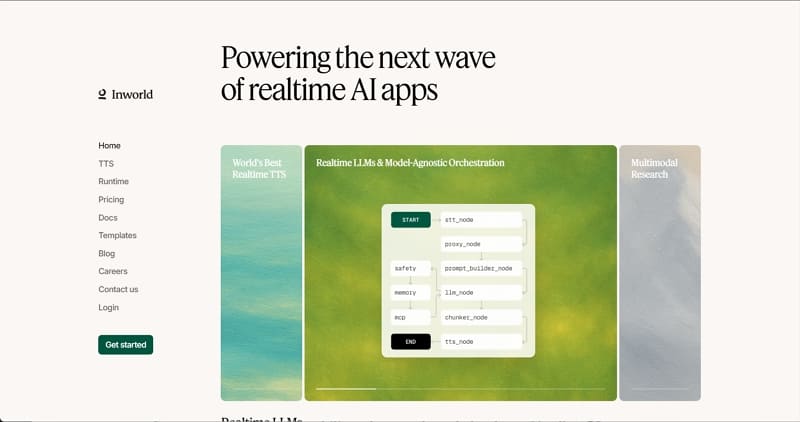
Inworld provides high-quality, real-time AI voice synthesis and expressive conversational tools via its API. Optimized for low latency and natural-sounding speech, it also enables developers to build voice agents with custom voices, emotional nuance, and multilingual support. Moreover, Inworld’s models are designed for responsive applications such as assistants, virtual characters, and interactive voice experiences across platforms.
Key Features
- Generate expressive voices with emotion control for interactive character apps.
- Optimized for low-latency speech generation in real-time sessions.
- Create custom voices and multilingual output through developer-friendly APIs.
9. OpenAI Real-time Voice API (via Real-time & Agents SDK)
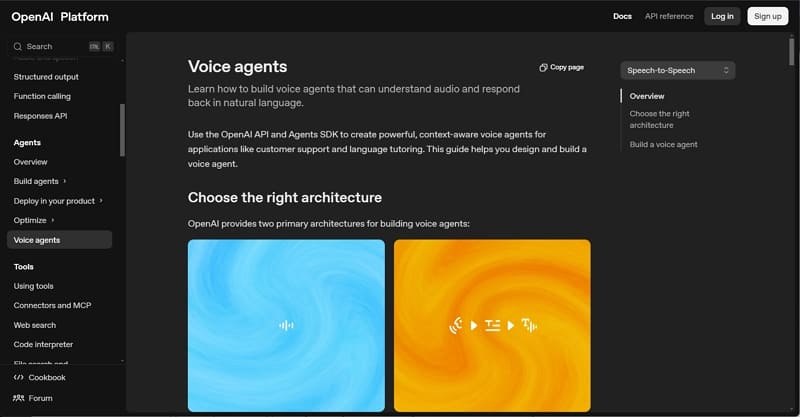
This AI voice API empowers developers to build low-latency voice agents using real-time audio streaming, context-aware assistants, and speech-to-speech interactions. It also integrates seamlessly with LLMs and the Agents SDK for dialog control, interruption handling, and multi-turn conversations. Besides, this API is designed for powerful and intelligent voice applications with adaptive reasoning and live audio interactions.
Key Features
- Supports adaptive prompt updates mid-conversation for dynamic responses.
- Provides built-in intent detection for voice-driven task execution.
- Allow custom voice styles and accents for branded conversational experiences.
10. Symbl.ai
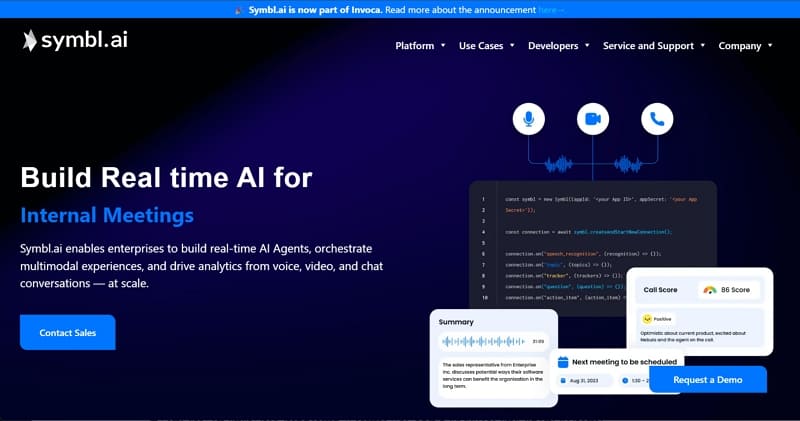
A real-time AI voice API focused on conversational intelligence and spoken language understanding. It combines streaming speech recognition, intent analysis, and topic extraction to power intelligent voice agents. Furthermore, this platform enables live transcription, dialog insight generation, and workflow automation during calls. Its API helps businesses build voice applications that understand customer intent to deliver more relevant adaptive responses.
Key Features
- Real-time speech recognition for continuous conversational voice interactions.
- Built-in intent, sentiment, and topic detection from live calls.
- Event-driven analytics triggering workflows, CRM updates, and agent actions.
How to Choose the Best AI Voice API for Your Business
Choosing the right AI voice API positions your business for seamless conversational automation. This section guides you through simple steps to match platforms with real operational needs:
- Conversation Use: Define whether you need inbound support lines, outbound campaigns, or AI voice agents. Additionally, focus on APIs that support dialog flows and event webhooks for your scenario.
- Turn-Taking: Aim for sub-second speech-to-speech latency so conversations feel natural instead of robotic. Check whether the API supports streaming ASR and streaming TTS for overlapping responses.
- Interaction Quality: Evaluate how natural replies sound when driven by ASR-to-LLM-to-TTS pipelines. Besides, test in noisy environments to see how well intent accuracy and clarity are preserved.
- Telephony and Channels: Confirm support for PSTN, VoIP, and in-app audio so one platform covers all channels. Plus, look for programmable call control, IVR routing, and agent handoff workflows.
- Integration: Prefer APIs that expose WebSockets, callbacks, and webhooks for call events. Moreover, strong SDKs and clear documentation reduce integration time and production issues.
The Future of AI Voice APIs
The future of AI voice APIs is moving toward truly real-time and human-like conversations. As adoption increases, businesses are shifting from simple voice automation to intelligent AI agents that can listen, understand, and respond instantly during live interactions.
Latency is becoming the most critical factor in voice experiences. Leading platforms are aiming for sub-300ms speech-to-speech response times to support natural turn-taking, interruption handling, and smooth conversational flow. Systems that fail to meet these real-time expectations will struggle to deliver acceptable user experiences.
At the same time, AI voice agents are expanding beyond customer support into sales, onboarding, education, and in-app assistants. As these use cases scale globally, platforms must provide stable real-time infrastructure, multi-channel voice support, and event-driven control to operate reliably in production environments.
Conclusion
To conclude, AI voice APIs transform applications with natural, real-time conversations that feel fast and human. Thus, this guide has highlighted the top platforms to match different needs. Therefore, choosing the right API ensures faster integration, smoother performance, and reliable global delivery. Among them, ZEGOCLOUD stands out for its ultra-low latency and worldwide real-time coverage.
FAQ
Q1. What is the best real-time AI voice API?
There is no single best option for every use case. The right real-time AI voice API depends on your latency requirements, conversation complexity, channel support, and integration needs.
Q2. Is a real-time AI voice API different from a text-to-speech API?
Yes. A text-to-speech API only converts text into audio. A real-time AI voice API manages the full conversation loop, including live speech recognition, intent analysis, dialog logic, and speech synthesis, all in real time.
Q3. What are common use cases for real-time AI voice APIs?
Typical use cases include AI customer support agents, voice assistants, sales and lead qualification bots, in-app conversational helpers, appointment booking systems, and interactive education or onboarding experiences.
Let’s Build APP Together
Start building with real-time video, voice & chat SDK for apps today!
