









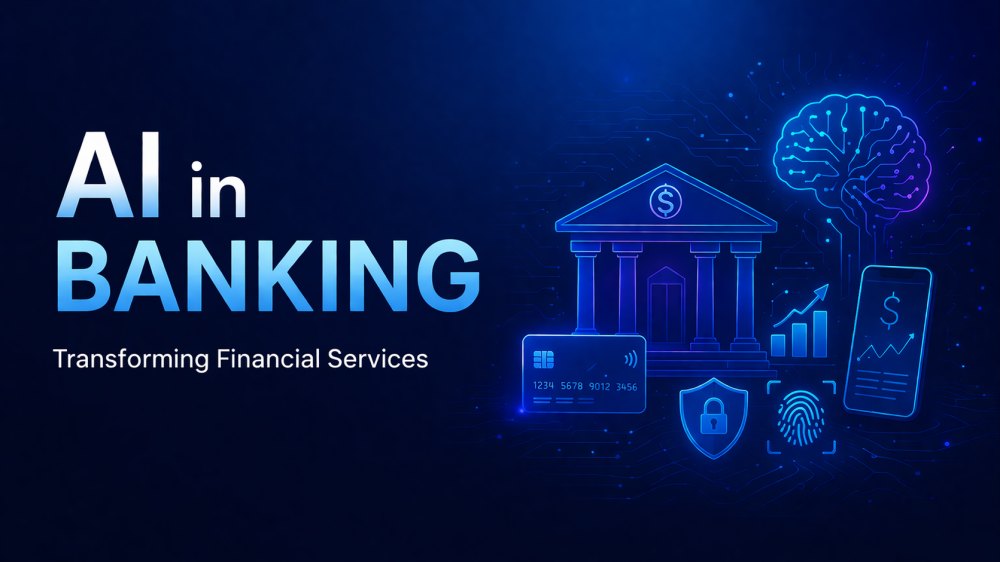
Banks now face fast changes as customers expect quick, safe, and smart services every day. Therefore, AI in banking helps improve security, detect fraud, and provide better customer support. Not just that, it allows banks to analyze data, predict risk, and offer personalized services with ease. Thus, this guide explains the key benefits and practical solutions, showing how banks use AI to build trust, reduce costs, and better serve customers.
What is AI in Banking?
AI in banking refers to smart computer-based systems to enhance services, automated processes, and data analysis throughout the bank to assist in making decisions, risk prediction, and support. In this aspect, the AI applies to novel approaches such as Machine Learning, Natural Language Processing, and Robotic Process Automation.
This way, banks enhance security by conducting real-time fraud, AML controls, and credit-risk analysis. On the inside, AI banking eliminates manual work, speeds up reporting, and enables regulatory compliance. Generally, it renders banking more secure, quicker, and more efficient for both the clientele and the banks.
Why AI Matters to Banking and Financial Services?
A report from Health Care states that North America leads in AI for banking. Around 98% of banks use it for risk analysis, customer support, and fraud prevention. Additionally, the Asia-Pacific region grew 21% in AI investments, while European banks integrated AI in 28%. So, despite this massive usage, if you want to know why AI in baking matters, here are 5 key reasons:
- Efficiency and Cost: AI automates tasks like KYC checks, loan processing, reconciliations, and document handling, and reduces the staff workload. Furthermore, the report claims that AI development leads to 36% lower processing costs and faster back-office processing.
- Risk and Fraud: Machine learning algorithms are capable of scanning millions of transactions in a second to identify fraud, money laundering, or cyberattacks. Alternatively, AI-based credit models are the ones that employ alternative data sources to minimize defaults and enhance portfolio quality.
- Customer Personalization: AI can analyze the behavior of customers by giving personalized recommendations, budgeting alerts, and investment advice. Moreover, chatbots and virtual assistants provide 24/7 services, enhance the response time, and increase the satisfaction rate.
- Data-Driven Decisions: In addition, AI in investment banking processes handles larger volumes of transaction, market, and segment data more quickly than human investment bankers can, providing strategy insights. Approval of credit and processing of payments can reduce days to minutes, which enhances speed and throughput.
- Competitive Advantage: Banks can introduce robo-advisors, smart savings, and personalized offers to a greater extent and are interested in new and underserved clients. Integrated data and AI will enhance cross-sell/upsell, trust, and a contemporary brand image.
AI in Banking Market Trends in 2026
Talking about the trend and usage of generative AI in banking, the numbers are massive and are growing significantly. According to McKinsey, 78% of organizations use AI in at least one function, up from 72% in early 2024 and 55% last year. Additionally, it further says that the financial industry spent $35 billion on AI in 2023, with banking at $21 billion.
This is expected to add $2 trillion globally, clearly highlighting a promising future. Despite this growth, the Boston Consulting Group (BCG) says that 26% of companies have the skills to move past AI proofs of concept and create real value. So, even though the struggle to integrate AI persists, the AI banking market could reach USD 339.1 billion by 2034, according to Dimension Market Research.
Key Applications of AI in Banking
According to the BankBase, McKinsey urges banks in 2026 to go beyond experiments and use multi-agent AI systems to transform key business workflows. Taking this advice, here are some applications where conversational AI in banking plays a major role:
1. Fraud and AML
Banks use machine learning models to scan millions of transactions in real time for unusual patterns. Thus, AI adapts to new fraud tactics, reduces false positives, and highlights high-risk alerts for investigations.
2. Credit Scoring
AI analyzes transaction history, cash-flow patterns, and alternative data to assess the likelihood of loan repayment. Additionally, the AI automatically reads payslips, tax returns, and IDs, cutting approval times from days to minutes.
3. Customer Support
Chatbots and voice assistants handle balance checks, card blocks, and password resets 24/7. Moreover, AI in banking and finance passes complex issues to human agents with full context, improving response speed and first-contact resolution.
4. Personalized Offers
AI studies spending, income, and life events to suggest tailored loans, cards, and savings plans. Alternatively, some banks send alerts about upcoming bills, unusual spending, or ways to avoid fees and interest.
5. Trading and Risk
For better trading and risk management, AI also analyzes market data, detects signals, and monitors portfolios. Additionally, in treasury, models forecast quality, interest rate exposure, and capital needs more dynamically than spreadsheets.
6. Operations and Compliance
AI automates reconciliations, data entry, exception handling, and report creation in back-office teams. In addition, it structures regulatory data, flags potential breaches, and maintains tamper-proof audit trails.
7. Onboarding and KYC
Here, AI and banking go hand in hand, as AI verifies IDs, performs liveness checks using selfie videos, and compares applicants against sanction lists. Hence, this reduces manual work, prevents fake accounts, and speeds account activation.
Benefits of AI in Banking
It’s true that banks leveraging AI can achieve significant cost savings, but these perks go beyond that. Now, generative AI in banking is helping banks add products that are hard to offer manually and assisting with operational resilience. So, to know how AI fits into these dimensions, here are the 5 main benefits:
- New Products: AI enables robo-advisors, smart savings, usage-based insurance, and tailored investment tools that are hard to provide manually. Thus, banks can reach new customer segments and increase cross-sell or upsell with more relevant offerings.
- Real-Time Insights: AI analyzes large datasets from transactions, markets, and customer journeys in near-real time to support decision-making. Consequently, management gains sharper insight into profitability, risk, pricing, product design, and capital allocation.
- Operational Resilience: AI can also monitor IT systems, detects anomalies, and predicts failures to prevent outages in digital banking services. Additionally, it identifies operational risks such as process issues and unusual workloads, thereby improving overall reliability and uptime.
- Inclusive Finance: Know that AI credit models use alternative data to score customers with limited credit history, helping SMEs and underbanked individuals. So, banks can offer loans safely while supporting financial inclusion goals and reducing default risks.
- Marketing and Retention: AI segments customers for targeted campaigns, improving response rates and reducing marketing costs. Furthermore, churn-prediction models spot at-risk customers so banks can intervene with offers or service improvements.
Challenges of AI in Banking
AI in banking comes with many hurdles, ranging from data and governance, bias, integration, and operational risks. Therefore, this section highlights a few of them to help you decide if its integration in 2026 is worth it.
- Regulatory Challenges: The bank must ensure that AI complies with laws such as AML/KYC, fair lending, and data protection, even as models evolve rapidly. So, it’s important because regulatory demands for transparency and explainability conflict with the “black box” nature of AI and slow deployment.
- Data and Governance: AI requires high-quality, structured data; fragmented systems and legacy formats reduce model accuracy and reliability. Moreover, banks must manage data collection, sharing, and privacy carefully to avoid legal or reputational risks.
- Bias and Fairness: Historical data can introduce bias, leading AI to make unfair lending or pricing decisions. In addition, bank audit models, adjust features, and monitor outcomes to meet ethical and regulatory standards.
- Integration and Skills: Legacy core systems make AI integration complex and costly without disrupting operations. Besides, there is a shortage of professionals skilled in both AI techniques and banking risk/compliance, creating gaps.
- New Risks: AI creates model, cyber, and operational risks, including adversarial attacks or faulty automated decisions. Thus, reliance on a few shared AI providers can cause systemic risk, amplifying shocks across multiple banks.
The Future of AI in Banking
The future of AI and banking uses autonomous operations, personalized services, and predictive analysis to improve risk management and customer support. In a Blue Prism report, Rob Paisley says that by 2028, AI operations and maintenance will account for a large share of total investment. Thus, it will make string systems and efficiency crucial for banks.
On the contrary, Akademos states that the future of AI in banking goes beyond chatbots and fraud checks, expanding into advanced real-time capabilities like:
- Advanced algorithms will handle real-time credit decisions, global transition monitoring, and predictive compliance.
- Moreover, banks will use AI to manage risks and anticipate customer needs. This will include warnings about low balances or suggestions for investments.
So, all these innovations rely on AI, data analytics, and cloud platforms to make banking faster, smarter, and more personalized.
Powering Conversational AI in Banking with Real-Time Voice and Video
Multiple reports claim that AI in banking and finance is now moving beyond simply chatbots. Here, conversational AI matters more paired with live video and voice assistance. Thus, using the ZEGOCLOUD AI Agent API, you can offer an in-app chat application that lets users interact with multiple AIs. While communicating, users can transition from video to voice calls and text messages with low latency under 500ms.
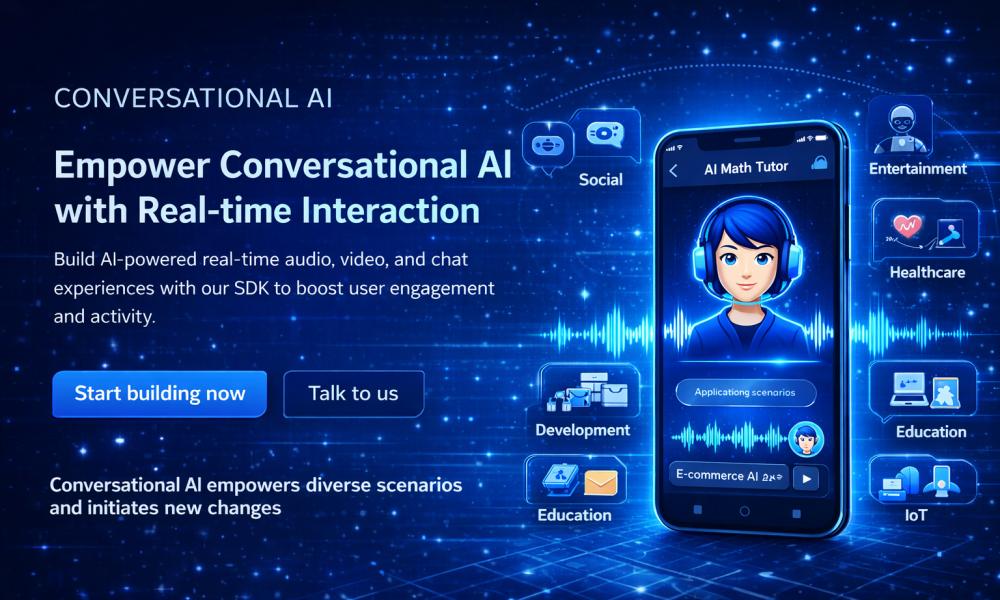
AI uses LLMs, TTS, and NLP to make customer support, onboarding, and basic fraud checks faster and more natural. If the app focuses on customer support, ZEGOCLOUD can remember past conversations and adapt to human tones. Moreover, user interruption handling, along with AI noise and echo cancellation features, ensures smooth interaction. Overall, developers can use 20+ pre-built UIKits to integrate AI into banking apps in real-time.
Conclusion
To sum up, AI in banking improves security, detects fraud, and automates tasks, making services faster, safer, and more personalized. To further justify its promising future, this guide has explained its key applications, benefits, and possible challenges. However, for seamless integration of conversational AI, real-time voice, and video in banking apps, ZEGOCLOUD is suggested.
FAQs
Q1: How is AI used in banking?
AI is used in banking for fraud detection, credit scoring, customer service, risk analysis, document processing, compliance monitoring, and personalized financial recommendations. It helps banks improve efficiency, reduce manual work, and deliver faster service.
Q2: Which banks are leading in AI?
Several major banks are actively investing in AI, including JPMorgan Chase, Bank of America, HSBC, Wells Fargo, and Citi. These banks use AI across areas such as fraud prevention, customer support, data analysis, and internal process automation.
Q3: What are the five benefits of AI in banking?
The five main benefits of AI in banking are improved fraud detection, faster customer service, better risk management, more efficient operations, and more personalized user experiences. Together, these benefits help banks lower costs and improve service quality.
Q4: How is JP Morgan using AI?
JP Morgan uses AI in several areas, including fraud detection, contract analysis, trading support, customer service, and internal data processing. AI helps the bank handle large volumes of financial data more efficiently and support faster decision-making.
Q5: What are the challenges of AI in banking?
Common challenges include data privacy concerns, regulatory compliance, model bias, integration with legacy systems, and the need for high-quality training data. Banks also need to balance automation with human oversight.
Let’s Build APP Together
Start building with real-time video, voice & chat SDK for apps today!
