




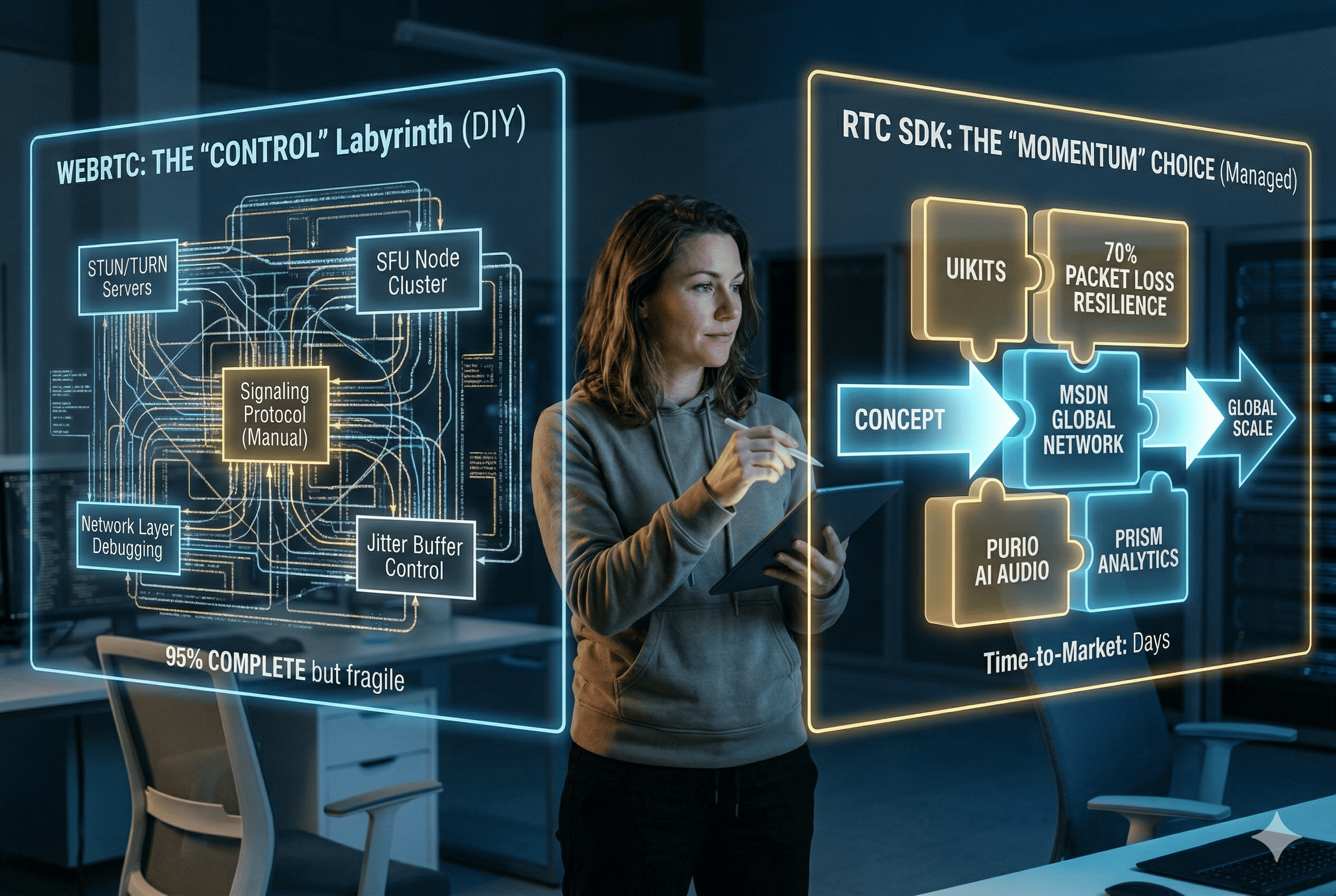
In the race to build a real-time calling app, developers often reach a critical crossroads: Do you build your own infrastructure using a raw WebRTC stack, or do you integrate a professional real-time communication SDK? Making the right choice regarding WebRTC vs SDK for Real-Time Calling is crucial, as it impacts everything from initial development time to long-term app performance.
While the open-source allure of WebRTC is tempting, the “Day 2” reality of global scaling, network jitters, and device fragmentation often turns a quick project into an engineering nightmare. For businesses looking to scale, this decision is no longer just about code—it is a strategic choice regarding innovation velocity and operational resilience.
WebRTC vs SDK for Real-Time Calling: Where the Real Complexity Lies
WebRTC is often described as the backbone of real-time communication. That’s true—but it’s only part of the system.
What it actually provides is the ability to transmit media between peers.
What it doesn’t provide is everything required to make that transmission reliable at scale.
To move beyond a demo, teams quickly find themselves building:
- A signaling system to coordinate sessions
- STUN/TURN infrastructure for network traversal
- Media servers (SFU/MCU) for multi-user calls
- Routing logic for cross-region traffic
- Mechanisms to handle packet loss, jitter, and reconnection
At this point, the question is no longer just about choosing technology.
It becomes a question of ownership: How much of this system does your team want to build—and maintain?
Why It’s Hard to Build a Real-Time Calling App at Scale
The difficulty isn’t in making a call connect.
It’s in making it feel effortless under real-world conditions.
1. Scaling Beyond 1-on-1 Calls
WebRTC’s peer-to-peer model works well for simple scenarios. But as soon as you introduce:
- group calls
- large rooms
- high concurrency
…the underlying architecture can no longer stay the same.
At that point, teams need to introduce media servers (such as SFUs), manage bandwidth distribution across participants, and continuously optimize performance to maintain call quality at scale.
2. The Reality of Global Networks
Real-time communication is highly sensitive to network conditions—especially:
- latency
- packet loss
- network instability
A connection that works perfectly in one region may degrade significantly in another. Without intelligent routing and edge infrastructure, maintaining consistency becomes a constant challenge.
3. Experience Is the Product
Users don’t evaluate your system based on architecture. They evaluate it based on experience:
- Does the audio feel instant?
- Does the video freeze?
- Does the call recover smoothly after a drop?
These are not “edge cases”—they are the product.
And this is where many self-managed WebRTC implementations begin to struggle—not because they’re incorrectly built, but because they lack the infrastructure to adapt in real time.
The Hidden Tax of the Self-Managed WebRTC Stack
At first, building with WebRTC feels efficient. There are no licensing fees, and the flexibility is unmatched.
But as usage grows, a different kind of cost emerges.
- Engineering time spent maintaining signaling and media systems
- DevOps overhead for scaling infrastructure
- Continuous tuning for network conditions
- Debugging issues that only appear under real-world traffic
This is the “hidden tax” of the self-managed approach.
It doesn’t show up in the first sprint.
It compounds over time—especially when the product begins to scale globally.
WebRTC vs SDK for Real-Time Calling: Why ZEGOCLOUD Wins the Debate
In 2026, the question is no longer “Can we build this?” but “Should we maintain it?”
ZEGOCLOUD’s real-time communication SDK shifts the focus from “plumbing” to “product.”
1. The 70% Resilience Threshold
Standard WebRTC setups typically begin to stutter at 20% packet loss. ZEGOCLOUD’s proprietary algorithms and MSDN (Massive Serial Data Network) maintain smooth, high-definition interaction even under 70% packet loss.
We solve the “Last Mile” problem, so your engineers don’t have to.
2. Global MSDN vs. Standard Routing
While self-managed WebRTC stacks struggle with cross-border latency, ZEGOCLOUD leverages 500+ global nodes across 212 countries. This ensures an average end-to-end latency of 300ms , providing a “local” feel for users on opposite sides of the planet.
3. Observability via ZEGOCLOUD Prism
Devs often fear SDKs are “black boxes.” ZEGOCLOUD removes this fear with Prism, a professional-grade quality analytics tool. Instead of guessing why a call dropped, you get real-time insights into bitrate, latency, and device performance. You gain more control, not less.
4. Quality Analytics & Diagnostics
The comparison is often framed as a technical choice.
In reality, it’s a product decision.
| Feature | Custom WebRTC Stack | ZEGOCLOUD SDK |
| Network Resilience | Fails at ~20% Packet Loss | Stable up to 70% Packet Loss |
| Global Latency | Variable (Depends on TURN setup) | 300ms Average (via MSDN) |
| Time to Market | 3–6 Months (Infra + UI) | Minutes (via Scenario UIKits) |
| Maintenance | High (Dedicated Internal Team) | Zero (Managed PaaS) |
| Future-Proofing | Manual AI/Avatar Integration | Native AI & Digital Human Support |
Inspiration in Action: Real-World Use Cases
The true power of a real-time communication SDK is seen in how it transforms diverse industries. ZEGOCLOUD provides tailored solutions that go beyond simple video:
- Social Gaming: Platforms like Tamatam leverage ZEGOCLOUD to integrate 3D Spatial Audio and mini-games directly into the call stream. This turns a simple chat into an immersive social “hangout,” significantly boosting user retention.
- Live Commerce: E-commerce brands are moving beyond static “Add to Cart” buttons. Using ZEGOCLOUD’s low-latency streaming, they create interactive “Shop Together” experiences where hosts and viewers interact in real-time without the 10-second lag typical of traditional CDN streaming.
- Conversational AI: Modern apps use ZEGOCLOUD as the “ears and mouth” for AI agents. Our Purio AI Audio Engine ensures that noise-canceling technology allows AI models to process human intent perfectly, even in noisy environments.
Conclusion
The choice between self-managed WebRTC vs SDK for real-time calling isn’t about “flexibility vs. convenience.” It is about Control vs. Momentum.
With a self-managed WebRTC stack, you control every line of code, but you also own every middle-of-the-night server crash. With ZEGOCLOUD, the infrastructure is a solved problem. You focus on the features that actually drive revenue—like gamification, AI integration, and UX—while we handle the “hard math” of global data transport.
Stop sustaining infrastructure and start building experiences.
Explore ZEGOCLOUD and get 10,000 free minutes to stress-test our resilience in your most difficult network environments.
Let’s Build APP Together
Start building with real-time video, voice & chat SDK for apps today!
