





Customers today don’t interact with brands in just one place; they move between websites, apps, and even in-store experiences. This shift has now made omnichannel communication more than a strategy; a necessity. Therefore, companies that fail to connect these touchpoints risk delivering fragmented experiences that annoy customers and weaken trust. To maintain a unified approach that ensures consistency, you’ll need to expand your understanding of omnichannel communication through this article.
What is Omnichannel Communication?
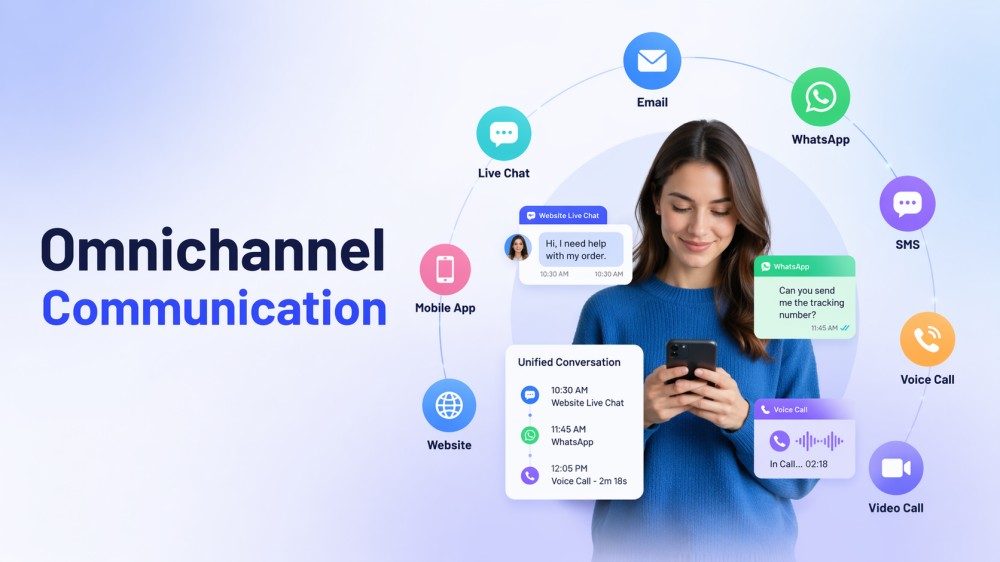
Omnichannel communication means talking to customers across multiple channels in a way that feels like a single, continuous conversation rather than a series of separate ones. For example, a person starts a chat on your website and later replies by email, but your team sees the full context. Moreover, the key idea is that all channels (like apps, websites, and SMS) are connected behind the scenes.
This omnichannel customer communication is different from simply being on many channels, where each operates in isolation. With this, data from every interaction is combined, enabling companies to respond faster and keep everything aligned. Additionally, it’s like building a unified customer experience across chat, in-app messages, and other touchpoints, rather than treating each channel separately.
How Omnichannel Communication Works
Clarity on what omnichannel communication is will help you see how different channels work together in a unified space. However, this section elaborates on how this strategy functions in practice to understand the concept behind it:
1. All Channels Connect to One System
In omnichannel communication, each channel (website, app, email) plugs into a single shared backend system. This system stores customer data and conversation history in one place, where the company can see the complete story. Thus, a conversation started on one channel can be continued on another without confusion or lost information.
2. Customer Data Stays in Sync
All customer information and conversation history is stored in a single profile that updates in real time whenever they interact. This profile can include their contact details, past questions and purchases, allowing everyone in the company to see the same record. However, the company can personalize replies, avoid repeating questions, and understand the full context behind each message.
3. One View for the Team
Agents do not have to switch between separate tools; instead, they see a single combined inbox or dashboard. The screen shows a timeline of everything the customer has done across channels, so an agent can understand the problem and respond. Moreover, different teams can all work from this same view, reducing miscommunication and making handoffs between teams smoother.
4. Smooth Customer Journeys
From the customer’s side, omnichannel communication feels like talking to one smart, organized company instead of many separate departments. They can switch from app chat to email to phone whenever it suits them, like starting with a chatbot. Additionally, it reduces time and builds trust because customers feel heard and remembered at every stage of their journey.
5. Continuous Improvement
Just because all channels and conversations run through the same system, companies can measure what works and what does not. They can analyze which channel customers prefer, where they drop off, and which one solves the issue faster. Over time, they can add automation and AI, like auto-replies for common questions or smart routing to the best agents.
Types of Omnichannel Communication
To break down the different types, it’s important to recognize how modern brands unify every customer interaction. Hence, this section shows how different omnichannel customer communications work together to maintain consistency:
- In‑App Chat and Messaging: This is the chat you see inside a mobile app, where you can talk to support in real time. Moreover, it’s used for quick questions, troubleshooting, and ongoing conversations where setup is connected to the same customer history.
- Email Communication: Email is used for longer messages, confirmations, and follow-ups that customers may want to save or search later. While email is linked to the same profile as chat and SMS, when you reply, everyone sees the message.
- SMS and Mobile Messaging: SMS and similar text channels are great for short, time-sensitive updates, such as codes and delivery alerts. It is one of several options, and you can follow up by text while keeping the same conversation context across tools.
- Push Notifications: These are the messages that pop up on a user’s phone to bring them back to an ongoing conversation. Moreover, they work together with email and SMS, so customers are reached on the best channel at the right moment.
- Social Media and Messaging Apps: Channels like WhatsApp, Facebook Messenger, and others let customers talk to brands where they already chat with friends. In omnichannel communication, these messages are pulled into the same system, allowing the team to see them as a continuous part.
- Voice and Phone Calls: Phone calls and voice systems remain important, especially for complex or time-sensitive issues. When voice is part of an omnichannel setup, call notes and recordings are linked to the same customer profile.
Benefits of Omnichannel Communication
Moving forward with what is omnichannel communication brings us to the advantages it offers. For this, we will list some benefits of why this approach is so effective in connecting all customer interactions:
- Better, Smoother Customer Experience: Omnichannel communication makes it feel like customers are talking to one smart, organized company, not many separate departments.
- Stronger Engagement and Loyalty: When every interaction is connected and personalized, customers feel understood and valued, so they stay longer with the brand.
- Faster, More Helpful Responses: As all the messages and data come into one place, teams can respond more quickly and with complete context.
- Consistent Brand and Messaging: In this channel, communication keeps the tone, information, and messages aligned across all touchpoints, whether via email or chat.
- Deeper Insights from Data: With all channels connected, the business can see the full journey, what people click, and which messages work best.
- Higher Retention and Revenue: When communication is easy, personal, and reliable, customers are more likely to stay and spend more over time.
Use Cases of Omnichannel Communication
Today, many businesses rely on integrated strategies to meet customers wherever they are active. Therefore, for a brief attention on real-world applications, look at how omnichannel customer communications are used overall:
1. Order Updates and Notifications
Companies use several channels together to keep customers informed about their orders in real time. A typical flow might be ordering confirmation by email, shipping, and “out for delivery” alerts by push notifications. Thus, the support team immediately sees the order status, and soon, when the customer replies to a question.
2. Marketing and Promotions
Omnichannel marketing uses multiple connected channels to send offers that feel relevant rather than spam. Therefore, customers who see coordinated messages across 3 or more channels are more likely to buy than those who see a single-channel campaign. KeyShot statistics on omnichannel show an increase of around 250-280% in purchase rates, raising average order value by about 13%.
3. Cart Abandonment and Win‑Back
When someone adds items to a cart but doesn’t check out, omnichannel flows can bring them back in a friendly way. First, they might receive a helpful email, later a push notification, or sometimes a social media or in-app message. Furthermore, the brand always links to the same cart and doesn’t push offers for products the customer has already bought.
4. Onboarding and Education
For new users, omnichannel communication can guide them step‑by‑step across different touchpoints. Someone might enter the website, receive a welcome email, and see in‑app tips the next time they sign in. Hence, this spread-out guidance helps people learn at their own pace, using the channel they’re most comfortable with.
5. Internal Team Coordination
This idea also applies inside the company, especially when different roles use different types of tools. According to the Unified Inbox Guide 2026, teams that move from separate apps to a single unified inbox see response times 30-60% faster. Thus, it’s easier to coordinate responses, avoid duplicate work, and keep everyone aligned on what has already been promised.
Multichannel vs Omnichannel
Businesses often use multiple platforms to reach their audience, but not all approaches deliver the same level of integration. To understand this difference clearly, review the given tabular comparison between multichannel and omnichannel customer communication:
| Major Aspects | Multichannel Communication | Omnichannel Communication |
|---|---|---|
| Main Focus | Being on many channels | Giving one smooth journey across channels |
| How Channels Work | Separately, each channel runs on its own | Connected channels share data and talk to each other |
| Customer Experience | Feels broken; the customer often repeats information | Seamless; the customer can pick up where they left off |
| Data and History | Stored per channel (siloed) | Remain in one place (single customer view) |
| Messaging | Same or different message on each channel, not coordinated | Consistent and personalized across all channels |
| Personalization Level | Basic, only inside each single channel | Deeper, based on full behavior across all channels |
How ZEGOCLOUD Powers Omnichannel Communication Experiences
ZEGOCLOUD helps deliver an omnichannel communication style experience by incorporating real-time chat APIs. With its In-App Chat SDK, you can offer one-on-one and group messaging, typing indicators, and rich media, enabling customers to connect teams. Moreover, its Voice and Video call API lets users smoothly move from text chat to live call or video session. This feature is more valuable when customers need deeper help, within the same app session.
Behind the scenes, all of this runs on ZEGOCLOUD’s low‑latency real‑time communication platform, acting as a single interaction. Additionally, it supports AI avatars and conversational agents, so you can automate common questions and keep service available 24/7. Together, these capabilities allow you to build a consistent customer journey across channels or chats without switching. Overall, it provides a unified interaction layer that you can integrate with your own CRM.
Best Practices for Building an Omnichannel Strategy
Focus on the discussed practices to achieve true consistency and efficiency, while building an omnichannel customer communications:
- Start with Customer Insights: At first, understand who your customers are and how they like to interact. Look at the basic data, plus behavior, so you can design a journey that actually matches real habits, not guesses.
- Map the Customer Journey: Draw a simple journey from “first hears about you” to “loyal customer,” including all key touchpoints. This helps you see gaps, duplicate steps, and places where customers have to repeat themselves, helping you know exact omnichannel connections.
- Keep Messaging Consistent: Ensure your tone, visuals, and core messages are consistent across all channels. Customers should recognize your brand instantly, whether they see an email, a push notification, or a social media post.
- Connect Channels and Data: Use tools like a CRM or customer data platform (CDP) to bring data from all channels into one place. Moreover, this single view helps you analyze the complete history, personalize messages, and avoid sending conflicting or duplicate communications.
- Prioritize Mobile and Ease of Use: Many journeys start on mobile, so make sure your site, app, and messages are easy to use on phones. Additionally, keep forms short, buttons clear, and flows simple to help customers smoothly switch between mobile and in-person channels.
Conclusion
In conclusion, the article shows that omnichannel communication eliminates communication gaps and guarantees consistent messaging. As a result, businesses can now build stronger trust, improve satisfaction, and increase long-term loyalty, offering a truly unified experience. However, to have a scalable experience, ZEGOCLOUD offers complete customization of functionalities, integrating any SDK you prefer.
FAQ
Q1: What does omnichannel communication mean?
Omnichannel communication means connecting multiple channels such as chat, voice, video, email, and messaging apps into one seamless user experience.
Q2: What are the 4 pillars of omnichannel?
The four pillars are channel integration, consistent experience, unified customer data, and seamless communication continuity.
Q3: What is an example of omnichannel?
A customer starts with website live chat, continues on mobile messaging, and then switches to a voice call without repeating the conversation.
Q4: What is the omni channel of communication?
It refers to a connected communication system where all customer touchpoints work together as one unified journey.
Let’s Build APP Together
Start building with real-time video, voice & chat SDK for apps today!
