Over the past two years, AI-powered social and entertainment apps have moved from novelty to mainstream. Millions of users now interact daily with AI companions, role-play characters, virtual hosts, and narrative-driven experiences. Yet as adoption has grown, so has a shared frustration: most AI interactions still feel flat, predictable, and short-lived.
The root cause isn’t model quality. Today’s AI is more capable than ever. The real limitation lies in how AI is used. Most AI social experiences are still built around a one-to-one interaction model: one user, one AI character, one conversation thread. This works for basic Q&A or lightweight companionship, but it breaks down in social entertainment — where users crave drama, tension, surprise, and a sense of shared presence.
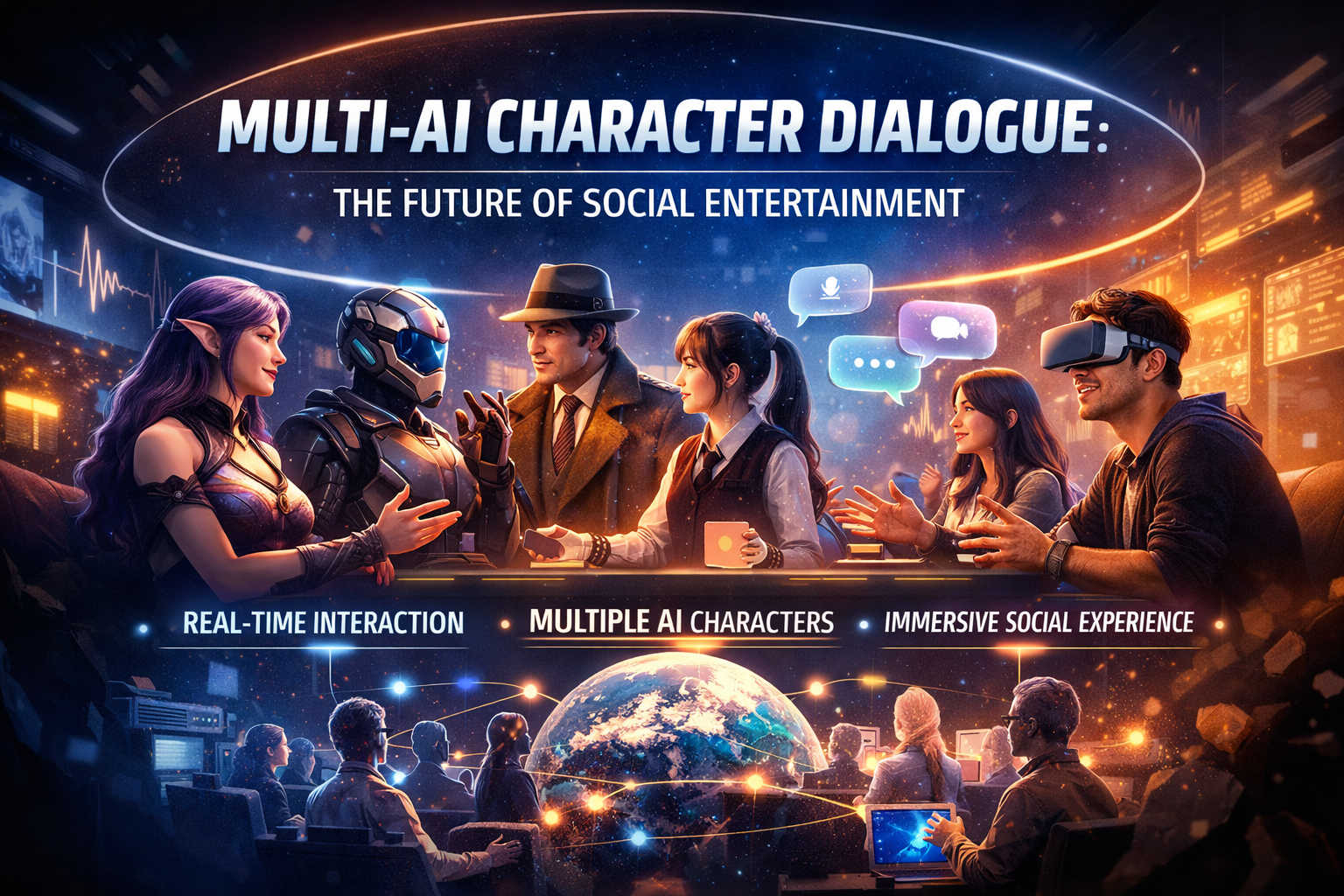
A new paradigm is emerging to close this gap: interactive experiences driven by real-time dialogue between multiple AI characters. Instead of chatting with a single bot, users step into living scenes where several AI personas talk to each other — and to the user — continuously. This shift is quietly reshaping how social entertainment products are designed, built, and scaled.
In this article, we’ll explore:
- Why single-AI experiences struggle to sustain engagement
- How multi-AI dialogue changes user behavior and retention
- Why real-time communication (RTC) is the missing system layer
- How platforms like ZEGOCLOUD make multi-AI social experiences production-ready
Why Single-AI Social Experiences Hit an Engagement Ceiling
If you look closely at user discussions across developer and AI communities, a consistent theme emerges: single-AI chat experiences struggle to sustain engagement.
From a user perspective, the issues are easy to recognize:
- Conversations lose momentum after a few turns
- AI responses become repetitive or overly agreeable
- There is no sense of social dynamics or conflict
- Stories feel scripted rather than alive
From a product perspective, these issues translate into poor retention curves, limited replay value, and high churn once the novelty wears off.
The underlying limitation isn’t the intelligence of the models themselves — it’s the interaction structure. Human social experiences are rarely one-dimensional. We are accustomed to group conversations, overlapping perspectives, disagreement, humor, and spontaneous exchanges. When AI experiences ignore this reality, immersion breaks quickly.
This is why many AI-native entertainment products plateau early: they try to simulate social experiences using a fundamentally non-social interaction model.
How Multi-AI Character Dialogue Unlocks Social Engagement
When multiple AI characters can interact within the same environment, the experience changes qualitatively. Dialogue shifts from linear exchanges to dynamic, emergent interaction. AI characters can:
- Respond to each other, not just the user
- Express conflicting opinions or emotions
- Form alliances, disagreements, or evolving relationships
- Drive conversations forward even when the user is passive
For users, this creates the feeling of stepping into an ongoing scene rather than starting a conversation from scratch. The experience feels closer to joining a group of people mid-discussion — a familiar and compelling social pattern.
This shift unlocks several powerful engagement mechanics:
- Narrative Depth
Stories are no longer delivered through monologues. Plot emerges through dialogue, tension, and interaction between characters with distinct motivations.
- User Agency
Instead of prompting the AI for the “next response,” users influence the direction of conversations, choose sides, interrupt, or provoke reactions.
- Unpredictability
When multiple AI agents interact, outcomes become less deterministic. This sense of unpredictability is critical for replayability in entertainment apps.
In short, multi-AI dialogue transforms AI from a conversational tool into a social environment.
Where Multi‑AI Character Dialogue Creates the Most Impact
Multi‑AI character dialogue can enhance many digital products, but nowhere is its impact more immediate—or more transformative—than in social entertainment. This category is fundamentally built on presence, interaction, and emotional engagement, all of which are amplified when multiple AI characters can converse naturally in real time.
Social Audio and Voice Rooms
AI characters no longer play a passive or ornamental role. They can host discussions, co‑host with humans, or participate as equal contributors—responding not only to users, but also to other AI characters in the room. Even when human participation dips, conversations continue to evolve, giving users the feeling of entering a live, ongoing discussion rather than an empty space.
Interactive Story and Drama Apps
Multi‑AI character dialogue shifts storytelling from consumption to participation. Users don’t follow prewritten branches or tap through scripted options. Instead, they speak directly to characters, interrupt scenes, challenge motivations, or steer conflicts. The result feels less like reading interactive fiction and more like stepping into improvisational theater.
AI Role‑Play and Companionship Experiences
Multiple characters introduce social context that a single AI can never replicate. Friends, rivals, mentors, and observers form a living social fabric around the user. Relationships emerge not just between the user and AI, but among AI characters themselves—making the experience feel communal rather than solitary.
Online Games and Virtual Worlds
When AI‑driven NPCs can talk to each other, worlds feel inhabited instead of staged. Players don’t simply trigger dialogue trees; they observe conversations unfolding, intervene at key moments, or influence outcomes through presence rather than prompts.
Across all these scenarios, one principle remains constant: social entertainment thrives on interaction density. Multi‑AI character dialogue increases the number of meaningful interactions happening at any moment, turning AI from a background feature into the engine of immersive, social experience design.
Why Multi-AI Dialogue Breaks Without Real-Time Infrastructure
Multi-AI character dialogue may sound intuitive, but delivering it as a smooth, believable experience is far more complex than adding another AI chatbot.
Once multiple AI characters interact in the same space, the experience stops being a simple AI feature and becomes a live social system. At that point, success depends not only on how smart the AI is, but on how well conversations unfold in real time.
Several core challenges consistently emerge:
- Conversation flow
Real group conversations are messy by nature. People interrupt, pause, react, and speak over one another. If AI characters can’t handle these dynamics, dialogue feels either chaotic or unnaturally rigid—especially in voice-based experiences.
- Latency sensitivity
In social entertainment, milliseconds matter. Even small delays can break the illusion of presence. When multiple AI characters generate and respond simultaneously, keeping interactions fast and fluid becomes far harder than in one-to-one chat.
- Character consistency
Each AI character needs a clear, recognizable personality and role that remains stable over time. If characters contradict themselves or lose their identity as conversations evolve, trust erodes and engagement drops quickly.
- Shared context
Multi-AI dialogue creates a living scene: what has already happened, which tensions remain unresolved, and how relationships are evolving. Keeping every character aligned with this shared understanding—without becoming slow, repetitive, or expensive—is difficult to sustain at scale.
- Audience-scale reliability
What feels impressive in a small demo often breaks under real-world conditions. These experiences must remain coherent and responsive when thousands of users join simultaneously from different regions and devices.
This is why many multi-AI concepts never reach production. The missing piece is rarely imagination or AI capability—it’s the real-time interaction foundation that keeps everything coherent, responsive, and scalable.
Real-Time Communication (RTC) is The Foundation for Multi-AI Character Dialogue
Solving multi-AI character dialogue at scale requires a shift in perspective. AI agents cannot be treated as background services that respond in sequence—they must behave as real-time participants inside a shared social space.
To make multi-AI dialogue feel natural and believable, social entertainment platforms need a real-time interaction foundation that supports:
- Low-latency voice and messaging, so conversations feel immediate rather than turn-based
- Reliable multi-party synchronization, keeping all participants—human and AI—aligned in the same moment
- Deterministic event ordering and speaker control, ensuring dialogue flows naturally even when interactions overlap
- Flexible role and session management, allowing AI characters and users to coexist seamlessly in the same room
At this point, real-time communication is no longer optional infrastructure—it becomes the core layer that holds the experience together.
Building Multi-AI Social Experiences with ZEGOCLOUD
With the right real-time foundation, multi-AI character dialogue becomes practical and engaging. ZEGOCLOUD’s platform combines AI orchestration and RTC infrastructure to deliver this at scale.
Key Capabilities
- Real-Time Group Interaction: Multiple AI characters and users share the same room, with synchronized voice or text and minimal latency.
- Flexible Agent Orchestration: Assign distinct roles, personalities, and behaviors to each AI character, creating dynamic interactions.
- Scalable Social Infrastructure: Handles high concurrency, global distribution, and network variability without degrading experience.
- Natural Voice Experiences: Ensures fluid, lifelike conversations in voice-first applications.
These capabilities let developers focus on designing immersive social experiences rather than managing underlying infrastructure.
Practical Use Cases
- Interactive Audio Dramas: Step into live scenes where AI characters evolve stories in real time.
- AI-Hosted Social Rooms: AI hosts guide discussions and respond dynamically to participants.
- Narrative-Driven Social Games: AI NPCs interact with each other to create emergent storylines.
- Collaborative Story Worlds & Role-Play Platforms: Communities influence AI character relationships, turning solitary play into social experiences.
By combining multi-AI dialogue with real-time interaction, ZEGOCLOUD transforms static AI into a living, participatory social environment.
Conclusion
The future of social entertainment is not about smarter answers — it’s about richer interactions. By moving beyond one-to-one conversations and embracing real-time, multi-party interaction, developers can create experiences that feel alive, social, and endlessly replayable.
The technology to build these experiences is already here. The next wave of innovation will belong to teams that combine intelligent agents with real-time communication — and design for interaction, not just conversation. If you’re exploring how to build AI-native social entertainment experiences, now is the time to rethink what dialogue can be.
Start building your AI-native social experience today with ZEGOCLOUD. Explore our platform, schedule a demo, and see how multi-AI character dialogue can transform your app into a living, interactive world.
Let’s Build APP Together
Start building with real-time video, voice & chat SDK for apps today!