






Real-time audio and video do not fail because people stop talking. They fail when networks become messy, routes become unstable, and users connect from places your system was never designed to handle.
Most real-time systems work perfectly—until they scale.
- Calls that are smooth locally become laggy across regions
- Packet loss spikes when users switch networks
- Failover takes minutes—or doesn’t happen at all
These are not implementation bugs.
They are architectural limits.
This is exactly why building real-time products today is no longer about APIs or SDKs—it’s about designing a global RTC architecture that can handle real-world network complexity at scale.
Why Traditional Systems Fail Before Reaching Global RTC Architecture
At small scale, even basic WebRTC setups behave predictably.
At global scale, they break in subtle but critical ways.
| Problem | What actually happens | Real-world impact |
| Single-cloud dependency | Locked into one provider’s regional strengths | Unbalanced global performance |
| Centralized media routing | Traffic anchored to fixed regions | High cross-border latency |
| Reactive failover | Recovery triggered after failure | Downtime in minutes or hours |
| Static routing logic | No real-time adaptation to network conditions | Jitter and packet loss |
These issues are not implementation bugs—they are architectural constraints.
Which is exactly why modern systems require a global RTC architecture, not just RTC features.
The Four Pillars of Elite Global RTC Architecture
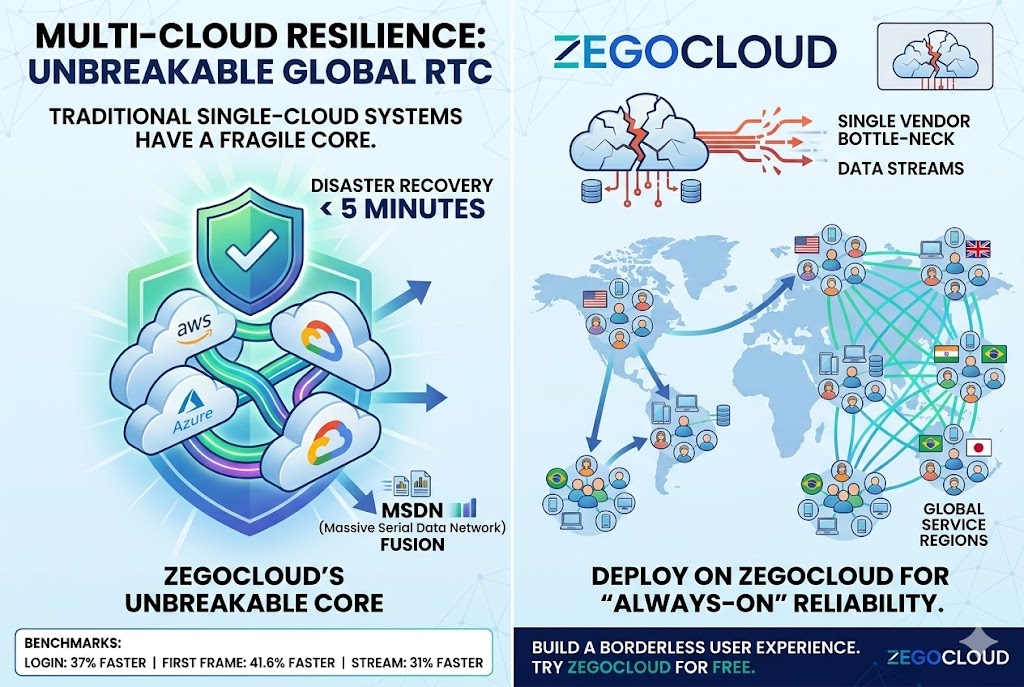
The core of this system is a multi-cloud fusion framework that has been verified by trillions of minutes of real-world use. By breaking away from single-vendor limitations, ZEGOCLOUD built a global RTC architecture defined by four critical technological breakthroughs:
1. Interconnected Co-hosting Clusters
Traditional architectures often face “cloud vendor lock-in” or data silos between different regions. Our solution implements cross-vendor and cross-region media flow synchronization to achieve a truly multi-active network.
- Self-developed MSDN: A network of 500+ global nodes that probes quality in real-time to provide intelligent routing and second-level fault recovery.
- On-demand Sync: Media information is synchronized based on active subscriptions, drastically reducing bandwidth waste.
2. Signaling Room 2.0
Signaling is the nervous system of any global RTC architecture. This version focuses on millisecond-level state synchronization.
- AI-driven routing decisions: Customizes transmission paths based on the user’s specific ISP and region to bypass congestion.
- Incremental Sync: Only changes in state (like a user joining) are synchronized, keeping the global experience consistent and fluid.
3. Edge Unified Access Layer
To ensure business continuity, we built a high-availability disaster recovery system that integrates into daily operations.
- Active Health Probing: 24/7 multi-path monitoring of latency and packet loss triggers proactive link switching.
- Rapid Migration: If a center fails, users migrate to a healthy center in under 5 minutes—slashing industry-standard recovery times.
4. Edge Secondary Scheduling
By offloading computational tasks like smart pre-connection and dynamic caching from the center to the edge, we achieve significant performance gains:
| Performance Metric | Improvement |
| First Frame Time | 41.6% faster |
| Login Latency | 37% faster |
| Stream Publishing | 31% faster |
| Center Server Load | 45% reduction |
Competitive Landscape: How Different RTC Approaches Relate to Global RTC Architecture
“RTC” is not a single solution—it’s a spectrum of architectural ownership.
Different platforms represent fundamentally different approaches.
Self-managed WebRTC Stack (Full Ownership Model)
The most flexible—but also most operationally complex approach.
Built with:
- WebRTC core
- Custom SFU (mediasoup, Janus, etc.)
- Self-managed signaling + routing
Trade-off:
- Maximum flexibility
- Maximum complexity
You are responsible for building the entire Global RTC architecture yourself
Twilio (API Abstraction Model)
Twilio abstracts infrastructure entirely.
Position in RTC stack:
- Provides APIs instead of architecture
- Hides routing and media complexity
Trade-off:
- Fastest to integrate
- Limited control over routing and performance
Best for speed—not for deep optimization.
ZEGOCLOUD (Full Global RTC Architecture Model)
ZEGOCLOUD focuses on infrastructure-level design rather than only SDK or API abstraction.
Position in RTC stack:
- Multi-cloud fusion
- Edge routing + scheduling
- Media cluster interconnection
- Built-in failover and global optimization
Trade-off:
- Requires more architectural awareness
- Removes the need to build core infrastructure internally
Decision Framework: Who Should Choose What?
| If you are… | Best choice |
| Infrastructure-heavy team with RTC expertise | Self-managed WebRTC |
| Need fastest time-to-market | Twilio |
| Need global-scale reliability and performance | ZEGOCLOUD |
The real decision is not about features—it’s about how much of the architecture you want to own.
Why Global RTC Architecture Matters for AI-Native Applications
The rise of Real-time AI voice agents is redefining infrastructure requirements.
These systems demand:
- Sub-300ms latency
- Continuous bidirectional streaming
- Zero interruption tolerance
Unlike traditional RTC:
- Delays break conversation flow
- Packet loss disrupts AI inference
- Failures destroy user experience
This makes Global RTC architecture not just important—but foundational.
Key Insight: Where Real Differentiation Lives
Most teams focus on:
- APIs
- SDKs
- Codecs
But these are not the true bottleneck: the real differentiation in real-time systems lives in the Global RTC architecture.
Because that’s where:
- latency is controlled
- failures are absorbed
- global consistency is maintained
Conclusion
As real-time applications evolve—from live streaming to AI voice agents and immersive collaboration—the requirements placed on infrastructure are fundamentally changing.
A modern global RTC architecture is no longer optional infrastructure design—it is the foundation that determines whether real-time experiences feel seamless or fragmented.
By combining multi-cloud fusion, edge intelligence, adaptive routing, and resilient signaling systems, platforms like ZEGOCLOUD are building systems where:
- Distance becomes irrelevant
- Failures become invisible
- Performance becomes globally consistent
Ultimately, the success of real-time applications will not be defined by features alone—but by how well their global RTC architecture is designed.
Because in real-time communication:
It is not enough for systems to work.
They must work everywhere.
FAQ
1. How does Global RTC architecture handle unreliable local networks?
The system uses 500+ MSDN nodes to constantly probe network quality. If a path shows high packet loss or jitter, the intelligent routing algorithm automatically switches to a better path in seconds.
2. What happens if a major cloud provider goes down?
Because this is multi-cloud fusion architecture, your service isn’t tied to one vendor. Our “Seamless Traffic Migration” can move users to a healthy center provided by a different vendor in under 5 minutes, usually without the user noticing.
3. How is global state consistency maintained?
Signaling Room 2.0 uses a millisecond-level incremental synchronization mechanism. It only sends updates when something changes, ensuring everyone in the room—regardless of their physical location—sees the same status at the same time.
4. Does this architecture support compliance requirements?
Yes. The multi-cloud approach allows you to select specific cloud providers or data centers that meet the local regulatory and compliance requirements of the countries you are operating in.
Let’s Build APP Together
Start building with real-time video, voice & chat SDK for apps today!
