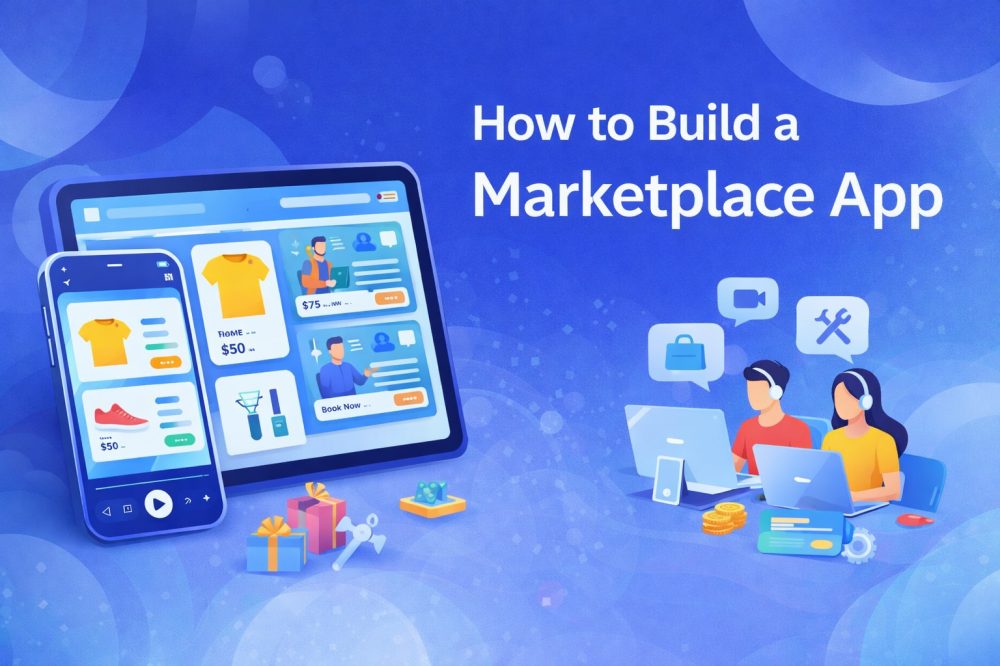
Connecting buyers and sellers on a single platform is a new way to grow businesses and reach new audiences. Companies are eager to build a marketplace app that provides a seamless shopping experience, enabling users to discover products. Therefore, a well-structured marketplace app ensures accessibility anytime, anywhere, with a trusted space for all. To get started, continue reading the guide for guidance on building a successful app, including a feature breakdown.
What is a Marketplace App?
An app-like marketplace is a digital platform that connects multiple buyers and sellers, allowing them to list, browse, and transact products or services in one place. It’s a web or mobile application where many independent vendors create listings, buyers search and compare options. Moreover, it serves as an intermediary, providing infrastructure such as user accounts, reviews, and secure checkout.
The E-commerce Germany report states that the digital marketplace market is valued at USD 580 billion in 2024. However, it is expected to exceed 1.06 trillion USD by 2030, growing at roughly 10.6% annually. Popular examples include Amazon and eBay, where the apps aggregate inventory from many providers and offer it to customers. They also facilitate numerous options and price comparisons, helping sellers reach more customers with lower setup costs.
Types of Marketplace Apps
As businesses explore the potential of online platforms, knowledge of different models can help them choose the right approach. From product-focused platforms to service-based solutions, each listed app for the marketplace also ensures business growth and user engagement.
1. B2C Marketplace App
This type connects professional businesses with end customers, like Amazon and AliExpress, offering a range of consumer services. Moreover, its core features include rich product listings, search and filtering, and multiple payment options. Statistically, Amazon generated approximately USD 638 billion in revenue in 2024, underscoring the dominance of B2C marketplace platforms.
2. B2B Marketplace Apps
It connects companies buying and selling in bulk, like Alibaba and other procurement platforms for raw materials and wholesale goods. However, the functionalities include contract management, multi-user company accounts, and an invoicing system to streamline corporate purchasing. According to the Digital Commerce report, Alibaba serves importers and exporters from over 240 countries, illustrating its global B2B sourcing.
3. C2C Marketplace App
Another mobile marketplace app that allows individuals to sell or rent items to others, similar to eBay or Facebook. Such types include simple listing creation, chat or messaging, and local search, enabling regular users to trade used goods. Notably, leading C2C platforms such as Etsy facilitate tens of millions of buyers seeking secondhand and unique goods.
4. P2P / Sharing Marketplace App
P2P marketplace apps focus on sharing or renting assets and skills directly between people, like Airbnb (homes) or Uber. They emphasize profiles and verification, scheduling, or booking, and location services, often adding ratings to build trust. Additionally, they rely on calendars, real-time matching, and strong identity verification to manage customer risk.
5. Product Marketplace Apps
They specialize in selling physical goods from multiple vendors, including Amazon, Etsy, and Walmart Marketplace. Features include inventory and catalog management, shipping and logistics tools, along with order tracking functionality. Moreover, it includes possibilities like SKU management, optimizing search, and merchandising to move physical goods.
6. Service Marketplace Apps
It connects customers with service providers rather than physical products; for instance, Upwork, Fiverr, and UrbanCompany. With features such as portfolio upload, booking, time-slot management, and chat/call functionality, it controls the system’s quality. Factually, Upwork processes over USD 4 billion, while Fiverr handles about USD 1.13 billion across 700+ service categories.
7. Vertical Marketplace Apps
It’s among the best marketplace apps, focusing on a single industry or product category, like only fashion or only home services. Moreover, they provide specialized filters, domain-specific content, and curated listings to deeply serve a single niche. In addition, this narrow focus helps attract a dedicated audience, generate high revenue, and reflect strong engagement within its niche.
8. Horizontal/Global Marketplace Apps
These apps cover many unrelated categories and often operate across regions or globally, similar to Carrefour’s marketplace. In addition, it offers capabilities such as broad-category navigation, multi‑language or multi‑currency support, and global shipping options on one platform. Their advantage is resilience and massive traffic, but they solve complex organizational challenges while keeping navigation or search simple.
Is It Worth Building a Marketplace App?
Building apps like Facebook Marketplace can be worthwhile, as online commerce and marketplace spending continue to grow. According to Netguru Ecommerce Statistics, online sales totaled $6.7 trillion and are expected to reach $8 trillion in 2027. This also indicates strong demand for digital buying channels, with marketplaces playing a significant role. However, from a business model perspective, marketplace apps are attractive because they avoid holding inventory.
Founder’s guide in 2025 notes that a basic MVP marketplace can often be tested in the 30,000-50,000 USD range. Besides, global mobile app revenue is projected to reach approximately USD 900 billion in the coming years. However, an app’s worth building depends on having a clear niche and solving real problems for both sides of the market.
Key Features of a Successful Marketplace App
Consider the provided features and determine how to build a marketplace app that attracts users and keeps them engaged:
1. User Accounts
Clear profiles for buyers and sellers help store names, contact details, and history, enabling people to know whom they are dealing with. Moreover, easy sign-ups with email, phone, and social logins reduce friction and encourage more users to register.
2. Detailed Listing and Catalogs
Product or service listing pages show photos, description, and price information so buyers understand exactly what is offered. Moreover, a structured catalog with categories, tags, and attributes keeps thousands of listings organized and easy to browse.
3. Search and Filter Functionality
Strong search allows users to type a keyword and instantly see their relevant results. Additionally, filters for price, category, and availability, or sorting options, help people quickly narrow down to the right choice.
4. Secure Payments and Payouts
Integrated payment gateways allow safe card and digital payments inside apps like a marketplace. Furthermore, split payments and payout tools send the right amount to each seller and keep a commission for the marketplace.
5. Orders, Booking, and Tracking Feature
Order or booking management shows buyers and sellers at each step: placed, confirmed, shipped, delivered/cancelled. For physical goods, shipping tracking links and status updates make delivery clear; for services, time slots make scheduling easy.
6. In-App Messaging Ability
Built-in chats let buyers and sellers ask questions, confirm details, or negotiate before and after ordering. Moreover, keeping messages within the app improves safety, provides support teams with context, and minimizes misunderstandings.
7. Admin Panel and Analytics
An admin panel allows the marketplace owner to approve sellers, moderate content, set commission, and handle disputes. In addition, it displays key metrics such as GMV, active users, and top sellers, enabling data-driven decisions.
8. Notifications and Personalization
Push notifications and email alerts notify users about new messages, order status, and newly launched offers. Additionally, personalized recommendations and “related items” help users discover more relevant products and drive sales.
9. Ratings and Reviews
In mobile marketplace apps, buyers should rate sellers and write short reviews about quality and communication. Ultimately, this feedback also builds trust, helps new users choose, and pushes sellers to provide better services over time.
How to Build a Marketplace App
With an appropriate development approach and technology stack, businesses can successfully learn how to create a marketplace app. In this context, a comprehensive guideline is explained below that is scalable, secure, and user-focused:
1. Demonstrate Your Concept and Niche
Start by deciding what your marketplace will focus on: products or services, and which niche (fashion or home services). Besides, study your target users, their main problem, and why they would choose your app instead of existing competitors.
2. Specify the Marketplace Type/Model
Decide on your kind, such as B2C (business to consumers), B2B (business to business), or C2C (people to people), or mix. Moreover, choose a monetization model, such as commissions per sale, seller subscriptions, listing fees, or advertising.
3. List Core Features (MVP)
Note down the minimum features you need for launch: sign up/login, profiles, cart/bookings, and basic admin tools. Additionally, keep the first version small so you can launch faster and get real feedback before adding advanced features.
4. Add Real-Time Communication with ZEGOCLOUD
Add real-time communication using ZEGOCLOUD Video Call SDK to enable direct interaction between buyers, sellers, and support teams. Real-time interaction helps users clarify product details, resolve order issues, and build trust, which is especially valuable for high-consideration purchases and service-based marketplaces.
5. Plan the Tech Stack and Architecture
Choose how you will build a marketplace app: native mobile app, web app, or selective backend technology. Moreover, plan your architecture so it supports three roles: admin, sellers, and buyers, and scales as listing and traffic grow.
6. Add Cart/Booking and Order Flow
For products, build a cart where users can add items from multiple sellers and place one combined order. However, for services, build a booking flow that includes date/time selection, confirmation, and status updates for pending bookings/cancellations.
7. Incorporate Payments and Seller Payouts
Connect a payment provider that supports the marketplace and split payments, for example, Stripe for marketplaces. After this, implement secure checkout, refunds, and automated payouts to ensure your system pays each seller correctly.
8. Test Thoroughly (QA and Security)
Run functional test (does the feature work), usability test ( is it easy to use), and load test (does it handle traffic). Furthermore, check security basics such as password rules, HTTPS, input validation, and protection of payment/personal data.
Why Choose ZEGOCLOUD for Your Marketplace App Development?
Considering ZEGOCLOUD for apps like Facebook Marketplace helps deliver real-time messages to users with lower latency, as low as 200ms. Besides this, its pre-installed layout can facilitate hundreds of millions of messages from users easily. Moreover, with its In-App Chat API, you can create a group or multiple buyers and launch your new product. Within this, you can integrate the User Management feature to update user statuses and avatars.
Most importantly, its built-in UIKits help demo a concept prototype to show developers what they want to build. You’re further supported by ready-made UI components to create a feature-rich communication experience with customization capabilities. Additionally, its Voice Call SDKs help address call quality issues in real time, enabling faster resolution. To improve support-to-buyer communication, you can also use the AI Noise Reduction API to remove all noise.
How Much Does It Cost to Build a Marketplace App?
Complete structural cost knowledge behind the best marketplace app helps set realistic expectations and avoid unexpected expenses. From app complexity and feature set to design, each listed factor influences the overall cost of building a marketplace app:
1. Typical Cost Ranges
- Basic MVP marketplace app (core features only) usually costs around 25,000-60,000 USD when built by a professional.
- Full-featured multi-vendor marketplace with advanced functions (analytics or marketing tools) ranges from 100,000 to 300,000+ USD.
2. Main Things That Change the Price
- Features and Complexity: Each additional feature (discounts, chat, live chat, or B2B flows) adds design, development, and testing time.
- Platform and Technology: Building for Web-only is cheaper than Web + iOS + Android, and native apps typically cost more than a single-platform codebase.
- Team Location and Rates: Agencies in the US/Western Europe often charge 80-150+ USD/hour. However, teams in Eastern Europe and South Asia may charge approximately USD 25-60/hour.
3. Backend, Integration, and Running Costs
- Backend and Integrations: Multi-vendor logic, payments, and real-time tools significantly increase backend and integration effort.
- Ongoing Costs: Plan to roughly use 15-25% of your initial budget per year for maintenance and updates. Moreover, include monthly hosting and third-party service fees in your app development planning.
Conclusion
In conclusion, to build a marketplace app, the first step should be to choose the right model and plan your estimated costs. To ensure success, the guide above covers a well-executed plan with stepwise guidance for the development process. However, ZEGOCLOUD is suggested to reduce costs and deliver a professional marketplace experience that meets modern user expectations.
FAQ
Q1: How much does it cost to develop a marketplace app?
The cost to develop a marketplace app usually ranges from $30,000 to $80,000 for a basic MVP. A more advanced marketplace with payments, real-time features, and scalability may cost $100,000 to $300,000+, depending on complexity and platforms.
Q2: How to develop a marketplace app?
Marketplace app development typically starts with defining a niche and business model, followed by building an MVP with core features such as listings, payments, and user management. After launch, you can scale by adding advanced features, integrations, and performance optimizations.
Q3: Are marketplace apps profitable?
Yes, marketplace apps can be profitable if they reach sufficient transaction volume and maintain healthy unit economics. Common revenue models include commissions, subscriptions, listing fees, and advertising, with profitability improving as the platform scales.
Q4: How to make your own marketplace?
To make your own marketplace, focus on solving a clear buyer–seller problem, choose the right marketplace model, and launch with essential features only. Validating demand early and iterating based on real user feedback are key to long-term success.
Let’s Build APP Together
Start building with real-time video, voice & chat SDK for apps today!