Today, students don’t need simple answers to their questions; they demand guidance adapted to their learning style. Thus, many of them prefer AI study companion apps like Gauth to make their passive study more interactive. Also, the growing necessity for remote learning and self-paced education makes an AI-driven study companion more relevant. So, if you’re on the journey to develop a similar companion of your own, continue with the guide below.
What is the Gauth AI Study Companion?
Gauth AI study companion is an app that helps you with homework by providing clear, step-by-step solutions and explanations, rather than just showing direct answers. Here, students can snap a photo of a question or type it in, and the companion simply helps them out. Furthermore, you can seek guidance for multiple Maths queries, as well as subjects like Physics or Biology.
It adds valuable tools like a built-in calculator, focus mode to reduce distractions, and a history of your solved questions. In particular, the Gauth app is designed to be a “Study Helper” that you can carry easily in your pocket. Simply, it’s a 24/7 tutor help for students over 13 years old, available on both Android and iOS devices.
Why Businesses Should Invest in AI Study Companion Apps Like Gauth?
As on-demand academic support gains momentum, businesses now look forward to smarter, AI-powered education solutions. In this context, this section further clarifies why investing in an AI study companion app like Gauth is valuable today:
- Huge and Fast-Growing Education AI Market: Currently, the AI education and tutoring space is growing immensely, so there is strong long-term revenue potential. Moreover, as Precedence Research shows, AI in the education market is growing roughly at 34-35% per year.
- Strong Value for Schools, Parents, and Teachers: An AI study companion can be sold to learners (B2C) and to schools or tutoring centres (B2B/B2G). Moreover, AI tutoring services are increasingly being integrated into learning management systems and school platforms as a “co-pilot assistant.”
- 24/7, Scalable Support at Lower Marginal Cost: Once built, an AI companion can support thousands of students at any hour with almost zero extra human cost. Thus, it helps businesses offer free models (free basic help, paid premium features like deeper explanation) and reach a global audience.
- Better User Engagement and Retention: AI study companion app with instant help and progress tracking keeps learners coming back more than static content. Additionally, higher engagement means more chances to upsell subscriptions or live classes, increasing lifetime value per user.
- Students Already Rely on AI for Homework: Building an AI study companion aligns with existing behaviour rather than trying to create new habits. A study by the College Board reports that 84% of high school students in the U.S. use generative AI tools.
How Does an AI Study Companion App Work?
With increasing dependence on AI apps for instant learning support, understanding the mechanics behind these platforms becomes essential. Thus, knowing what Gauth AI study companion is, let’s learn how an AI study companion app actually works:
1. Enter/Type a Question
First, you can either type a question, enter it, or take a picture of your homework. The app uses text and image recognition to read the question, automatically crop it, and detect the subject or topic. Most apps let users highlight just one part of a question to pinpoint exactly where they are stuck.
2. AI Understands the Problem
The app’s AI analyzes the question to figure out what is being asked. Moreover, it identifies key information (numbers or concepts) and determines which rules or methods should be applied. Also, if the question is unclear, it might ask you a quick follow-up to make sure you don’t guess wrong.
3. Generates Step‑by‑Step Help
Instead of only giving the final answer, the app creates a solution broken into clear, small steps. Each step is explained in simple words, sometimes with animations or highlighted parts for complete understanding. Additionally, you can tap to reveal the next step or a hint, which encourages you to think first.
4. Personalizes to Your Learning Style
Gradually, the app watches what you do, which subjects you ask about, and where you make mistakes. Hence, it suggests more practice in weak areas, adjusts the difficulty, and can change how it explains things. This makes the experience feel more like a personal tutor who knows you, instead of a one‑size‑fits‑all tool.
5. Offers Real‑Time Assistance
Most of the AI study companion apps include a chat-style helper or a virtual tutor. Some, like Gauth, can connect you with human experts 24/7 and combine AI with real tutors to deliver quick answers. Therefore, this mixture of AI help and human backup means you are rarely left stuck, even with hard problems.
6. Tracks Your Progress and Results
Lastly, the app keeps a history of solved problems and sometimes shows simple stats of what you’ve practised. Thus, it helps you review past questions, see your improvements, and plan what to study next. Such apps also turn progress into motivation, using streaks and badges to keep you studying a little bit every day.
Features of the AI Study Companion App, Like Gauth
The growing demand for AI-supported companions highlights the essential features that make a Gauth AI study companion effective. Hence, all the important features are outlined below that truly help students across different subjects and learning levels:
- Accurate, Stepwise Solutions: The app solves questions in a few seconds and shows each step clearly, not just the final answer.
- Multi‑Subject, All‑Grade Support: Gauth covers all school subjects like physics, biology, and more, from basic to advanced levels.
- 24/7 Real Expert Help: Besides AI, Gauth connects you to human experts who can answer tough questions any time of day.
- Easy Photo Input: You just need to take a photo of your homework, and the app automatically recognises and crops the question.
- All‑in‑One Study Toolbox: It includes extra tools like Reading help, writing help, Focus Mode, and a Calculator in the same app.
- Question Bank and Tutorial Videos: With Gauth Plus, you get access to over 100 million questions and more than 20 million tutorial videos.
- Wide Math Topics Coverage: Apps like Gauth support many math areas, including word problems, algebra, functions, calculus, and more.
- Fast, Mobile‑Friendly Experience: These apps are designed for quick, on-the-go use on phones and iPads, providing help in seconds.
- Multi‑Language Support: They support English plus 13 other languages, including French and German, making it convenient for non-English users.
How to Develop an AI Study Companion App Like Gauth
Bringing an AI study companion app to life requires careful planning, the right AI models, and a deep understanding. Therefore, a brief breakdown of steps is provided to see how technology, usability, and education align together for actual value:
Step 1. Define the Goal and Target Users
Decide who you are building for (middle-school or college students) and what problem you want to address. Moreover, list the core value clearly, for example, “instant stepwise help, available 24/7 on mobile.” A focused goal helps you explain your app to investors, schools, and students, avoiding feature creep.
Step 2. Plan Core Features
First of all, choose the main features set you want to include in version 1. For instance, typical features for a Gauth-style app include photo input for questions, AI stepwise solutions, and multi-subject support. Besides this, start with a focused feature set that works well, then add extras like exam modes in later updates.
Step 3. Choose Tech Stack and AI Components
Pick technologies for the app and server, like Front-end (React Native or Flutter) and Back-end (Node.js or Python). Additionally, combine an LLM (for explanations) with OCR (to read images) and a math/solver engine for accurate calculations. Plus, plan your cloud provider and monitoring tools to scale easily if the app grows fast.
Step 4. Integrate ZEGOCLOUD for Live Help
Use ZEGOCLOUD to add real‑time voice/video support on top of AI chat. Thus, you can create 1:1 or small-group sessions in which a human tutor or AI avatar explains problems via video. So, when a student taps “Live Help,” your backend creates a room/token and matches them with a tutor/AI agent. Its Video Call API also allows screen sharing, whether the entire screen or a selected application.
Step 5. Build the AI Solving and Explanation Engine
Create the logic that turns a question into a helpful answer and detects the subject in the AI study companion. Moreover, pass the problem to your solver/LLM and generate a step‑by‑step solution, not just the answer. Plus, add quality checks and fallbacks for situations when the AI is uncertain.
Step 6. Add Personalization and Study Support
Try to make your app feel like a real companion, not just a calculator or helper. Furthermore, track which subject/topic each user asks about, plus their common mistakes. Then, suggest similar practice problems, related concepts, or weak areas with gentle reminders before exams.
Step 7. Implement Progress Tracking and History
Store previously solved questions and basic stats for each student to track progress. In addition, show simple dashboards that show practised subjects, streaks, and filters for revising old questions before tests. This data also helps you see which topics are most popular or harder, guiding future content and feature updates.
Step 8. Run a Test and Launch the App
Finally, run a small pilot with your target users (for example, one school or a group of students). Moreover, watch how they actually use the AI study companion app, then launch it on the App Store/Play Store. After launch, keep collecting feedback and usage stats to improve accuracy, speed, and the overall learning experience.
Tech Stack Behind AI Study Companion App Development
To transform an AI study companion from concept to a high-performing application, always select the right technologies. Thus, examine the tech stack for the Gauth AI study companion apps to create a valuable learning platform:
| Layer | Main Options | Role in the App |
|---|---|---|
| Frontend (Mobile/Web) | React Native, Flutter, Swift/Kotlin, React.js | Builds the student UI, camera screen, or chat view |
| Backend (APIs & Logic) | Node.js, Python (FastAPI/Django) | Handles user data, question routing, and talks to AI |
| Database & Storage | PostgreSQL, MongoDB, or Firestore | Stores users, questions, and solutions |
| AI & Math Engine | LLM APIs (OpenAI, Gemini, Claude) or math solvers | Understands questions or generates step‑by‑step answers. |
| OCR/Vision | Google Vision, MathPix, Tesseract | Reads text and formulas from homework photos for processing |
| Real‑Time Voice/Video (Optional) | ZEGOCLOUD Voice & Video SDKs | Adds live 1:1 or group audio/video sessions with tutors |
| Cloud & DevOps | AWS, GCP, Azure, Docker | Hosts the app and scales services |
| Analytics & Monitoring | Google Analytics/Firebase Analytics, LogRocket | Tracks usage, errors, and performance |
Cost for Building an AI Study Companion App Like Gauth
For a complete AI study app development process, a detailed investment plan is required for any business. With what Gauth AI study companion is understanding, explore what influences the overall cost for building an AI companion:
| Aspects | What It Covers | Typical Range (USD) |
|---|---|---|
| Planning & Design | Market research, UX flows, UI screens | From $2,000-$5,000 |
| Core App Development | Frontend + backend | About $7,000-$18,000 |
| AI/ML & OCR Integration | LLM, math/solver, image recognition | Ranges $4,000-$10,000 |
| Testing and QA | Functional, performance, device testing | Estimatively $1,000-$3,000 |
| Deployment | Store listing, CI/CD, basic infrastructure setup | Starts from $500-$1,500 |
| Initial Marketing | Launch campaigns, basic ads | Roughly around $500-$3,000 |
| Maintenance (Yearly) | Bug fixes, updates, minor features | $1,000-$2,500 per year |
| Estimated Total (Gauth‑like v1) | Simple–medium complexity app | Nearly around $10,000-$40,000+ |
Future Trends of AI Study Companion App Development
Currently, AI study companion apps are moving toward more personalized, predictive learning. According to Precedence Research, this trend is backed by money and is expected to grow by about 139.79 billion USD. The same study reveals that the expected growth rate is about 34-35%, driven largely by the adaptive learning platform. Moreover, these AI companions will become a normal part of everyday student lives rather than a special tool.
As per the Boston Brand Research & Media report, 87% of students already use AI helpers for schoolwork. Whereas 62% say learning to use AI responsibly will be difficult for their future careers, this suggests that apps need to be built with built-in guidance. However, you can also expect tighter links between school systems and AI study companions. So, the next generation of study apps will plug directly into homework, rather than into a separate app.
How ZEGOCLOUD Enhances AI Study Companion App Development
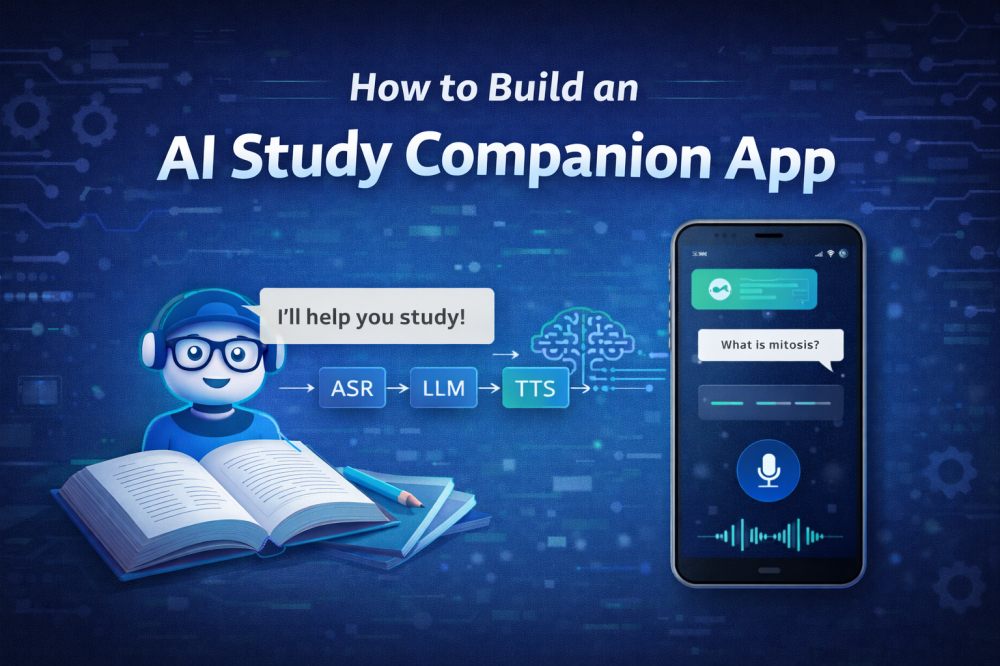
ZEGOCLOUD enhances the development of AI study companion apps like Gauth by enabling real-time conversational experiences between students and AI tutors. Instead of simply reading static answers, learners can interact with AI through natural voice conversations. With ZEGOCLOUD’s Conversational AI capabilities, developers can integrate speech recognition, AI processing, and text-to-speech into a single seamless workflow.

For example, when a student asks a question verbally, the system can instantly convert speech into text using ASR, process the request through an LLM, and return a spoken explanation through TTS. This creates a more engaging and interactive learning experience that feels closer to talking with a real tutor.
In addition, ZEGOCLOUD provides a low-latency real-time communication infrastructure that ensures smooth voice interactions and fast AI responses. This is especially important for study companion apps where students expect immediate feedback while solving problems or reviewing concepts.
Developers can also integrate features such as voice-based tutoring, live discussion rooms, or collaborative learning sessions using ZEGOCLOUD’s real-time communication SDKs. By providing ready-to-use APIs and scalable infrastructure, ZEGOCLOUD allows teams to focus on building intelligent learning experiences rather than managing complex real-time communication systems.
Conclusion
In conclusion, you can say now that an AI study companion has the potential to revolutionize the way students learn. Through instant problem-solving, these apps not only improve academic performance but also keep learners engaged. Therefore, businesses looking to build a high-quality AI study app should partner with ZEGOCLOUD for its 20+ pre-built UIKits.
FAQ
Q1: What is an AI study companion app?
An AI study companion app is an educational application that uses artificial intelligence to help students learn, solve problems, and review concepts. It can answer questions, explain solutions step by step, and provide personalized study assistance. Many apps also support voice interaction and real-time conversations.
Q2: What technologies are required to build an AI study companion app?
Most AI study companion apps rely on several core technologies, including large language models (LLMs), speech recognition (ASR), text-to-speech (TTS), and real-time communication infrastructure. These technologies allow users to interact with AI via text or voice, receiving instant explanations and feedback.
Q3: What are the key features of a successful AI study companion app?
Successful AI study apps usually include features such as instant question answering, step-by-step explanations, voice interaction, and personalized learning recommendations. Some platforms also support collaborative learning, live tutoring, or interactive study sessions.
Let’s Build APP Together
Start building with real-time video, voice & chat SDK for apps today!