Talk to us
Talk to us
menu

How to Develop an AI Math Tutor App

How to Develop an AI Math Tutor App

Math anxiety, learning apps, and one-size-fits-all classrooms leave many students struggling to keep up currently. Therefore, instead of generic lessons, many adapt to AI math tutor apps that identify their weak concepts in real time. This personalized approach helps learners build clarity and confidence, turning confusing formulas into manageable concepts. Thus, move beyond traditional learning limitations and embrace smarter support by reading the following article on AI math app development.

What is an AI Math Tutor App?

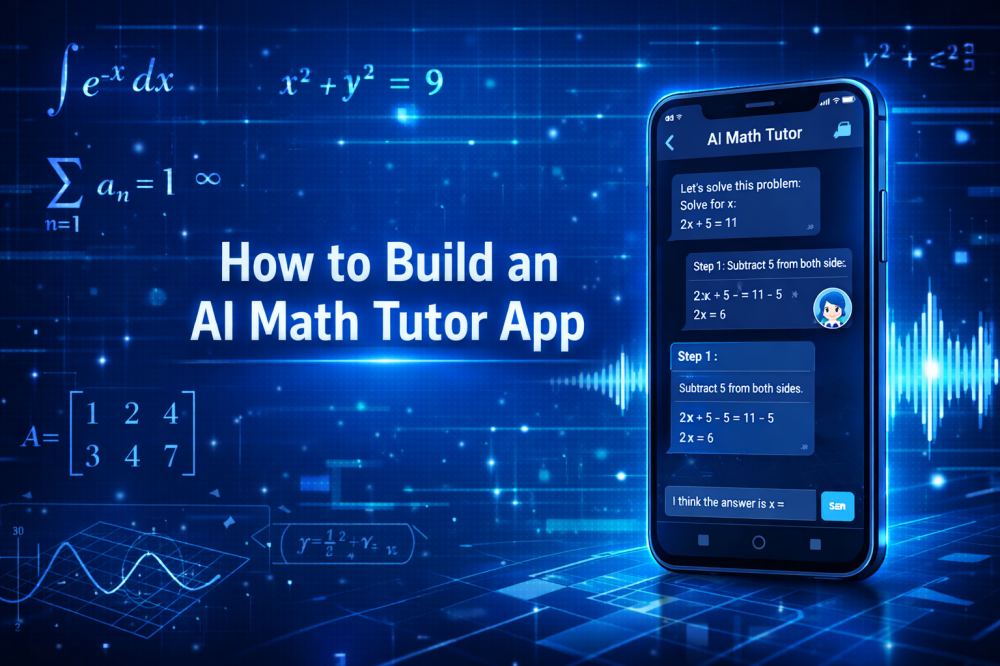
The best AI math tutor app is a software tool that utilizes AI to help you navigate and practice math step by step, like having a teacher in your phone. It can read your questions and show how to solve them, with hints instead of just giving the final answers. Moreover, it’s available 24/7 and adapts to your level by giving easier or harder problems based on your performance.

These apps are now popular because many students already use AI for schoolwork. According to HTF Market Intelligence, the market value of such apps is expected to reach 4.1 billion USD in 2033. While AI tutoring is becoming common in classrooms, Tutorela reports 1.5 times more math improvements with an AI math tutor. Hence, they are important among schools and families seeking cheaper, personalized help in subjects like math.

How AI Math Tutor Works

To genuinely appreciate the impact of personalized math learning, it’s vital to understand how an AI tutor for math works. Therefore, a brief workflow is explained below to transform students’ input into targeted guidance:

1. Enter a Math Problem

Initiate by typing a question, pasting it, or taking a clear picture of your homework. The app then analyzes the text, detects the symbols, and figures out what kind of problem it is. In this context, some math tutor apps might let you select a specific part of a multi-step question.

2. AI Understands and Classifies the Problem

The system examines the problem and determines which math rule to apply. Thus, it chooses an approach, such as factorization, using the quadratic formula, or applying a derivative rule. Behind the scenes, the app uses machine learning models trained on many solved examples to spot patterns.

3. Breaks the Solution into Steps

Instead of jumping to the final answer, the AI tutor splits the solution into small, logical steps. Furthermore, it first checks which ideas are needed, then shows each step in order, so students can follow the reasoning. On any mistake, the app can point to the exact step where things went wrong and explain why.

4. Gives Hints, Explanations, and Practice

Then, you can ask for hints instead of the full solution, and the AI will explain the concept in simple words. However, if you’re still confused, the best AI tutor for math will generate extra practice problems on the same idea. Some advanced AI tutors might switch explanation style (more visual, more stepwise, or more formula-focused).

5. Tracks Progress with Analytics

Finally, in the background, it records what topics you’ve covered, your score, and common error patterns. Additionally, the dashboard can show students where they are improving and which topics still need attention. Importantly, you might see simple charts like “Mastered,” “In Progress,” and “Needs Review” for each topic.

Key Features of an AI Math Tutor App

When looking to boost math skills, the features of a professional math tutor can help it stand out. Thus, let’s review what makes the best interactive math tutoring software using AI an essential for students of all levels:

  • Step‑by‑Step Problem Solving: The app breaks the solution into small, clear steps, helping students understand why each step is taken.
  • Photo and Text Problem Input: Students can either type a question or take a photo of a worksheet or textbook page.
  • Personalized Learning Paths: An AI math tutor analyzes students’ performance, focuses more on weak areas, and adjusts the order of topics.
  • Instant Feedback and Hints: When learners make a mistake, the app explains what went wrong and why with simple hints.
  • Visual Aids and Interactive Elements: A professional AI math app uses graphs, diagrams, and sometimes animations to show what’s happening in a problem.
  • Practice Sets, Quizzes, and Test Preparation: The Math tutor app facilitates students with practice problems and quizzes that match their school exam styles.
  • Progress Tracking and Analytics: The app’s dashboard shows proper scores and time spent, helping teachers and parents identify where the kid is stuck.
  • Multi‑Device and 24/7 Access: Most AI math tutors work on all devices, syncing progress across devices and staying available anytime.

How to Develop an AI Math Tutor App

Developing an AI-driven solution for any purpose requires careful planning and a clear understanding of the users’ needs. With this perspective in mind, a stepwise guideline is provided ahead for developing the best AI tutor for math:

Step 1. Highlight Goals and Target Users

Initially, decide exactly who the app is for and what problems it will solve. For instance, it will help grades 6-10 with Algebra and geometry, or support exam preparations for entry tests. Moreover, choose a focus area like homework help, stepwise practice, exam practice, or complete courses.

Step 2. Design the Learning Experience

Now, plan how the student will learn inside your app, such as scanning problems, getting solutions, and then seeing progress. Moreover, decide on features to include, like photo input, explanations, hints, and optional live/voice help. Additionally, ensure every screen and feature supports real understanding so the app feels like a real tutor, not a calculator.

Step 3. Consider Tech Stack and AI Services

Pick technologies for the front-end (React Native, Flutter) and the back-end (Node.js, Python). Plus, make use of LLM/math engine and a master parser/symbolic engine for reliable calculations. In addition, plan where you’ll host everything, so the app stays fast and stable as more students join.

Step 4. Integrate ZEGOCLOUD for Voice/Video Tutoring

Use the ZEGOCLOUD education solution and Video/Voice calls SDKs to create virtual one-on-one or small-group classrooms. Additionally, incorporate its live-streaming capability to deliver super-high-resolution live videos with low‑latency audio/video. In your AI math tutor, you can facilitate up to 10,000 participants in a video call of 4K resolution.

Step 5. Implement Progress Tracking and Dashboards

Show proper students, teachers, and parents’ progress with a dashboard built with simple visuals. Include key metrics such as topic-level accuracy, time spent, and question difficulty so everyone can analyze strengths and weaknesses. In addition, add simple filters and clear labels to help non-technical parents and younger students understand.

Step 6. Test with Real Students and Iterate

Later, run a pilot with your target users before the complete launch and observe the clarity of explanations. Besides this, observe correctness, speed, and how often students actually learn versus copy. In addition, collect feedback from students, teachers, and parents to improve prompts and logic accordingly.

Step 7. Launch, Monitor, and Scale

After building and testing, release your app to real users through app stores or the web with a clear description, screenshots, and compliance with platform guidelines. Then, continuously monitor key metrics such as active users, error rates, and AI latency to address problems promptly. As your user base grows, scale your servers, AI API capacity, and keep updating features in your AI math tutor.

Cost for Building an AI Math Tutor App

Development of an AI tutor for math requires a clear, concise picture of the financial commitments involved. Therefore, review the following section to analyze what drives the pricing and how different features impact the overall cost:

Key ConsiderationsWhat It CoversEstimated Range (USD)
Discovery and DesignRequirements, UX flows, UI designRoughly around $10,000-$30,000
Core DevelopmentFront-end + back-end, auth, main tutor flowsAround $40,000-$120,000
AI and Math Engine IntegrationLLM APIs, math parser/symbolic engine, promptsAbout $20,000-$70,000
Adaptive Learning and AnalyticsDifficulty adjustment, progress tracking, and dashboardsUp to $15,000-$60,000
Content and CurriculumQuestion bank, tagging by topic/gradeNearly $10,000-$50,000
QA, Security, and ComplianceTesting, performance, privacy, basic edu complianceApproximately $10,000-$40,000
One-Time Build (v1)Sum of a typical custom appRanges from $80,000-$300,000 and more.

Future Trends of AI Math Tutor App Development

Numerous free math AI tutor apps are moving toward more personalized, multi-modal learning, where AI actively teaches students. New systems are already analysing not only right or wrong answers, but also students’ learning journey. According to the AI Tutoring Service Market, these apps will continue to grow to around 21.6 billion USD by 2035. Moreover, their market value will nearly triple, with roughly 19.3% annual growth.

Subsequently, AI math tutors will be more tightly integrated into everyday teaching and big tutoring platforms. In many schools, the AI will give students step‑by‑step help and create extra practice questions on the spot. However, Stanford’s report of Ghana states that students using such apps achieve learning gains with an effect size of 0.36. This means that future AI math tutors will be expected to integrate with school systems.

How ZEGOCLOUD Powers AI Math Tutor Development

ZEGOCLOUD powers your AI math tutor app development by adding real-time interaction on top of your AI engine. This way, students don’t just chat with a bot but can also learn through live video/voice calls SDKs. Moreover, its education-focused SDKs enable you to create HD videos with features like screen sharing and whiteboards. With the Digital Human API, you can generate digital human videos with natural voices for better narration.

Most importantly, developers can control the whiteboard features and UI they want from the flexible APIs suite. For math problems, simply use the Recording and Playback features to help others with similar queries. By incorporating its Live Streaming API, you can enhance low-resolution live videos to high resolution for a better experience. Overall, it delivers an AI agent that responds in real time using LLM+TTS with everything streamed reliably.

Conclusion

In summary, today, AI math tutor apps are reshaping math education by making problem-solving more personalized and stress-free. With smart feedback, adaptive lessons, and instant hints, they help students overcome learning barriers more easily. However, to develop your own scalable product, consider ZEGOCLOUD for its real-time interaction SDKs and its boundless potential for UI/UX customization.

FAQ

Q1: Can I create my own AI tutor?

Yes. You can build your own AI tutor using large language models combined with a structured prompt system, math-solving logic, and a user interface. By integrating real-time communication, step-by-step explanations, and interactive feedback, you can create a personalized AI math learning experience.

Q2: Can you really build an app with AI?

Absolutely. Modern AI APIs enable the integration of text generation, voice interaction, and intelligent tutoring into web or mobile apps. With the right architecture, AI can handle problem-solving, explanations, and adaptive learning.

Q3: Which AI is best for math tutoring?

The best AI depends on your needs. Large language models like GPT-style models are strong at step-by-step explanations. For higher accuracy, combining an LLM with symbolic math engines or calculation APIs can improve reliability and precision.

Q4: How much would it cost to build an AI app?

Costs vary based on complexity. A basic MVP using AI APIs may cost a few thousand dollars in development. More advanced apps with real-time interaction, voice features, and scaling infrastructure can require significantly higher investment depending on usage and server costs.

Let’s Build APP Together

Start building with real-time video, voice & chat SDK for apps today!

Talk to us

Take your apps to the next level with our voice, video and chat APIs

Free Trial
  • 10,000 minutes for free
  • 4,000+ corporate clients
  • 3 Billion daily call minutes

Stay updated with us by signing up for our newsletter!

Don't miss out on important news and updates from ZEGOCLOUD!

* You may unsubscribe at any time using the unsubscribe link in the digest email. See our privacy policy for more information.