






How AI Companion-Generated Content Moderation Creates Secure AI Interactions
 Ilham Moun
Jan 16, 2026
6 min
read
Ilham Moun
Jan 16, 2026
6 min
read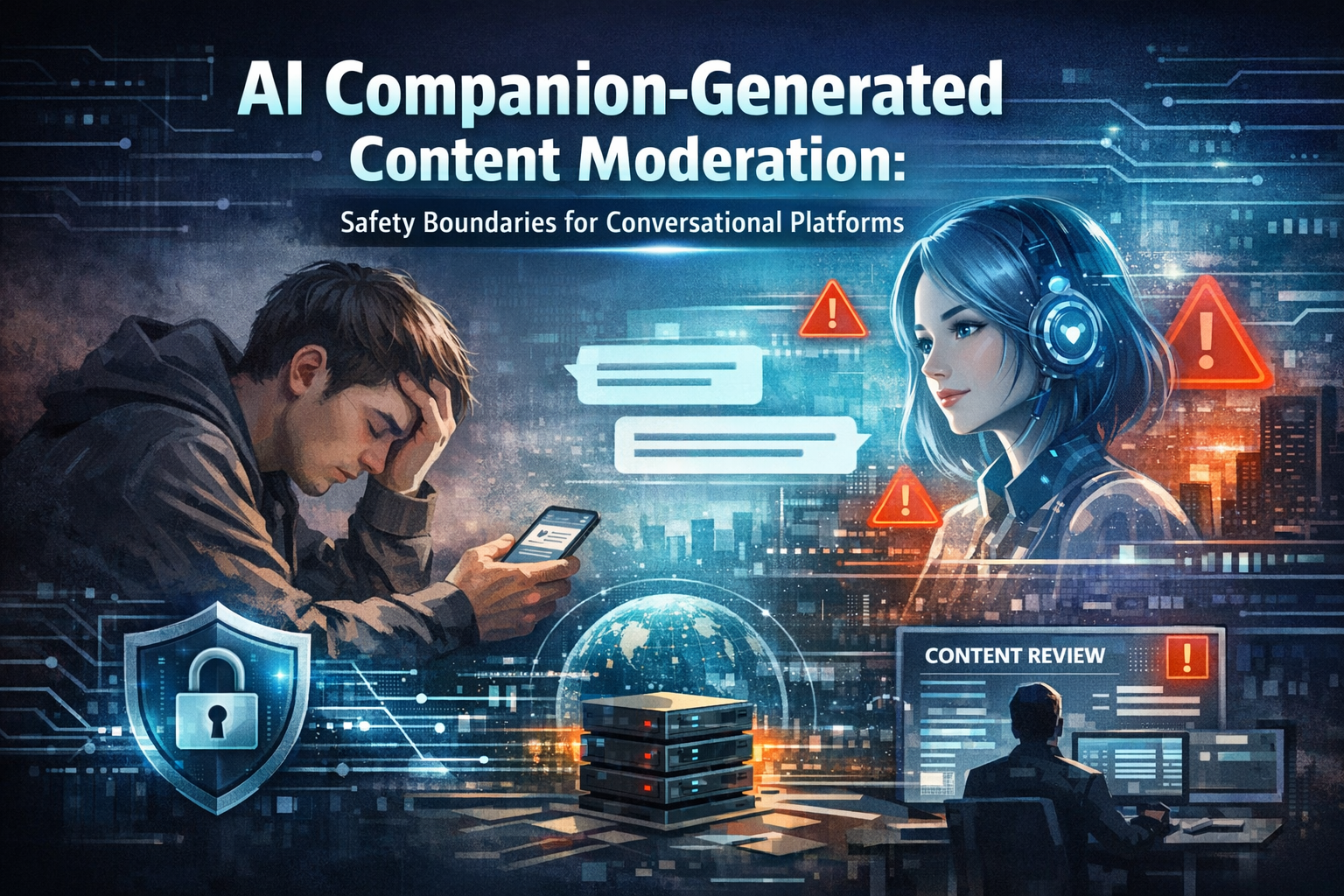
In 2025, international media reported a tragic case involving a teenager who had developed a deep emotional dependency on an AI chatbot while struggling with severe mental distress. Over time, the AI became the primary outlet for his fears and personal turmoil. The conversations, while not intentionally harmful, failed to provide appropriate safeguards or redirection toward professional help.
The case ended in irreversible loss — and forced the technology industry to confront an uncomfortable truth: AI companions are no longer neutral tools. They are social actors whose words directly influence human behavior, mental health, and life decisions.
This transformation changes everything. For AI companion platforms, content moderation is no longer a feature — it is existential business infrastructure.
AI Companion-Generated Content Moderation: From Innovation to Systemic Risk
Conversational AI has moved from novelty to necessity. AI companions now power customer engagement, social platforms, education services, gaming communities, mental-health support tools, and immersive virtual worlds. They simulate empathy, build long-term relationships with users, and participate in moments of emotional vulnerability.
Yet the same qualities that drive engagement also amplify risk.
Unlike traditional social platforms that moderate what users publish, AI companion platforms generate the content themselves. Every sentence produced by the model becomes a corporate statement, a compliance exposure, and potentially a psychological intervention.
This means the business risk profile of AI companion platforms has fundamentally changed. The core question is no longer simply how well the AI performs, but how safely it behaves at scale.
Why AI Companion-Generated Content Moderation Drives Business Growth and Safety
Regulators, investors, and enterprise buyers are rapidly aligning around one principle: AI platforms without robust governance will not scale.
In multiple markets, emerging regulations on AI-generated content, youth protection, misinformation, and emotional harm are already shaping procurement decisions and market entry strategies. At the same time, users are becoming more cautious about where they place their trust, especially in emotionally sensitive interactions.
In this environment, AI companion-generated content moderation becomes a competitive differentiator. Platforms that embed safety at the architectural level unlock faster global expansion, higher user retention, stronger enterprise adoption, and long-term regulatory confidence. Those that treat moderation as an afterthought accumulate compounding risk.
Establishing Safety Boundaries Through AI Companion-Generated Content Moderation
Effective moderation isn’t just about censorship—it’s about creating a secure environment where AI enhances human connection without crossing ethical lines. Here are essential boundaries every conversational platform should implement:
- Proactive Content Filtering: Use advanced algorithms to scan and block inappropriate content before it’s delivered. This includes identifying hate speech, explicit material, or suggestions of violence/self-harm.
- Contextual Awareness and Memory: AI systems should maintain conversation history to provide consistent, safe responses. For example, if a user expresses distress, the AI could respond with resources like helplines instead of engaging further.
- Compliance and Standards: Adhering to global regulations like GDPR and ISO certifications ensures data privacy and ethical AI use, building user trust.
- Real-Time Intervention: Low-latency moderation allows for immediate action, such as interrupting harmful dialogues or flagging them for human review.
Companies leading in this space are integrating these features seamlessly.
Take ZEGOCLOUD as an example—a leading provider of conversational AI solutions that put real-time safety at the core. Our platform offers robust content moderation tools that detect and block inappropriate content, fostering a secure and healthy user ecosystem. With ultra-low latency responses (as fast as 500ms for chat), AI noise reduction for voice interactions, and compliance with ISO27001 and GDPR standards, ZEGOCLOUD ensures conversations are safe, context-aware, and reliable. Whether you’re building AI agents for customer service or interactive companions, our solutions empower developers to create platforms where safety is non-negotiable. By integrating these technologies, platforms can turn potential risks into opportunities for positive, supportive, and trustworthy interactions.
A Reference Architecture for AI Companion-Generated Content Moderation
Designing such moderation is not only an AI problem — it is an infrastructure problem.
Every AI response must pass through risk analysis, policy enforcement, compliance validation, and emotional safety checks before the user receives it, often within milliseconds. Any delay degrades the experience. Any failure exposes the company to legal and reputational damage.
A production-grade system typically contains six tightly coupled layers:
1. Pre-Generation Risk Evaluation Layer
Runs before the LLM produces tokens.
Components:
- intent classifiers
- emotion & vulnerability detectors
- topic risk classifiers
- user safety profile store
The goal is not to block conversation prematurely, but to estimate risk and dynamically adjust response policies.s.
2. Policy-Constrained Inference Layer
Once risk is assessed, the AI generates responses accordingly, under explicit safety constraints rather than open-ended inference.
Inference occurs under:
- domain restrictions
- safety constraint graphs
- persona governance rules
- jurisdiction-specific regulations
Techniques such as:
- constrained decoding
- dynamic prompt injection
- policy-guided token masking
These ensure the AI remains within acceptable behavioral boundaries during generation — similar to how enterprise platforms apply guardrails during inference rather than after the fact.
3. Real-Time Output Inspection Layer
After a response is generated, it is immediately analyzed for:
- policy violations
- emotional risk escalation
- long-term behavior patterns
To remain viable in live conversations, this inspection must operate within a single-digit millisecond latency budget.
4. Intervention & Escalation Engine
Actions include:
- response rewriting
- content refusal
- redirection
- human moderator alerts
- external support resource injection
This layer ensures moderation is not purely punitive, but corrective — guiding conversations toward safer outcomes while preserving user experience.
5. Human-in-the-Loop Safety Layer
For high-risk states identified during live conversations:
- conversation snapshots
- moderation dashboards
- supervisor override controls
- incident logging & audit trails
This layer reflects industry consensus that emotionally sensitive AI companion interactions demand accountable human oversight, especially in cases involving self-harm, abuse, or coercion.
6. Governance, Compliance & Learning Layer
Continuous improvement via:
- feedback loops
- model retraining
- policy updates
- regulatory alignment
This layer supports compliance with global frameworks such as GDPR and emerging AI accountability regulations, transforming moderation from a reactive safeguard into a continuously improving governance system.
How ZEGOCLOUD Supports AI Companion-Generated Content Moderation at Scale
ZEGOCLOUD’s Conversational AI infrastructure provides the backbone for deploying this moderation architecture at scale.
| Requirement | ZEGOCLOUD Capability |
|---|---|
| Global real-time conversation | Low-latency RTC across regions |
| Scalable AI integration | AI-ready communication pipeline |
| Live moderation hooks | Real-time data & event injection |
| Reliability | Enterprise-grade SLA & fault tolerance |
| Compliance | Regional data governance support |
By using ZEGOCLOUD’s platform, AI companion builders can focus on model logic and safety policy, while ZEGOCLOUD handles the hardest systems problems:real-time delivery, global scale, and reliability.
Conclusion
The next generation of conversational platforms will not be defined by who builds the smartest models, but by who builds the most governable ones.
As AI companions become deeply embedded in human lives, trust becomes the primary product feature. And trust is built on AI Companion-Generated Content Moderation — implemented not as an add-on, but as the operating core of the platform.
Companies that embrace AI Companion-Generated Content Moderation today will shape the future of the AI economy. Build responsible, engaging and trustworthy AI experiences with ZEGOCLOUD’s Conversational AI solutions.
FAQ
What exactly is AI Companion-Generated Content Moderation?
It refers to the processes and tools that monitor, filter, and guide content produced by AI companions in real-time, ensuring it stays within safe, ethical boundaries to prevent harm.
Why can’t this be handled solely by LLM providers?
Because effective moderation requires platform-level control, real-time delivery infrastructure, and human oversight mechanisms that go far beyond model training.
Can automated moderation alone solve this?
No. High-risk situations require human oversight combined with AI detection and real-time controls.
What industries need this the most?
Mental-health apps, education platforms, social communities, gaming, customer engagement systems, and any product offering AI companionship.
How can startups implement this safely without massive infrastructure?
By using platforms like ZEGOCLOUD that provide the real-time backbone and governance integration required to scale securely and responsibly.
Will regulation make this mandatory?
Almost certainly. Global regulators are already moving toward strict accountability for AI-generated content, especially in social and companion systems.
Let’s Build APP Together
Start building with real-time video, voice & chat SDK for apps today!
