High-quality video is now the gold standard for every digital viewer today. This amazing clarity comes from 4K streaming, which brings cinema visuals home. Therefore, people love watching sharp movies and live shows on their smart devices. Yet, you need the right setup to enjoy this level of crisp detail. Hence, in this guide, we explore how this tech works for your daily viewing needs.
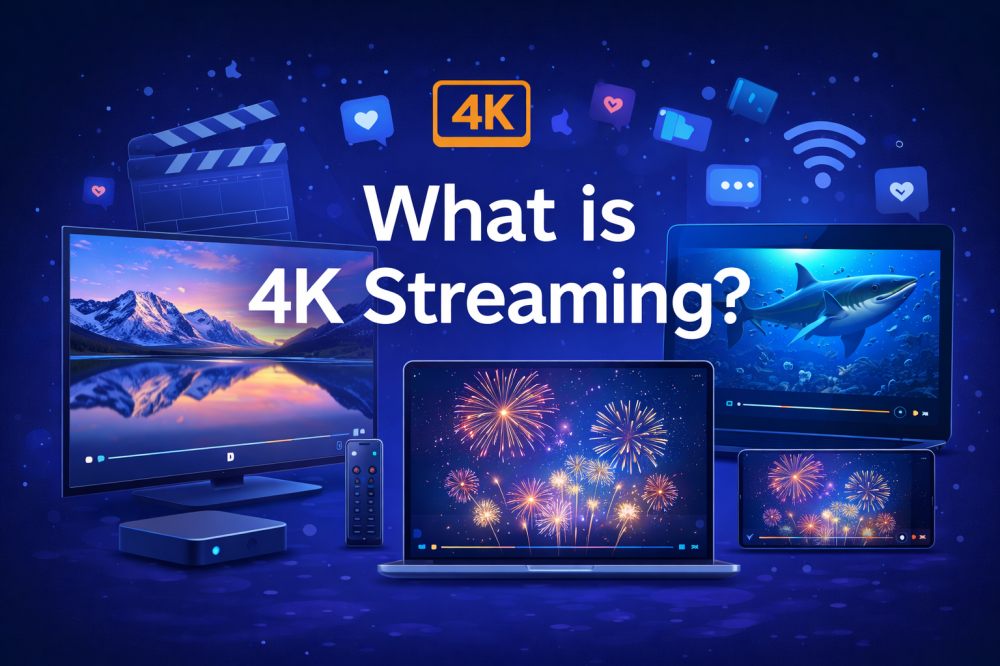
What is 4K Streaming?
4K streaming means watching online videos in Ultra High Definition (UHD), giving sharper images than standard HD. It also shows pictures at a resolution close to 3840 by 2160 pixels with vibrant clarity. Moreover, each frame contains around 8.3 million pixels that bring richer colors and sharper visuals. This level of detail makes every scene look real, especially on big displays.
Unlike regular HD, it delivers 4 times more visible depth and crispness. According to inoRain, most platforms, including Netflix, need at least 25 Mbps download speed. So, stronger connections give smoother motion and fewer loading breaks during playback. 4K streaming services provide this clarity across famous apps and smart devices. However, it uses nearly 7 to 8 GB of data every hour.
Pros and Cons of 4K Streaming
Any viewer should learn about the different advantages and disadvantages of 4K stream. So, the following table provides a clear comparison of these important factors for you:
| Pros of 4K Streaming | Cons of 4K Streaming |
|---|---|
| Offers 4 times the pixels of standard 1080p high definition. | Needs at least 25 Mbps to 50 Mbps for stable playback. |
| Supports HDR and Dolby Vision for much deeper and richer blacks. | Uses 7GB to 10GB of data during every single hour watched. |
| Aligns with modern hardware standards for all new movie releases today. | Requires expensive hardware and premium subscription tiers for full access. |
| Often includes ad-free viewing and multiple screens for the whole family. | Lower bitrates can cause small visual artifacts compared to physical discs. |
Key Features of 4K Streaming
High-resolution video requires specific technical elements to maintain a stable 4K stream bandwidth. Below is the list of details of the essential features that define this quality format:
- Color Depth: The color support 10-bit provides the audience with more than 1 billion distinct colors. Thus, this aspect removes unsightly color banding in clear skies or dark shaded zones.
- Advanced Codecs: New formats like HEVC compress these huge files for much faster transmission. Hence, these smart tools let high-quality video travel across standard home internet connections.
- Motion Quality: High frame rates, such as 60 frames per second, allow smooth movement. So, fast action sports look incredibly fluid and realistic during these intense live broadcasts.
- Upscaling Tech: TVs boost lower-resolution content to fill the entire screen now. Alongside, non-4K videos gain improved sharpness and better overall clarity.
- HDR Support: High Dynamic Range creates brighter highlights and much deeper black levels throughout. Hence, this technology provides a wider range of colors for a truly lifelike image.
How Does 4K Streaming Work?
Finding the best 4K streaming service requires a basic understanding of its background technology. So, this section breaks down how this technology reaches your screen without any hassle:
Step 1. Prepare the 4K Video Initially
To understand what 4K streaming is, it is recommended to capture the original video in 3840 x 2160. After that, codecs such as H.265 or AV1 can be used to minimize file size without losing detail. Additionally, multiple versions at different bitrates are created, allowing adaptive streaming.
Step 2. Video Delivery Over the Internet
Servers store the 4K video in short segments of 2 to 10 seconds each. Here, the best 4K streaming breaks content for fast delivery across networks now. Moreover, your device always downloads these chunks over secure HTTP or HTTPS. Additionally, protocols like HLS or DASH handle requests smoothly during playback time.
Step 3. Access the Adaptive Bitrate Streaming
The player adjusts video quality based on your 4K stream bandwidth in real time. Therefore, when your connection is slow, the player will soon change to a reduced bitrate. This also prevents any annoying buffering or pauses during your favorite action movies. Once your speed improves, the player moves back to full ultra-high definition.
Step 4. Decoding and Display on Your Device
Your smart TV or streaming box decodes compressed 4K video using native hardware chips. Moreover, it unpacks every frame quickly to match native display capabilities now. 4K live streaming encoders prepare content so devices render it flawlessly. Additionally, TVs read HDR data to boost brightness and color vibrancy instantly.
Step 5. What You Require for it to Function Effectively
To enjoy a smooth 4K stream, you need a capable display and a compatible device. Additionally, a stable internet connection of at least 25 Mbps per stream is essential. For external devices, use HDMI 2.0 or 2.1 cables. So, these elements ensure HDR support and smooth playback across all content.
Key Factors Influencing 4K Streaming Performance
Buffering in movies makes you understand that 4K stream bandwidth requires a steady and high-speed internet connection. Thus, below are key factors that affect smooth, clear 4K streaming at home:
- Speed and Bitrate: A rapid internet connection maintains clarity of videos and avoids stalling of 4K streaming. So, most homes need 15–25 Mbps speed for one smooth 4K stream on a daily basis.
- Data Usage and Caps: It can burn up to 20 GB of your data to watch a single ultra-high-definition movie. Therefore, customers who have low monthly plans will need to keep track of their accumulated hours to prevent additional charges.
- Router Limits: 5 GHz wireless networks provide the best path for high-speed data across your home. Therefore, using a wired connection ensures that your video signal remains strong and very stable.
- Codec Efficiency: Modern formats like HEVC can reduce the required bandwidth by almost 50% in total. Hence, your hardware must support these new tools to avoid dropping back to lower resolutions.
- Concurrent Usage: Running multiple separate streams at once will require at least 60 Mbps of speed. So, you should always have extra headroom to handle sudden changes in your network performance.
How to Stream 4K Effectively?
To have a smooth 4K stream, you require the appropriate arrangement and a stable connection. So, this part explains simple tips that help you stream 4K effectively without buffering problems:
1. Sufficient Internet Speed
In the case of the best 4K streaming, a speedy and reliable internet connection is required. Thus, at least 25 Mbps allows one stream to run, and higher speeds are useful to many devices. Many times, 3 parallel television sets may demand up to 75-100 Mbps to avoid buffering problems.
2. Prefer Wired or Strong Wi-Fi
Using an Ethernet cable provides the most stable signal for your high-quality video playback. In addition, wireless users are also supposed to have a connection to the 5 GHz band to prevent any interference with the signal. Additionally, a mesh system helps keep speeds high in every room of a large house.
3. Optimize Router and Network Settings
Central placement of the router enhances signal strength throughout your house. Moreover, quality prioritization helps ensure your 4K stream maintains bandwidth during background activity. According to Hollyland, watching a 2-hour movie can consume 12–20 GB, which is important for capped plans.
4. Use Capable Hardware and Correct Settings
Ensure your monitor supports the native resolution of 3840×2160 pixels. Thus, your player must decode modern video formats to show the best possible picture. Moreover, use an HDMI 2.0 cable to support 60 FPS and rich colors.
5. Configure Streaming Quality and Apps
Manually set your video quality to high instead of using the automatic playback mode. Furthermore, close any large background downloads to give your movie the full network speed needed. Hence, proper app configuration prevents the resolution from dropping down to standard high definition video.
How ZEGOCLOUD Supports 4K Streaming for Developers
Developers choose ZEGOCLOUD as the best 4K streaming service for live video projects. Basically, it delivers powerful tools that handle high-resolution broadcasts smoothly every day. The platform’s SDKs support 4K resolution at 60 frames per second with HDR included. Furthermore, end-to-end latency stays under 1000 milliseconds for real-time interaction now. Moreover, chat and commentary responses are made within 400 milliseconds during live sessions.
In addition, ZEGOCLOUD’s global MSDN network spans 500 nodes across 212 countries worldwide today. Besides, it keeps 4K streams stable even with millions of viewers connected. Adaptive encoding also allows multiple streams from a single publisher to be encoded simultaneously. Moreover, viewers can pull either high-res or low-res versions based on their network conditions instantly. Apart from that, ZEGOCLOUD’s web, mobile, and native SDKs fully handle H.265 and H.264 encoding.
The Future of 4K Streaming
4K streaming evolves rapidly with codecs that slash bandwidth needs significantly. According to The Verge, AV1 rolls out across major platforms and cuts data use by 20%. Therefore, Netflix and YouTube adopt it to make the best 4K streaming accessible. So, this lowers costs for viewers on mobile and home connections. Additionally, DVEO states that VVC will deliver 4K-quality video at just 6-8 Mbps in the coming years.
As a result, AI encoding becomes standard after 2027 and handles 8K streams too. In addition to this, new TVs hit 70 to 75% 4K models by the end of 2026 worldwide, states Dacast. So, streaming libraries expand as mid-range phones record 4K at 60 fps. Hence, consumers gain smoother access as bitrates drop and devices upgrade fast. Soon, viewers will enjoy cinema-quality without speed or hardware barriers.
Conclusion
In summary, 4K streaming brings clear pictures and smooth motion to your home screens today. Yet you now fully understand its features, setup requirements, and performance tips. Moreover, strong internet and the right devices make every viewing session sharp and enjoyable. Besides, developers build better live streams with ZEGOCLOUD’s powerful tools and low delay support.
FAQ
Q1: Is Netflix 4K streaming?
Yes. Netflix offers 4K streaming on selected plans. Users must subscribe to a premium plan and use a compatible 4K device to access Ultra HD content.
Q2: How do I know if I’m streaming in 4K?
Most streaming platforms display a 4K or Ultra HD label on the content title. You can also check your streaming settings to ensure the highest video quality is enabled and confirm your internet speed supports 4K playback.
Q3: What is the difference between 4K and HD streaming?
4K streaming delivers a resolution of 3840 × 2160 pixels, while HD typically provides 1920 × 1080 pixels. This means 4K offers sharper images, more detail, and better clarity, especially on larger screens.
Q4: Is 4K streaming suitable for live streaming?
Yes, but it requires strong encoding capability, sufficient upload bandwidth, and low-latency delivery infrastructure. Without proper optimization, 4K live streams can cause buffering and playback delays.
Q5: What bitrate is recommended for 4K streaming?
Typically, 4K streaming requires 15–25 Mbps for compressed video. The exact bitrate depends on the codec used, frame rate, and compression efficiency.
Let’s Build APP Together
Start building with real-time video, voice & chat SDK for apps today!